
Ms. T.Tr (Hanoi) went for examination after 5 days of ear discharge, hearing loss even though she had taken medicine but it did not improve. Doctors discovered an abnormal tissue mass in the middle ear that had eroded many bone structures. If not treated promptly, the disease can cause permanent deafness, facial paralysis and spread to the brain.
Initially, Ms. Truc only felt a slight itching in her left ear, tinnitus and discharge, so she thought it was due to water entering her ear when bathing or influenced by a noisy working environment, so she cleaned her ears at home without going to the doctor.
However, after 5 days, the symptoms not only did not subside but also worsened. The left ear began to hear noticeably worse than the right ear, ear discharge flowed more with a foul odor, even though she had proactively cleaned and limited water in the ear. Recognizing prolonged abnormal signs, she decided to go to Hong Ngoc General Hospital (BVDK), Yen Ninh facility for examination.
Here, through Otorrinolaryngology, doctors discovered that the left ear parietal region had many ivory-white tissues deposited at the bottom, suggesting a characteristic lesion.
Examination results and in-depth imaging showed that the patient had left atrial appendicitis, suspected cholesteatoma - a dangerous form of injury in the middle ear that can develop silently and destroy the structure of the ear bone if not intervened in time.
Corrosive cholesteatoma in the patient's left ear
According to MSc.BSNT Le Xuan Ngoc (Department of Otolaryngology - Hong Ngoc General Hospital Yen Ninh facility) with more than 10 years of experience in ear surgery, the patient's injury is already in a late stage.
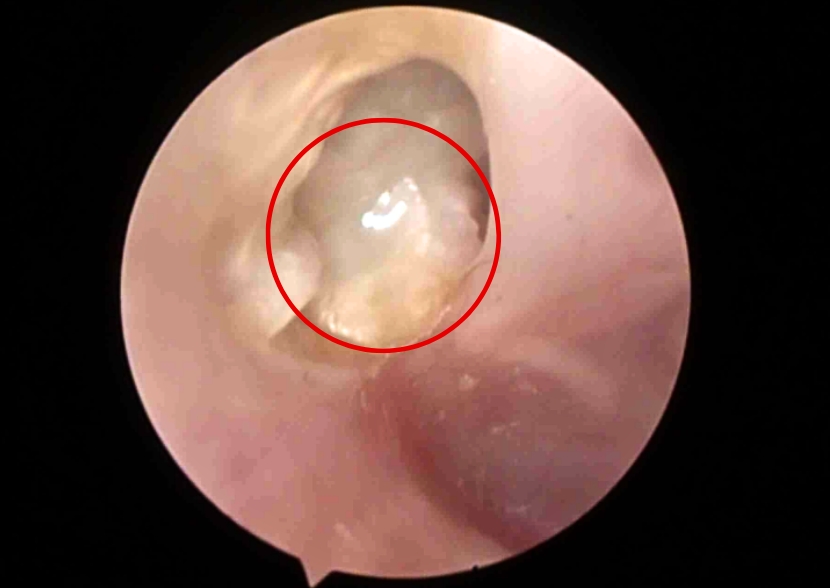
The cholesteatoma has not only destroyed almost the entire skeletal system that plays a role in transmitting sound, but also eroded close to the VII nerve, the nerve that controls facial muscle movements of the patient.
More worryingly, the damage has spread to the area near the meninges. This is a complex anatomical region with dense nerve and blood vessel density, increasing the risk of serious complications such as facial paralysis, meningitis, brain abscesses or permanent hearing loss if not intervened in time.
Cholesteatoma is not cancer but has very strong destructive properties. The disease usually progresses silently for a long time, initial symptoms are easily confused with common ear infections, so many people are subjective. When detected, the lesion has deeply penetrated important structures, making the treatment process more complicated," said Dr. Ngoc.
Also according to the doctor, the cause is often related to prolonged otitis media. When the eardrum is contracted and deeply recessed, the epidermal cells that peel off and are not excreted will gradually accumulate and block, forming a cholesteatoma. This block continues to develop in the closed space of the middle ear and silently erodes the surrounding bone.
Faced with the severe severity of the injury, doctors prescribed mastectomy combined with reconstructive bone system under a microscope to remove all lesions and restore patient hearing.
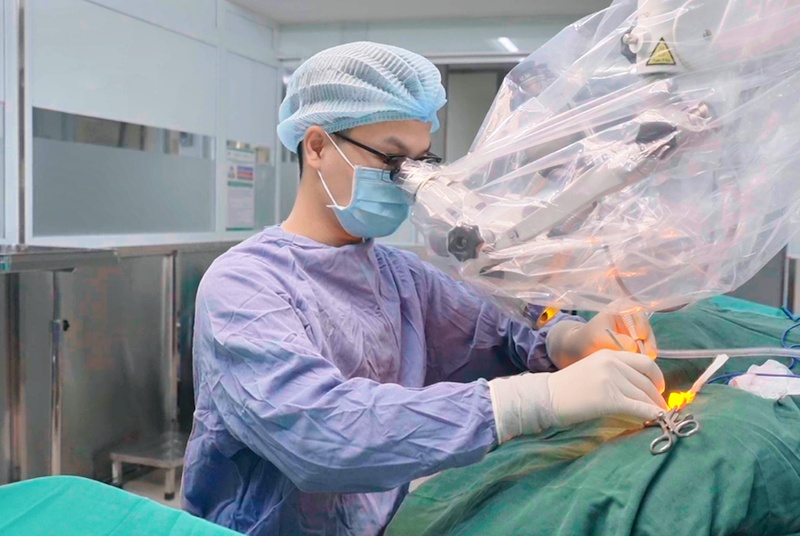
This is a highly difficult surgery due to widespread lesions and close proximity to many important structures. During the surgery, the team had to remove the cholesteatoma tumor from the facial nerve area and the area adjacent to the meninges, but still had to ensure the maximum preservation of healthy structures.
According to Dr. Ngoc, just a small deviation in the intervention process can cause patients to face the risk of facial paralysis, prolonged dizziness, cerebrospinal fluid leakage or intracranial complications after surgery.
After surgery, the patient did not record signs of facial nerve damage, no vestibular disorder or headache appeared. Recovery progress after surgery was stable.

When the doctor explained the danger of the disease and the risks that could occur during surgery, I was really worried. However, thanks to careful advice, I was more reassured to treat it. Fortunately, after surgery, the incision recovered well and my health improved significantly," Ms. Truc shared.
Dr. Ngoc recommends that people should not be subjective about signs such as prolonged ear discharge, tinnitus, hearing loss or ear pain. Early detection and treatment helps limit the risk of dangerous complications, while increasing the ability to preserve hearing and nerve function for patients.


