On May 13, the Ho Chi Minh City Department of Construction announced that from May 15, Cong Hoa street will be organized for traffic with a reverse lane model according to the time frame.
Previously, Cong Hoa road, about 2.5 km long, from Ut Tich intersection to Truong Chinh road, had its concrete median strip removed to widen the road surface to 6 lanes.
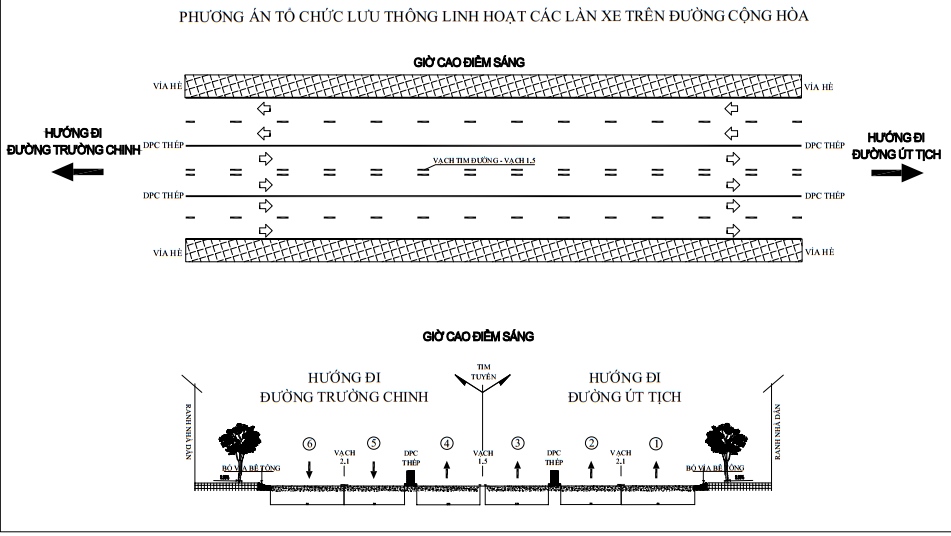
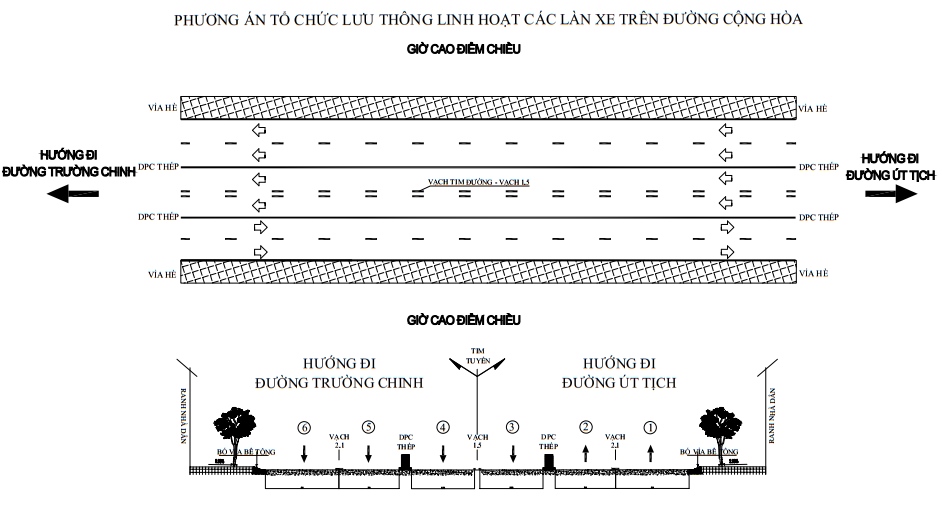
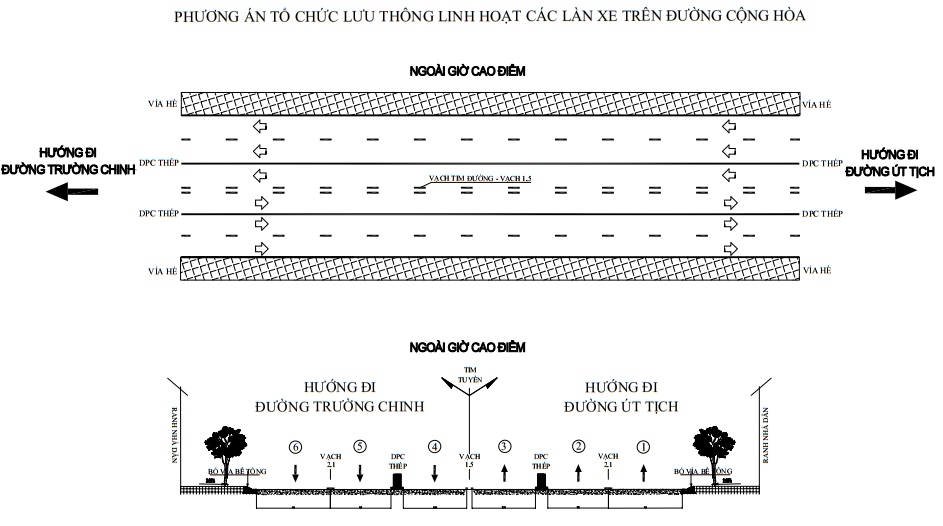
According to the plan, the two lanes in the middle of the route will be separated by a fixed steel median strip on both sides to limit the situation of vehicles arbitrarily changing lanes.
At both ends of Cong Hoa street, mobile medians will be installed to flexibly close and open at different times of the day to adjust traffic directions to suit the actual traffic flow.
At the morning peak, when the volume of vehicles from the Northwest region pouring into the center and Tan Son Nhat airport increases, the median strip on the Truong Chinh side will be opened for vehicles to move into the two middle lanes. At that time, the total number of lanes heading towards the center increases to 4 lanes, while the opposite direction has 2 lanes.
By the afternoon peak, the plan will be reversed to prioritize vehicles from the city center going to Truong Chinh, An Suong intersection. At this time, the median strip on Ut Tich side is opened for vehicles to enter the middle lane, while Truong Chinh side will be closed to avoid traffic conflicts.
Outside peak hours, the two middle lanes operate two-way traffic as usual.
According to the Ho Chi Minh City Department of Construction, this solution helps maximize the existing road surface, increasing traffic capacity without expanding the route. In the initial phase, the mobile median strip will be operated manually before studying the automation plan.
Cong Hoa Street is currently one of the vital traffic axes connecting the Northwest region with the center of Ho Chi Minh City and Tan Son Nhat airport. However, the route is often overloaded, especially during peak hours in the morning and afternoon.
According to data from the transport sector, the traffic volume on the route has exceeded about 142% of the designed capacity. Therefore, even a small collision can cause prolonged congestion.
In the long term, Ho Chi Minh City plans to invest in an elevated road along the Truong Chinh - Cong Hoa axis, about 11.2 km long, with 4 lanes, extending from An Suong intersection to Tan Son Nhat airport area.
The project is expected to be synchronized with the plan to expand National Highway 22 to 60 m, forming an important connecting axis from the Northwest area to the center of Ho Chi Minh City, contributing to reducing traffic pressure at the gateway to Tan Son Nhat airport.