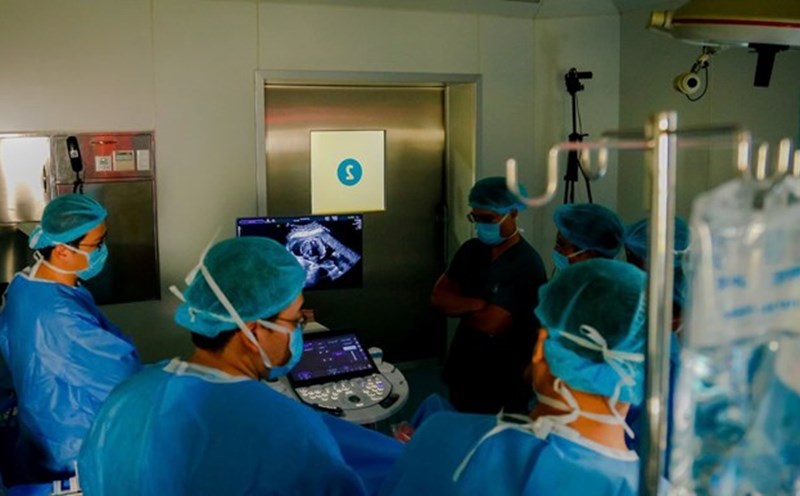
On October 15, Tu Du Hospital said that the hospital's fetal intervention team in coordination with Children's Hospital 1 had just successfully intervene with pregnant woman T.N.D (29 years old, Ho Chi Minh City) with a fetus with severe congenital heart disease.
After more than 3 years of marriage, in August 2024, Ms. D became naturally pregnant but had labor in the 8th - 9th week. A few months later, she suddenly discovered that she was pregnant again when the pregnancy was 6 - 7 weeks old. During this pregnancy, Ms. D had a full examination and screening test, the results were within normal limits.
In August 2025, when she was 19 weeks and 4 days pregnant, an early abnormality in the fetal heart was detected in an ultrasound suspected of narrowing the pulmonary artery valve. After that, Ms. D went to Tu Du Hospital for examination with a diagnosis of 20-week, 4-day pregnancy with moderate and dense echocardiography. Doctors closely monitor fetal heart progression periodically every 2 weeks.
However, after more than 27 weeks, the fetal heart condition became more severe, causing a severe imbalance between the 4 heart cells, the right atheroscope narrower, the right atheroscope - gradually losing the left atheroscope function with a severe 3-leaf valve opening - when atheroscope had to compression blood through the 3-leaf valve refluxed to the right atheroscope, instead of going up the pulmonary artery.
When pregnant for more than 29 weeks, the level of pulmonary and peripheral valve narrowing must progress rapidly, with the risk of heart failure at one month, and the prognosis of death after giving birth due to not being able to have a heart transplant immediately. At the same time, the risk of menstruation exceeding 40% if not intervened promptly.
After being consulted, Ms. D agreed to undergo fetal intervention to save her child. On October 13, she was admitted to the hospital with a diagnosis of a 29-day pregnancy with severe pulmonary valve narrowing, no pulmonary valve leakage, right subcutaneous hypopharynx, and severe tricuspid regurgitation.
On the morning of October 14, an inter-hospital consultation between Tu Du Hospital and Children's Hospital 1 determined that this was a case of congenital heart disease that progressed rapidly and needed emergency intervention. The surgery lasted 80 minutes - considered one of the fastest fetal heart interventions ever performed at Tu Du Hospital.
After surgery, the mother was given special attention. After 24 hours, Ms. D's health condition was stable, she was excited to know that the baby had been successfully treated. The fetal heart is functioning well, there are no signs of uterine contractions, no abdominal pain and the mother is normal.
Tu Du Hospital said this was the 11th successful fetal heart intervention in a series of cooperation programs between the unit and Children's Hospital 1. This marks an important step forward in the journey to complete the legal documents for the Ministry of Health to include cardioversion technique in fetal intervention in the first official list of techniques in Vietnam. This success opens up opportunities for better life and development for many fetuses with severe congenital heart disease in the future.