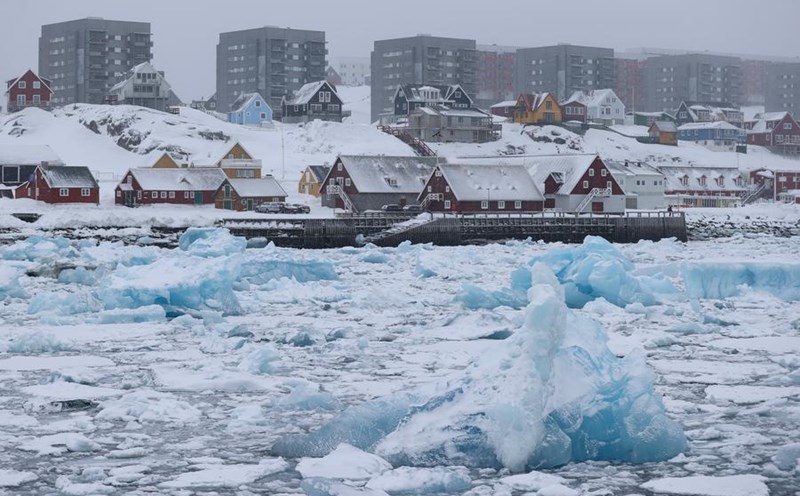
In an interview with TASS news agency, Russian Ambassador to Denmark Vladimir Barbin affirmed that Russia has no territorial claims or plans to provoke Greenland or other Arctic countries.
According to this diplomat, Moscow does not threaten to use force, does not put political pressure and has no "intention" of sovereignty over any territory in the region.
The above statement was made in the context of US President Donald Trump constantly emphasizing the "living" importance of Greenland to US national security.
Mr. Trump believes that Washington needs to control this island, through negotiations or other measures, to avoid the scenario of Russia or China expanding their presence and becoming a "strategic neighbor" to the US.
Ambassador Barbin pointed out that NATO countries themselves are "relying on imaginations about threats from Russia or China" to promote the process of Arctic militarization. According to him, this goes against the spirit of cooperation that has been maintained for decades in this considered relatively stable region.
Mr. Trump's statements have put NATO Secretary-General Mark Rutte in a sensitive position. As the person tasked with maintaining the unity of the 76-year alliance, Mr. Rutte faces the problem of balancing between satisfying Washington and avoiding tensions in Greenland revealing internal rifts.
Instead of directly commenting on the dispute, Mr. Rutte chose a cautious approach: Focusing on emphasizing the need to strengthen Arctic security in general, while avoiding questions related to disagreements between the US and European allies.
He affirmed that his role is not to publicly intervene in disputes between member states, but to handle issues "behind the scenes".
At a meeting with European Parliament parliamentarians, the NATO Secretary-General was repeatedly questioned about the alliance's ability to respond if member countries could not reach consensus.
However, he still maintains the position that the top priority is to ensure NATO does enough to protect the Arctic region - an indirect argument that reinforces the security view that Mr. Trump pursues.
Not only that, Mr. Rutte also said that the pressure from the US President has forced European allies to increase defense spending, thereby making NATO "stronger" in the long term - a controversial statement but clearly reflecting the "keeping the US in the alliance" strategy of the NATO leader.
Meanwhile, some European leaders such as Danish Prime Minister Mette Frederiksen or French President Emmanuel Macron appeared more frank in their statements, emphasizing the issue of sovereignty and international law.
However, the actual steps so far have focused on strengthening NATO's military presence in Greenland and the Arctic region. Denmark has deployed more troops to the island, and some other European countries have also sent forces to the region as a signal of readiness to strengthen the alliance's role.
According to analysts, the most feasible solution for NATO is to build a common framework of cooperation or tasks in the Arctic, sufficient to address US security concerns, but not to push the alliance into a public confrontation between members.