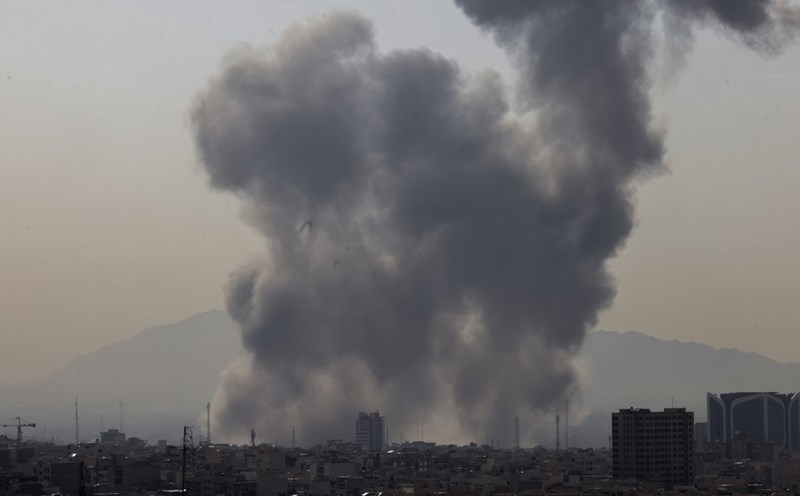
Immediately after the US airstrike on Iran on February 28, the biggest question raised was whether the president had the right to launch a new war without the consent of Congress, especially if the conflict dragged on and escalated.
The US Constitution clearly stipulates that only Congress has the right to declare war or authorize the use of force. However, many presidents, including Mr. Trump, often cite Article II of the Constitution - granting the general command power to the president - to justify military actions considered to be aimed at protecting national interests abroad.
In the message announcing the attacks, Mr. Trump acknowledged the possibility of casualties and called it war, while describing the operation as large-scale and ongoing. According to some sources, the US military has prepared for many days of continuous attacks.
However, the White House has not announced detailed legal arguments to the public. Foreign Minister Marco Rubio also did not provide a full explanation to Congress, according to US media.
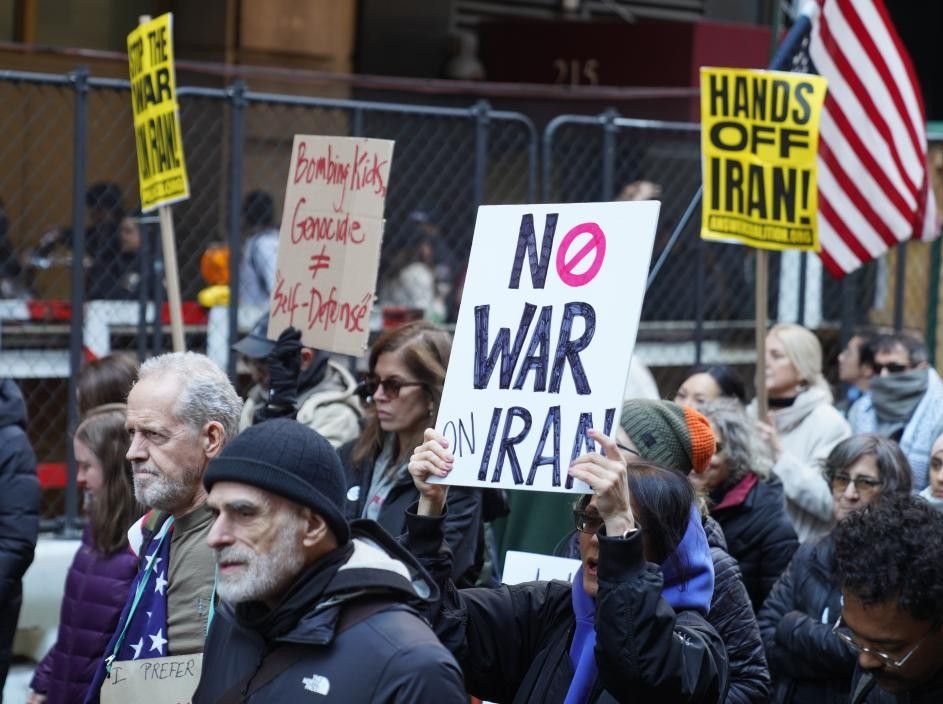
Christopher Anders, a lawyer from the American Civil Liberties Union, argues that the president has violated the US Constitution by unilaterally launching a military campaign. According to him, the constitutional document clearly states that the authority to declare war belongs to Congress, and the president cannot delegate that power to himself.
Law professor Ilya Somin of George Mason University, a scholar at the Cato Institute, also said that this is clearly war. He argued that if the president himself calls it war, it is very difficult to deny its constitutional nature.
The issue becomes more complicated when considering precedents. The US administration once cited Article II to justify previous military campaigns, such as airstrikes on Libya under President Barack Obama, or attacks on Syria and Iran during Mr. Trump's first term.
Recently, the US Department of Justice has also used similar arguments to protect the legality of some law enforcement activities abroad.
Notably, the US Supreme Court in 2024 issued a ruling on immunity, which is said to significantly expand the scope of the president's power.
According to a senior White House official at the time, the widespread interpretation of executive power contributed to creating a basis for conducting military operations without prior approval from Congress.
However, experts believe that this argument can only stand firm if the scale, scope and duration of the campaign are limited.
Professor Steve Vladeck of Georgetown University said that the Department of Justice is increasingly making unconvincing arguments when justifying airstrikes, especially when the campaign shows signs of expanding into prolonged conflict.
For many years, both the Democratic and Republican governments have relied on resolutions authorizing the use of force issued after 9/11 or during the Iraq war to expand the scope of military action.
However, many opinions suggest that those resolutions cannot be infinitely interpreted for new wars that are not directly related.
Although there is still debate about wisdom in military decisions, many scholars emphasize that the core element is still constitutional jurisdiction.
According to them, if the campaign in Iran continues to escalate, the pressure to ask Congress to speak out and re-establish the boundary of power between executive and legislative will increase, setting a new test for the US Constitutional order.