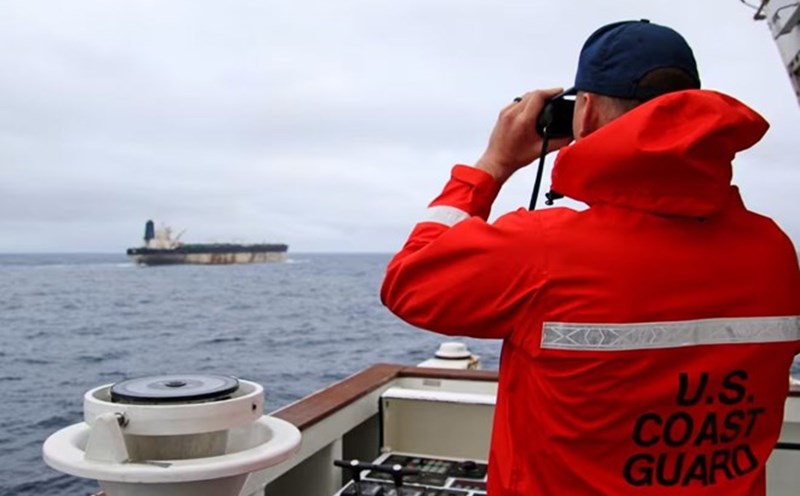
On February 9, in a statement posted on social network X, the US Department of Defense said that the country's functional forces had intercepted the oil tanker named Aquila II. The incident took place in the area of responsibility of the Indian Ocean - Pacific Command.
According to a statement from the US side, the legal basis leading to this military intervention is that the Aquila II ship is accused of violating regulations on "quarantine for sanctioned ships in the Caribbean Sea". This is one of the maritime control mechanisms that Washington applies to tighten sanctions against illegal oil and gas transportation activities.
The US Department of Defense used the professional term "maritime inspection and deterrence rights" to describe this operation. Accordingly, the US Navy approached and put personnel on board the Aquila II ship to exercise control.
Representatives of the US Department of Defense affirmed that the entire landing and inspection process took place "without any incidents", ensuring safety for both the task force and the crew on the blocked ship.
A noteworthy detail in the statement is that the US military described that they had "tracked and pursued" this ship throughout a long journey. The Aquila II ship is believed to have moved from the Caribbean Sea, traveling thousands of nautical miles to the Indian Ocean before being intercepted by US forces.
The interception of a ship originating from the Caribbean right in the Indian Ocean shows that the scope of US surveillance and enforcement of sanctions is being expanded globally, not limited to neighboring waters. This area spans a large area of the Indian and Pacific Oceans, and is a vital maritime route connecting energy supplies with major consumption markets in Asia.
Although the incident has been confirmed, the Pentagon has not yet released detailed information about the profile of the Aquila II oil tanker. Important data such as ship registration nationality, ownership identity, crew members or the specific volume and type of cargo being transported on the ship have not yet been disclosed.
This move comes as the US and Western allies are trying to tighten "loopholes" in the international maritime transport network, especially targeting fleets suspected of transporting oil to evade economic sanctions.