NATO closely monitors Russian submarines in the Arctic before diving deep into the ocean

Khánh Minh |

NATO is doubling its patrols in the Arctic and North Atlantic to closely monitor Russian submarines.

According to Vice Admiral Rune Andersen, Commander of the Norwegian Joint Operations Command, NATO's military operations in the Arctic have more than doubled in the past 2-3 years on all 3 fronts: Air, Sea and Land.

Mr. Andersen said this increase is "partly a response to Russia's increased deployment of submarines out of the traditional zone, and the need to closely monitor those activities.

Russia currently owns one of the largest submarine fleets in the world with about 64 operating ships. Most of this force belongs to the Northern Fleet, stationed in the Murmansk region on the coast of the Barents Sea.

From the Murmansk base, Russian submarines often move west through the Arctic before moving south to enter the Atlantic, Mediterranean or Baltic Sea. This route forces them to pass through a strategic area called GIUK Gap - the sea between Greenland, Iceland and the United Kingdom, considered an important "bottleneck" of the navy.
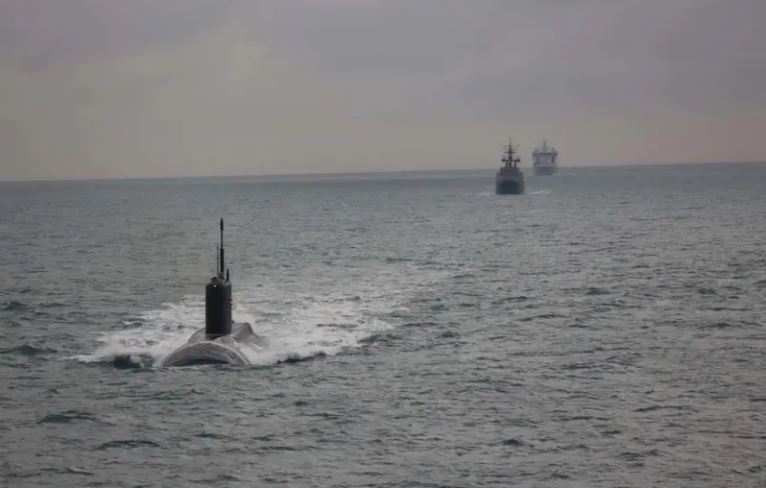
Hải quân Hoàng gia Anh theo dõi một tàu ngầm Nga qua eo biển Anh. Hải quân Hoàng gia Anh
The British Royal Navy monitors a Russian submarine across the English Channel. British Royal Navy

According to Colonel Martin O'Donnell, Spokesman for the Supreme Command of the European Union allied forces (SHAPE) under NATO, detecting Russian submarines before they leave shallow waters is a key factor.

If they escape from relatively shallow waters and move into the vast ocean, tracking will become much more difficult," Mr. O'Donnell said.

According to him, as the Russian submarine has gone deep into the vast ocean, the level of difficulty in detecting and tracking has increased "increasingly", creating a security risk not only for Europe but also for the United States.

To cope, NATO deployed a series of anti-submarine vehicles such as small destroyers, submarines, anti-submarine helicopters and maritime patrol aircraft. Many member countries have recently invested in more military capabilities to increase the ability to detect underwater targets.

Last month, European countries participated in the Arctic Dolphin 26 exercise off the coast of Norway, with a focus on protecting the North Atlantic and the GIUK Gap area from submarine threats.

However, NATO's increased presence in the Arctic is not only due to concerns about the Russian navy.

After Russia launched a military campaign in Ukraine, two Nordic countries, Finland and Sweden, joined NATO, raising the number of Arctic countries in the alliance from 5 to 7. This means NATO has more soldiers, warships and aircraft participating in protecting the region.

Since the end of last year, NATO's Norfolk Joint Forces Command has expanded its scope of responsibility, including Finland, Sweden and Denmark. This agency is currently leading a new deterrence campaign called Arctic Sentry.

NATO Secretary General Mark Rutte said the operation helps the alliance adopt a "unified Arctic" approach, synchronize military operations and maintain a regular presence throughout the region.

According to NATO officials, the Arctic is becoming an increasingly important strategic region. This place is not only rich in natural resources but also has new shipping routes as sea ice melts due to climate change. Therefore, this military alliance wants to maintain its advantage in the Arctic region.

Khánh Minh
RELATED NEWS

Oil tanker hit near Russia's oil export artery

|

A Greek-flagged oil tanker has just been attacked near Russia's most important oil export port in the Black Sea.

Hormuz Strait paralyzed, Southeast Asia turns to Russian oil

|

The global energy shock caused by the blockade in the Strait of Hormuz is causing many Southeast Asian countries to consider increasing Russian oil imports.

Sweden arrests another oil tanker captain suspected of belonging to the Russian shadow fleet

|

Sweden arrested the captain of a oil tanker suspected of belonging to Russia's "dark fleet" after discovering the ship was flying a fake flag.

NATO considers spending 22 billion USD to extend strategic oil pipeline

|

NATO is considering expanding its underground pipeline network from the Cold War era by 10,000km, ready to respond to a large-scale conflict scenario.

109-year-old voter in Quang Tri directly goes to vote

|

Quang Tri - Many voters over 100 years old still personally go to the polling station on election day March 15, showing a sense of responsibility and belief in citizens' ballots.

From voters' votes, sending faith in the new term

|

On March 15, nearly 79 million voters nationwide excitedly went to vote for National Assembly and People's Council deputies for the 2026–2031 term, placing their trust in worthy deputies.

Miss Bao Ngoc, Quyen Linh and artists share their feelings when going to vote

|

Ho Chi Minh City - On the morning of March 15, artists such as Miss Bao Ngoc, Thanh Thuy, Quyen Linh came to polling stations in the city to participate in voting.

Important day at the westernmost point of the Fatherland

|

Dien Bien - From early morning, more than 3,500 voters who are ethnic minorities of Sin Thau commune - a border commune in the westernmost part of the Fatherland joyfully gathered at the polling stations.

Oil tanker hit near Russia's oil export artery

Song Minh |

A Greek-flagged oil tanker has just been attacked near Russia's most important oil export port in the Black Sea.

Hormuz Strait paralyzed, Southeast Asia turns to Russian oil

Ngọc Vân |

The global energy shock caused by the blockade in the Strait of Hormuz is causing many Southeast Asian countries to consider increasing Russian oil imports.

Sweden arrests another oil tanker captain suspected of belonging to the Russian shadow fleet

Khánh Minh |

Sweden arrested the captain of a oil tanker suspected of belonging to Russia's "dark fleet" after discovering the ship was flying a fake flag.

NATO considers spending 22 billion USD to extend strategic oil pipeline

Lam Anh |

NATO is considering expanding its underground pipeline network from the Cold War era by 10,000km, ready to respond to a large-scale conflict scenario.