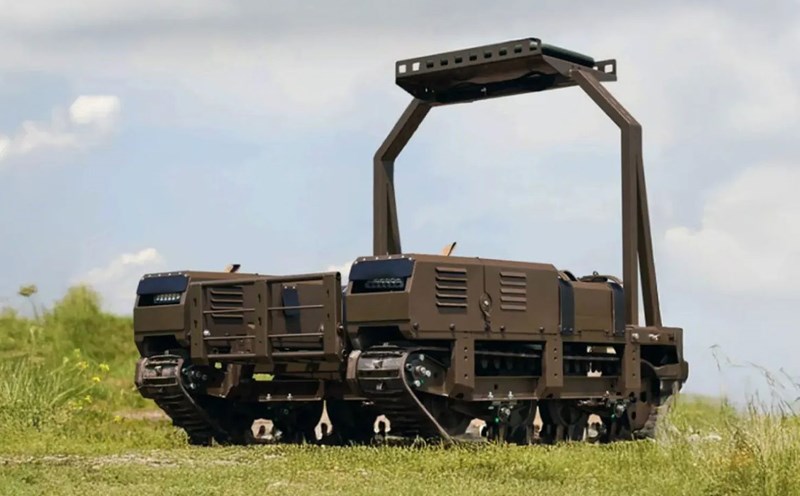
On April 3rd (local time), international reporters recorded a major change in Ukrainian combat units, where battery-powered robots are gradually replacing humans in the most dangerous missions.
From chain machines carrying anti-tank mines to systems equipped with remote-controlled machine guns, the use of UGVs has grown exponentially since 2024. Lieutenant Victor Pavlov of the 3rd Ukrainian Corps affirmed: "This is the face of modern warfare. Every army in the world will have to be robotized".
Currently, ground robots undertake up to 90% of the logistics work of the Ukrainian army. In the context of Russian suicide drones (FPVs) densely covering the sky, moving by traditional armored vehicles becomes too risky.
In January 2026 alone, the Ukrainian army carried out a record 7,000 UGV operations to transport supplies, ammunition and evacuate wounded soldiers. These machines are compact, more difficult to detect and can operate continuously for 8 hours under intense fire.
The robot's firepower is also changing the melee situation. The DevDroid TW 12.7 system once successfully defended a position for 45 consecutive days, while another suicide robot carrying 200kg of explosives traveled 20km to destroy the enemy's base.
The front line is now like a Terminator movie. You shoot a soldier in the chest, they will stop. But shooting a robot, it doesn't know pain and will still fire back at the commander behind the screen," a drone pilot shared.
Not only stopping at combat, Ukraine is also becoming a global center for developing unmanned weapons. Thanks to its real-world experience, Kiev has signed 10-year defense agreements with many Gulf countries such as Saudi Arabia and Qatar to provide cheap drone interceptor equipment.
The technology ecosystem here allows engineers to receive direct feedback from soldiers to immediately improve products, from ground robots to sea-based automatic boats.