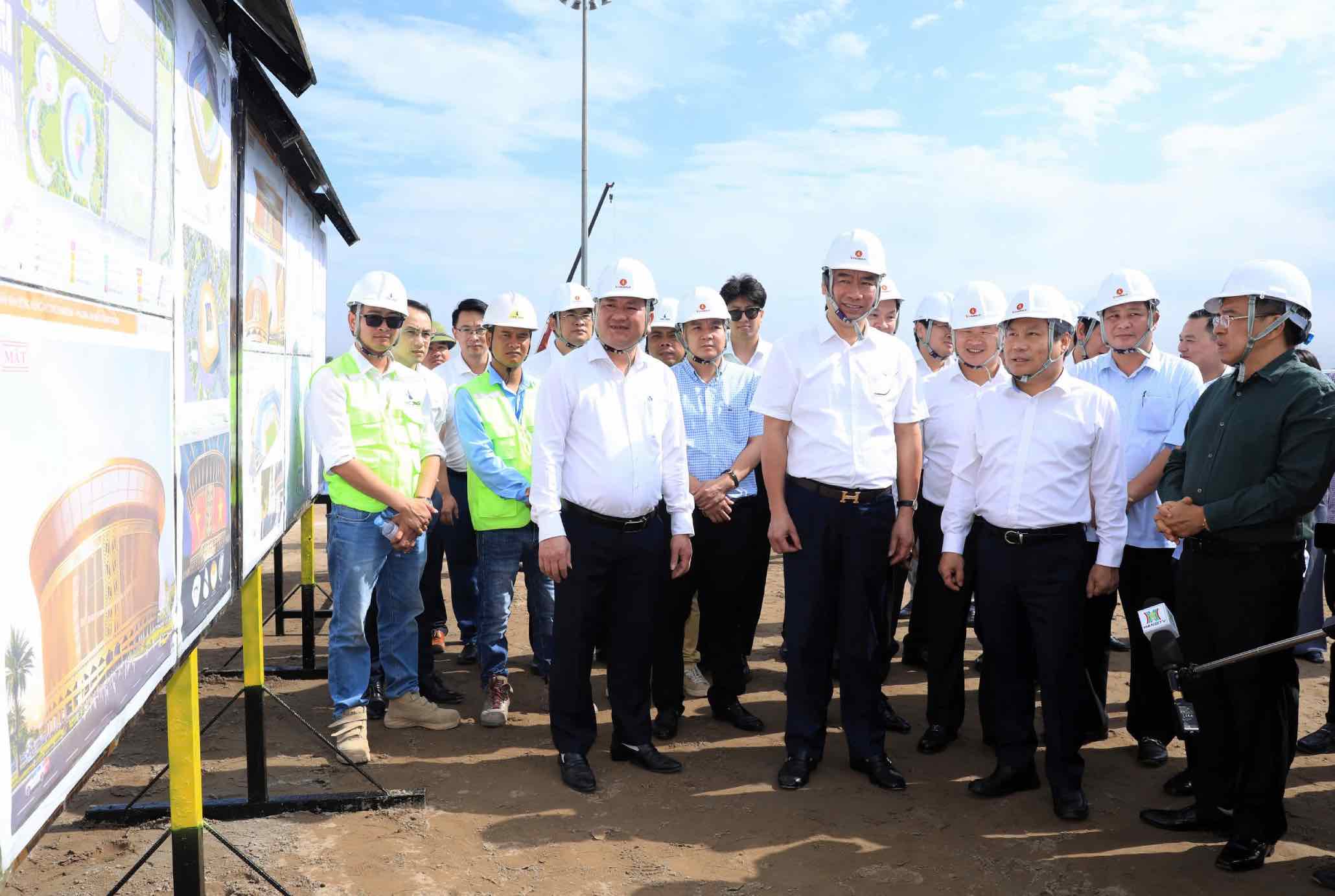
On May 13, Member of the Party Central Committee, Deputy Secretary of the City Party Committee, Chairman of Hanoi People's Committee Vu Dai Thang inspected the field and worked with investors, departments and local authorities on the progress of the Olympic Sports Urban Area construction investment project, including Hung Vuong Stadium project.
Focusing resources on constructing the Hung Vuong Stadium complex
According to the report of the Investor Consortium representative, the Olympic Sports Urban Area Project (now renamed Hanoi International Sports Urban Area) has a scale of about 9, 171ha located in 11 wards and communes: Thanh Liet, Dai Thanh, Ngoc Hoi, Nam Phu, Thuong Tin, Hong Van, Chuong Duong, Thuong Phuc, Tam Hung, Thanh Oai, Dan Hoa; divided into 4 functional sub-zones including TOD urban area associated with Ngoc Hoi station, sports urban area, tourist urban area and sports complex.
Up to now, the measurement and ownership work has been completed on the entire project area. Localities have organized meetings to announce the policy of site clearance to people; and at the same time deploy land acquisition and approve compensation plans in some areas belonging to sub-zone B.
The work of reviewing and clearing the 500kV power line corridor, relocating and restoring technical infrastructure is also being coordinated and implemented.
Currently, the investor is focusing resources on constructing the Hung Vuong Stadium complex of 135,000 seats in sub-zone B, with the goal of completion in July 2027. Many items are being implemented such as constructing foundations, floor beams, concrete columns; and at the same time deploying connecting traffic routes, auxiliary infrastructure, landscape, parking lots and preparing to invest in international hotels.
Reporting at the working session, leaders of communes also reflected some difficulties related to mechanisms and policies for service land, tomb relocation, resettlement arrangement and handling of cases of residential land that have existed for many years but legal documents are incomplete. Communes proposed that the city continue to pay attention to directing removal, and at the same time support investment in infrastructure, cultural institutions, transportation and have vocational training solutions to create livelihoods for people after land acquisition.
Minimize coercion
Concluding the working session, Chairman of Hanoi City People's Committee Vu Dai Thang emphasized that this is one of the first projects implemented under the special mechanism of the National Assembly for Hanoi under Resolution 258/2025/QH15. Although it has only been implemented for nearly 5 months, through actual inspection at the construction site, the shape of the modern sports complex has basically been formed.
Emphasizing that the Project has a scale of more than 9,000ha, spreading over 11 communes and wards in the South of the City, Comrade Vu Dai Thang said that the project will be implemented synchronously with other key infrastructure projects such as expanding National Highway 1A, urban railway, high-speed railway... creating strong development momentum for the Southern Capital area towards modern urbanization.
Therefore, in the coming time, the Chairman of the City People's Committee requests localities to continue to closely coordinate, accelerate the progress of site clearance, and strive to complete the entire work before June 30. For localities still facing human resource difficulties, the city will consider strengthening support staff to ensure the overall progress.
Chairman of the City People's Committee Vu Dai Thang especially reminded localities to pay attention to career change and create sustainable livelihoods for people after land acquisition. Along with the rapid urbanization process, the nature of labor and people's lives will change greatly, so communes and wards need to proactively develop socio-economic development plans in accordance with the new plan.
Regarding site clearance work, Mr. Vu Dai Thang proposed that localities mobilize the entire political system to participate, strengthen propaganda and mobilization to create high consensus among the people, and minimize coercion when the city's mechanisms and policies are complete and appropriate.