
Storms and floods caused thousands of billions of VND in damage to the seafood industry
Information from the Department of Fisheries and Fisheries Control said that according to the preliminary reports of the provinces of Quang Ngai, Gia Lai and Dak Lak, the total area of aquaculture area with broken embankments, flooding, and outgates for aquaculture is estimated to have suffered about 632 hectares of damage after storm No. 13 Kalmaegi. The total number of damaged cages is about 22,321 cages.
Of which, Quang Ngai suffered damage to 31 cages and 63.2 hectares of aquaculture, including 61.2 hectares of brackish water farming; Gia Lai suffered damage to 590 marine cages and 269 hectares of aquaculture; Dak Lak suffered damage to 21,700 cages, over 1,468 tons of fish and shrimp of all kinds, in addition to damage to 301 fishing vessels. The storm and flood caused damage to both facilities and aquaculture of 3,015 aquaculture households, with an estimated loss of VND1,081 billion.
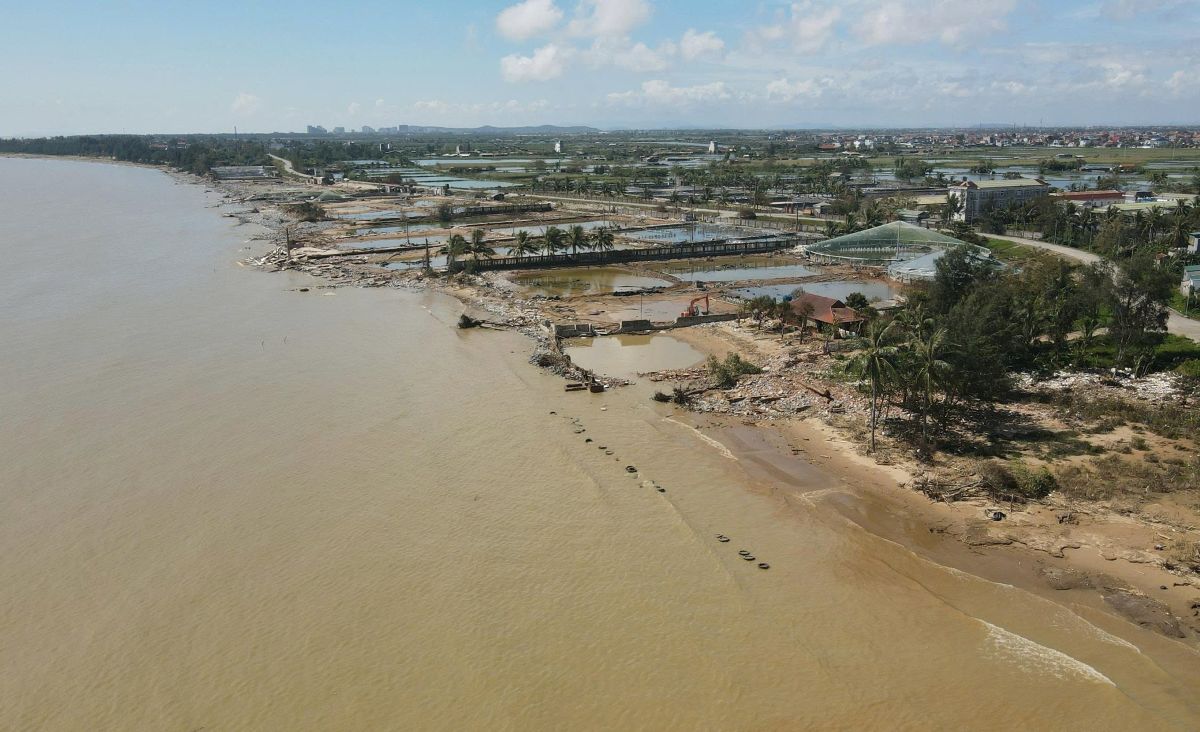
Previously, after two storms No. 10 Bualoi and No. 11 Matmo, in the northern provinces from Quang Ninh to Hue, the total area of aquaculture had broken embankments, flooding and estimated damage of about 23,526 hectares. In which: The area of damaged brackish water shrimp farming is 3,862 hectares, freshwater aquatic products are affected by flooding of 19,664 hectares. The estimated damage to aquaculture caused by storms No. 10 and No. 11 and post-storm floods is about 1,553 billion VND.
At the beginning of the year, the Department of Fisheries and Fisheries Control issued directives and guidelines on natural disaster prevention and control, strengthening the management of aquaculture in extreme weather conditions, environmental monitoring and disease prevention.
When storm No. 13 formed and made landfall, the Department seriously implemented the instructions of the Prime Minister and the National Civil Defense Steering Committee. At the same time, the Department organizes a 24/7 duty, closely monitoring the storm's developments through the fishing vessel monitoring system (VMS); promptly guiding vessels to take shelter safely. The Department's working group also directly worked in localities to direct response and damage recovery.
Urgently support people, stabilize production
Speaking to Lao Dong, the leader of the Department of Fisheries and Fisheries Control (Ministry of Agriculture and Environment) said that immediately after storm No. 13, the Department issued an urgent dispatch, requesting localities to synchronously deploy measures to restore production. From collecting dead aquatic products, treating the environment, disinfecting and disinfecting; to drainage, continuously monitoring farming areas to promptly warn and support people to stabilize production.
The Department also guides people to reinforce ponds, renovate water supply and drainage systems, and repair cages, especially in areas for lobster farming and cage farming at sea. Rearranging the population density and making quick plans for subjects with short cycles becomes important, especially when the New Year and Lunar New Year are approaching.
The Department of Fisheries and Fisheries Control also proactively coordinated with the III III Institute for Aquaculture Research and related functional units of the locality to organize environmental monitoring and assess the quality of water environment in key farming areas in localities affected by storms and floods, as a basis for guiding people to restore and rearrange appropriate production after the storm.
"The Department of Fisheries and Fisheries Control has contacted and requested a number of companies and enterprises to join hands to support and assist fishermen in recovering production, supporting fish caught, life buoys, communication equipment, cage materials, nets, breeds, feed, biological products, chemicals, veterinary medicines and other materials to overcome natural disasters and soon restore production," said a representative of the Department.
Along with technical solutions, the Department proposes that the Government and ministries and branches soon have credit policies to support households and businesses that have suffered heavy damage, while adding investment resources to centralized aquaculture infrastructure. The Department has also requested the Ministry of Science and Technology to preside over and coordinate with the Ministry of Agriculture and Environment to develop a key science and technology program on adapting to natural disasters in aquatic products.


