
Domestic pepper prices: Stand still
As of 11:30 am today (January 1), domestic pepper prices remain unchanged in all areas, averaging at 150,600 VND/kg. Currently, key areas are trading in the range of 149,500 - 151,500 VND/kg.
Provinces and cities maintain the current price range and price lists for regions as follows:
Gia Lai province stabilizes, priced at 150,000 VND/kg.
Ho Chi Minh City and Lam Dong after the day decreased by 500 VND/kg, anchored at the threshold of 151,000 VND/kg.
Dong Nai and Dak Lak did not change the closing price of the previous session, respectively bringing to the market the milestones of 149,500 VND/kg and 151,500 VND/kg.
World pepper prices: Price increase
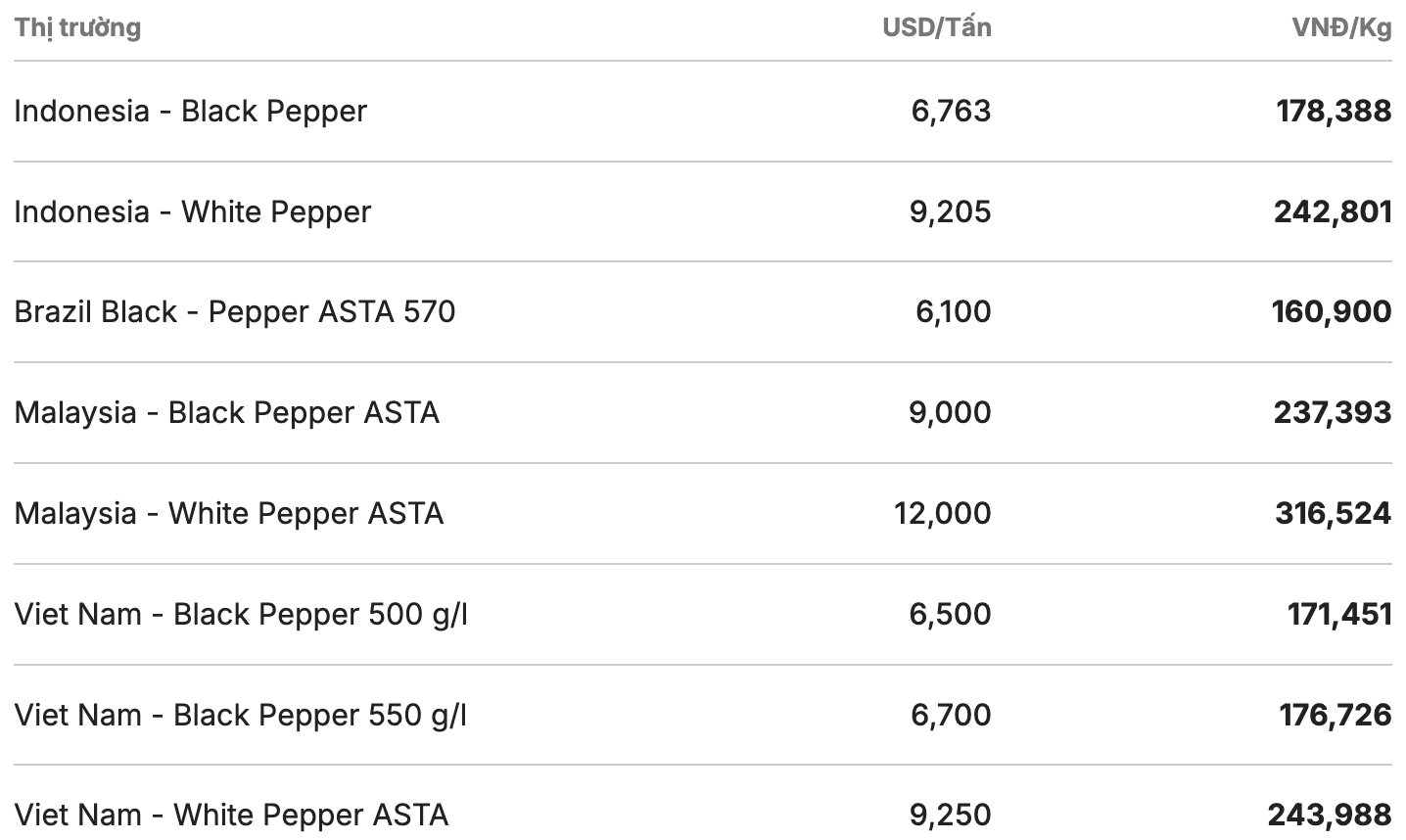
In the world market, pepper prices fluctuate in some countries. Indonesian exchange - one of the most vibrant markets continues to push up prices. These two items are traded in the range of 6,763 - 9,205 USD/ton (equivalent to 178,388 VND/kg - 242,801 VND/kg), increasing by 25 USD/ton and 34 USD/ton respectively.
In the same direction, the Brazilian market suddenly increased by 100 USD/ton, currently at 6,100 USD/ton (about 160,900 VND/kg). Meanwhile, black and white pepper traded at 12,000 USD/ton and 9,000 USD/ton.
Notably, in Vietnam's pepper export market, the price of black pepper of 500 g/l and 550 g/l maintains a price range of 6,500 - 6,700 USD/ton. The current ASTA white pepper price is at 9,250 USD/ton (equivalent to 243,988 VND/kg).
Perspectives and forecasts
Due to entering the Lunar New Year holiday in 2026, pepper prices maintained a stable state when most large purchasing agents and export companies temporarily suspended operations.
In key areas, pepper prices still maintain a high price threshold, creating excitement for people in the growing area on the first day of the new year.
Looking at the prospects for 2026, Vietnam's pepper industry is facing opportunities mixed with challenges. After experiencing 2025 with many fluctuations due to the impact of El Nino reducing output, 2026 is expected to be a year of value recovery.
Production in 2026 is expected to improve when entering the peak harvest season after the Lunar New Year, but it has not yet fully recovered to normal levels. This continues to be a factor supporting this item in the medium and long term.


