
Domestic pepper prices: Weekly slight increase
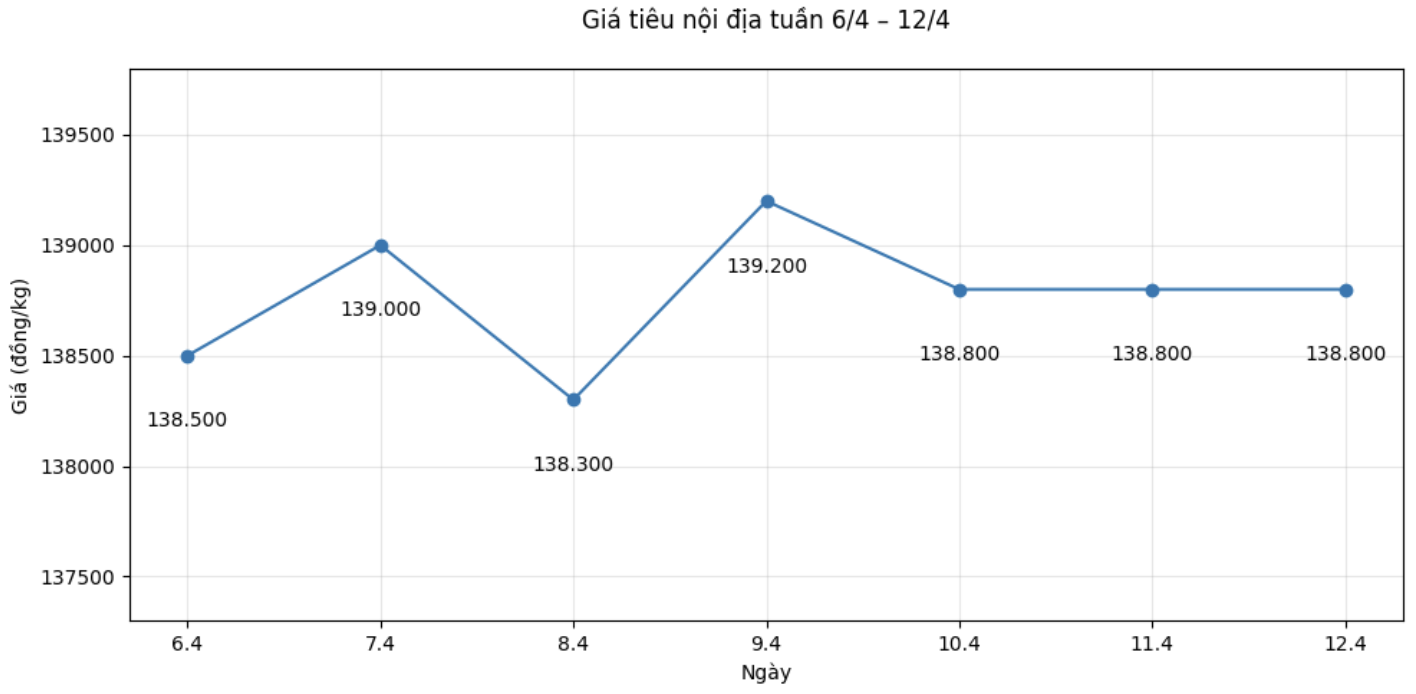
Today (April 12), domestic pepper prices traded in the range of 138. 500 - 139. 500 VND/kg, an increase of 500 VND/kg compared to last week.
At the end of last week, Dak Lak pepper prices recorded a slight increase of 500 VND/kg, bringing the purchase price to the milestone of 139,500 VND/kg. Meanwhile, Lam Dong and Ho Chi Minh City diễn biến theo xu hướng đi ngang, equal to the price compared to the closing session of last week at 139,000 VND/kg and 138,500 VND/kg.
The remaining localities simultaneously increased by 500 VND/kg, with prices in Gia Lai and Dong Nai commonly at 138,500 VND/kg.
World pepper prices: Increase and decrease intertwined
According to the International Pepper Corporation (IPC), pepper prices in leading producing countries fluctuated in opposite directions compared to the closing session of the previous week.
Indonesian black pepper closed last week at 7.074 USD/ton, down 41 USD/ton compared to the previous week. At the same time of the survey, Indonesian white pepper prices decreased by 54 USD/ton last week, reaching 9,320 USD/ton.
Brazilian black pepper ASTA 570 maintained an increase of 100 USD/ton, anchored at the mark of 6,150 USD/ton. Meanwhile, black and white Malaysian pepper prices remained unchanged, respectively anchored at the price thresholds of 9,300 USD/ton and 12,200 USD/ton.
In the opposite direction, in Vietnam, export black pepper prices increased again, trading in the range of 6,100-6,200 USD/ton for types 500 g/l and 550 g/l. In the same direction, the price of white pepper in Vietnam increased by 100 USD/ton, to 9,000 USD/ton.
Assessments and forecasts
The fact that pepper prices are approaching the threshold of 140,000 VND/kg reflects that demand in the market is gradually recovering. Meanwhile, many farmers still tend to keep goods, not rushing to sell them right in the early harvest season, contributing to making the supply to the market not too abundant.
One of the important factors supporting the pepper market in the first 2 months of the year is the strong increase in import demand from the US. According to data from the International Trade Center (ITC), in February 2026, the US imported nearly 6,000 tons of pepper, of which Vietnam continued to hold the position of largest supplier.
In general, in the first 2 months of 2026, Vietnamese pepper accounted for more than 80% of US total imports, thereby continuing to consolidate its position as the main supplier in this large market. This development shows that demand for Vietnamese pepper is still maintained at a high level, especially when some large producing countries are facing difficulties in supply or cost.


