
Domestic pepper price: Close to the 140,000 VND/kg mark
As of 11:30 am today (April 11), domestic pepper prices maintained an upward trend, averaging 138,800 VND/kg. Currently, key areas are trading in the range of 138,500 - 139,500 VND/kg.
Domestic pepper prices simultaneously set an increase of 500 VND/kg with the previous session closing, listing the price as follows:
Gia Lai, Dong Nai and Ho Chi Minh City provinces are all listed at the mark of 138. 500 VND/kg.
Meanwhile, Dak Lak and Lam Dong are still the regions with the highest offering prices in the country with a threshold of 139,000 VND/kg.
World pepper prices: Indonesia adjusts down
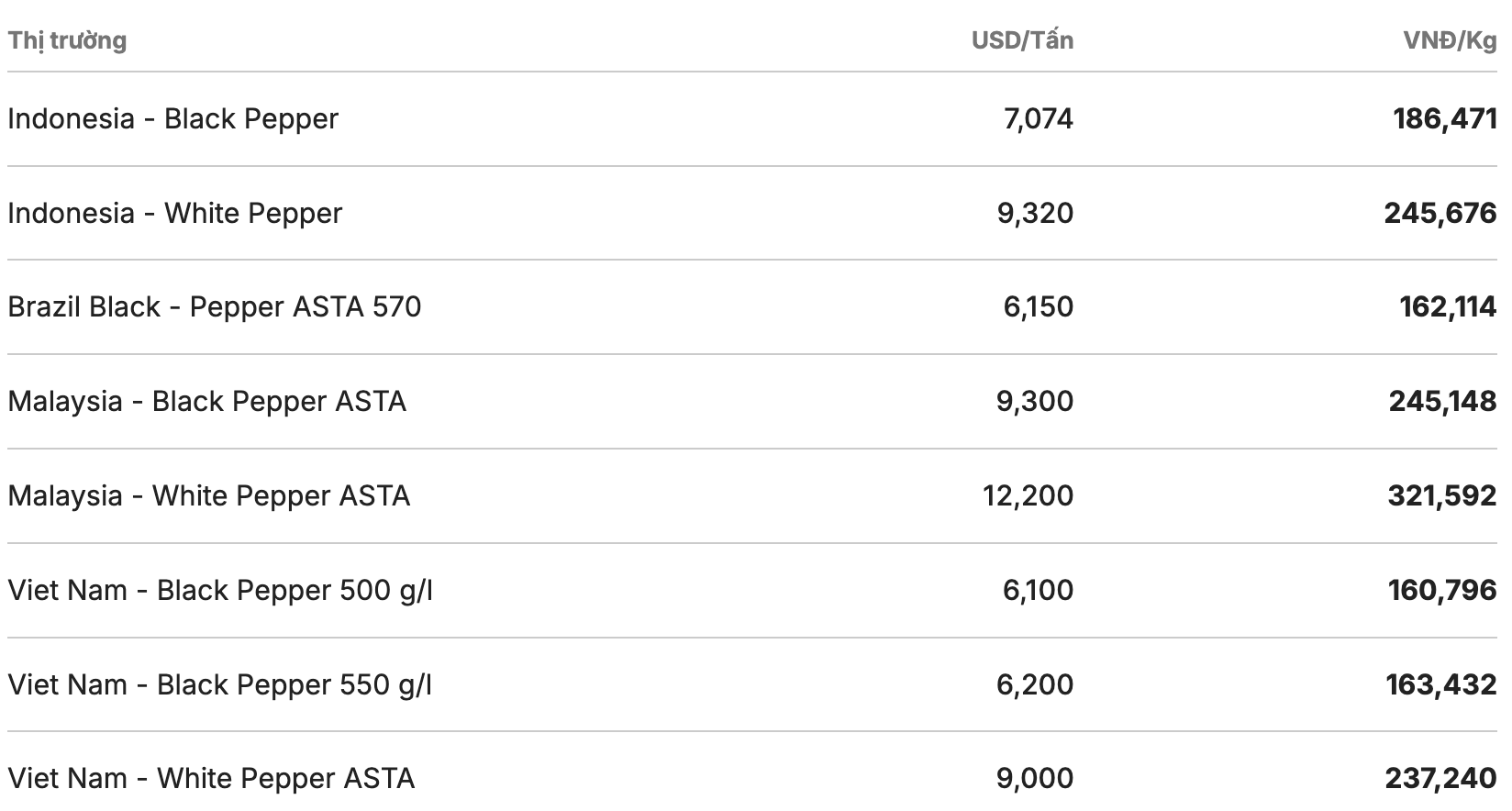
In the world market, pepper prices mostly maintain a stable state. In particular, Indonesia's black and white pepper prices reversed to decrease, trading in the range of 7,074 - 9,320 USD/ton (equivalent to 186,471 VND/kg - 245,676 VND/kg), down 13 USD/ton and 17 USD/ton respectively.
The Brazilian market maintained an increase of 50 USD/ton, listed at 6,150 USD/ton (about 162,114 VND/kg). Notably, black and white pepper kept increasing from 100 - 200 USD/ton, trading at 12,200 USD/ton and 9,300 USD/ton.
In Vietnam's pepper export market, the price of black pepper of 500 g/l and 550 g/l remains at 6,100 - 6,200 USD/ton. In the same direction, ASTA white pepper is offered for sale at 9,000 USD/ton (equivalent to 237,240 VND/kg).
Assessments and forecasts
According to preliminary statistics from the Vietnam Pepper and Spice Plant Association (VPSA), by the end of the first quarter of 2026, Vietnam had exported 66,350 tons of pepper, with a total turnover value of 430 million USD, a sharp increase of 39.2% in volume and a turnover increase of 31.7% compared to the same period in 2025.
This result shows a clear recovery momentum of export activities right from the beginning of the year. Notably, this is also the highest turnover level in the first quarter ever.
In which, the US continued to be Vietnam's largest market in the first quarter with a volume of 16,859 tons, an increase of 63.9% over the same period and accounting for 25.4% market share. China rose strongly with 8,563 tons, an increase of 321.0%, becoming the second largest market. Followed by the UAE reaching 3, 182 tons, an increase of 15.4%; India reached 2,456 tons, down 27.1% and the Philippines reached 2,383 tons, up 46.9%. Asia continued to be the main growth engine, accounting for 46% of total exports, while America accounted for 28% and Europe accounted for 20%.


