
SJC gold bar price
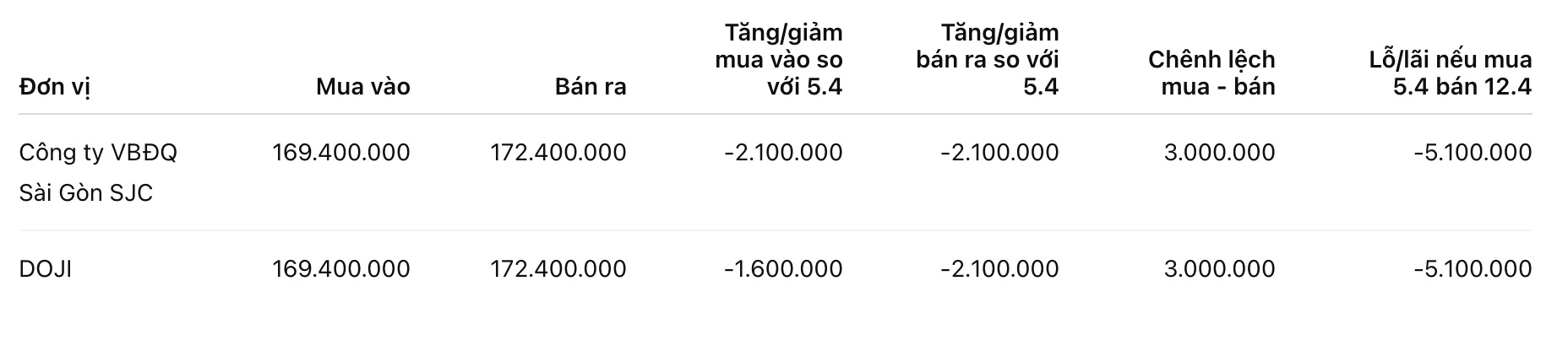
Closing the week's trading session, Saigon SJC Jewelry Company listed SJC gold prices at 169.4-172.4 million VND/tael (buying - selling). The buying - selling difference is at 3 million VND/tael.
Compared to the closing session of last week (April 5), the price of SJC gold bars at Saigon SJC Jewelry Company decreased by 2.1 million VND/tael in both directions.
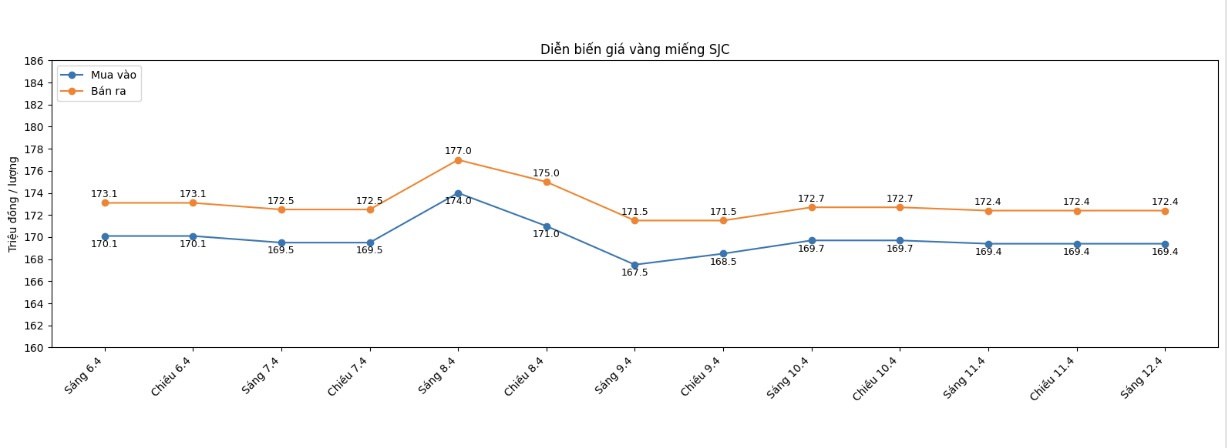
Meanwhile, DOJI listed SJC gold price at the threshold of 169.4-172.4 million VND/tael (buying - selling). The buying - selling difference is at 3 million VND/tael.
Compared to the closing session of last week (April 5), SJC gold bar price at DOJI decreased by 1.6 million VND/tael on the buying side and decreased by 2.1 million VND/tael on the selling side.
If buying SJC gold bars in the April 5th session and selling them in today's session (April 12th), buyers at Saigon SJC and DOJI Jewelry Company both lost 5.1 million VND/tael.
9999 gold ring price
At the same time, DOJI Group listed the price of gold rings at the threshold of 169.4-172.4 million VND/tael (buying - selling), down 1.6 million VND/tael on the buying side and down 2.1 million VND/tael on the selling side. The buying - selling difference is at 3 million VND/tael.
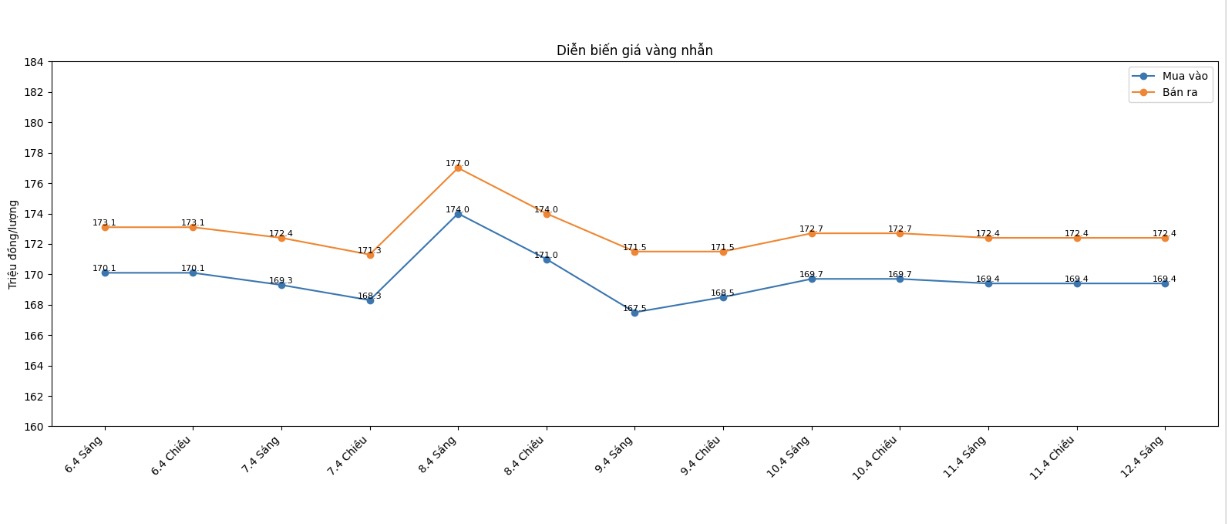
Phu Quy Gold and Gems Group listed the price of gold rings at the threshold of 169.2-172.2 million VND/tael (buying - selling), down 1.8 million VND/tael in both directions compared to a week ago. The buying - selling difference is at 3 million VND/tael.
If buying gold rings in the April 5 session and selling them in today's session (April 12), buyers at DOJI will lose 5.1 million VND/tael. Meanwhile, buyers of gold rings at Phu Quy will lose 4.8 million VND/tael.

World gold price
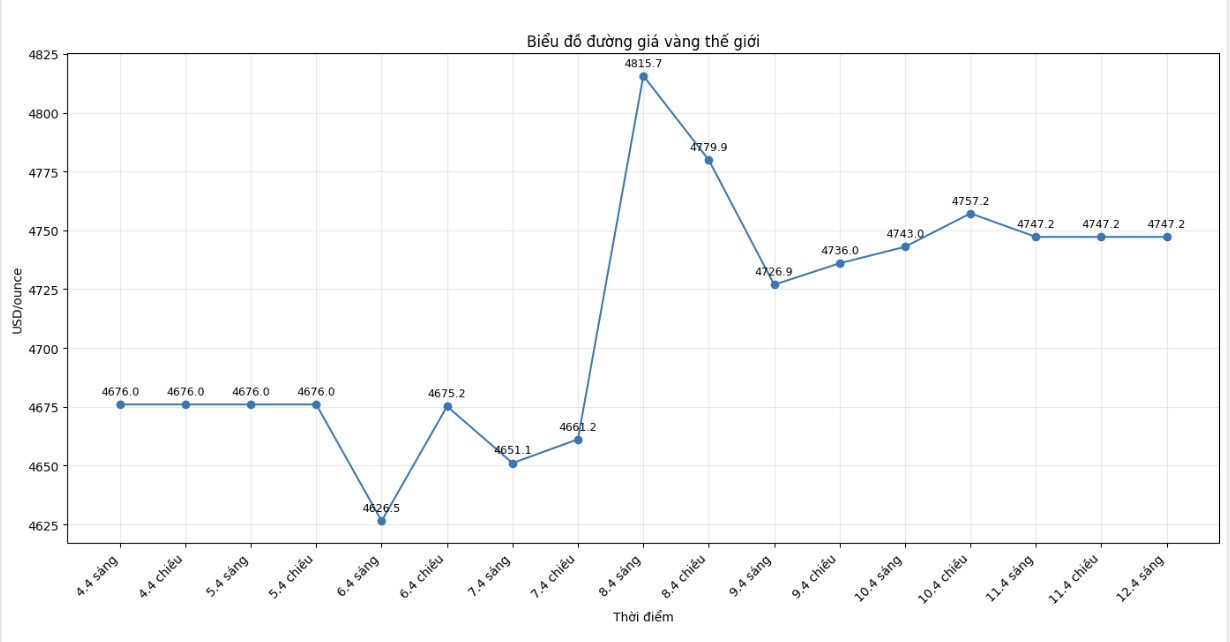
Closing the week's trading session, world gold prices were listed at 4,74.2 USD/ounce, up 71.2 USD compared to a week ago.
Gold price forecast
Next week, gold prices are forecast to continue to fluctuate strongly in the context that the market is still particularly sensitive to geopolitical signals and US monetary policy expectations. After a fairly deep correction phase, the precious metal has shown signs of stabilization as tensions in the Middle East temporarily subside, thereby helping investor sentiment to be less pessimistic than in previous sessions.
Kitco's weekly gold survey shows that the optimistic trend is returning. Many Wall Street experts and individual investors believe that gold still has room to rise, especially when the safe-haven role of precious metals has not decreased in a global risky environment that is still large.
However, analysts also noted that the upward momentum of gold may not take place in a straight line, but will alternate with very strong fluctuations.
Mr. Adrian Day - Chairman of Adrian Day Asset Management - believes that gold is in a fairly favorable position. According to him, if the ceasefire agreement is maintained, monetary factors such as inflation, interest rates and the need to hold safe assets will continue to support gold prices.
Conversely, if the conflict escalates again, the need for risk hedging may quickly push gold up more strongly. This assessment shows that gold is still an asset that benefits in both scenarios, as long as instability is not really over.
From a technical perspective, Mr. Marc Chandler, Managing Director of Bannockburn Global Forex, said that if gold surpasses the 4.915 USD/ounce zone, the market may regain its upward momentum and head towards the 5,000 USD/ounce mark. This is considered an important resistance zone, which may determine the short-term trend of world gold prices next week.
However, adjustment risks are still present. The market next week does not have too many outstanding economic data, but reports related to manufacturing, manufacturing and US housing market inflation may still significantly affect interest rate expectations.
If inflationary pressure continues to persist, the US Federal Reserve (FED) may maintain a cautious stance for longer, thereby creating more variables for gold prices. In the current context, the dominant trend of gold still leans towards positive, but investors need to prepare psychologically for strong fluctuations and rapid reversals.
Gold price data is compared to a week earlier.
The world gold market operates through two main pricing mechanisms. The first is the spot market, where prices are quoted for transactions and immediate delivery.
The second is the futures contract market, where prices are set for futures delivery. Due to year-end closing activities, December gold futures contracts are currently the most actively traded type on the CME.
See more news related to gold prices HERE...


