
Domestic pepper prices: Suspension of high-moving days
As of 1:30 PM today (January 13), domestic pepper prices suddenly reversed to decrease in all areas, averaging 150,800 VND/kg. Currently, key areas are trading in the range of 149,000 - 152,500 VND/kg.
After a series of days of standing still, provinces and cities simultaneously reduced from 500-1.000 VND/kg. Currently, the pepper price list for specific areas is as follows:
Gia Lai and Dong Nai provinces listed at prices of 150,000 VND/kg and 150,000 VND/kg respectively.
Ho Chi Minh City is anchored at the threshold of 151,500 VND/kg.
Dak Lak and Lam Dong are the two provinces with the highest prices, offering to the market at the milestone of 152,500 VND/kg.
World pepper prices: Decline
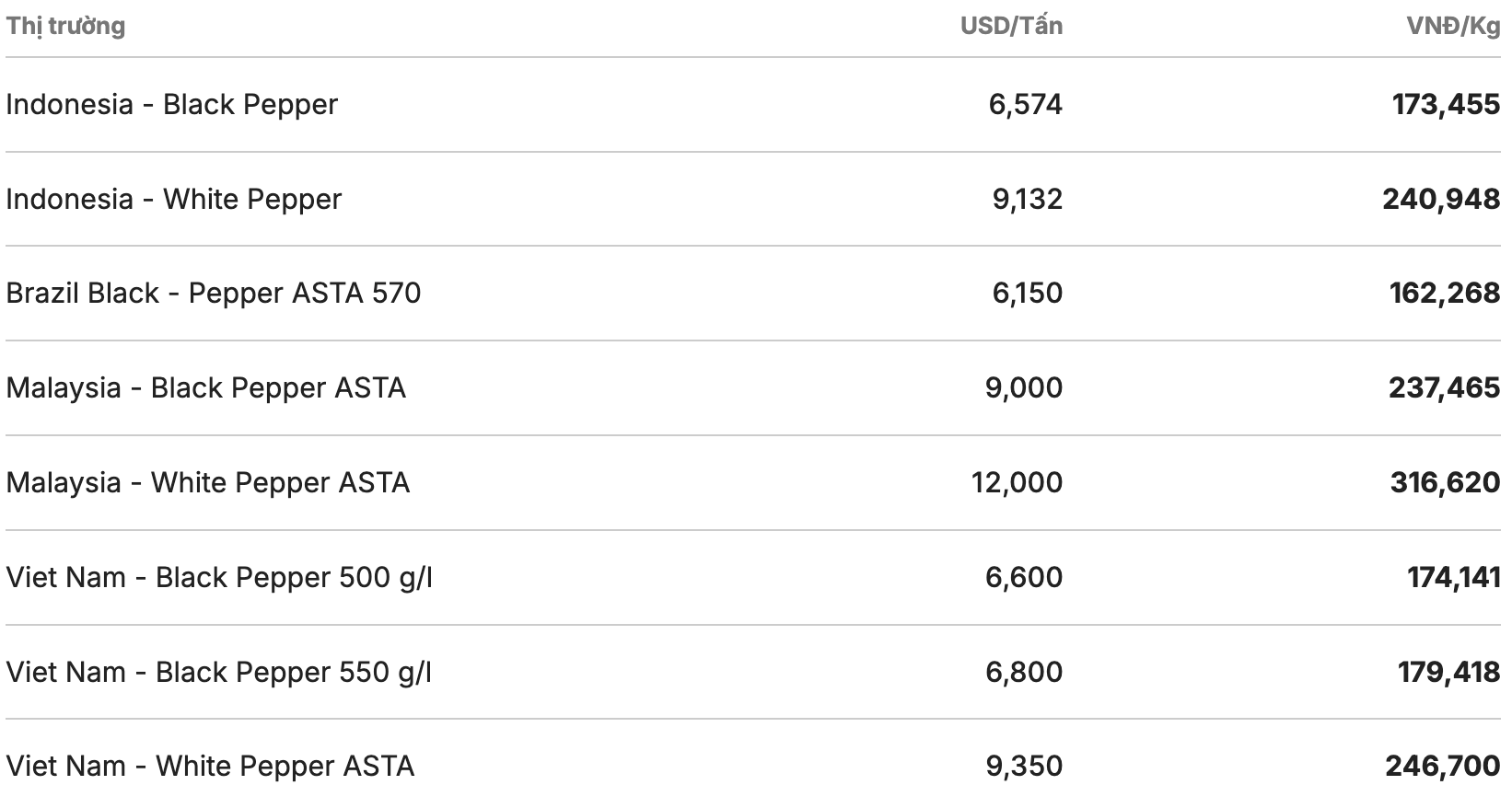
In the world market, consumer prices fluctuate in countries. Indonesian exchange - one of the busiest markets to reduce prices. These two items are traded in the range of 6,574 - 9,132 USD/ton (equivalent to 177,215 VND/kg - 241,220 VND/kg), down 143 USD/ton and 11 USD/ton respectively.
Meanwhile, the Brazilian market stood at 6,150 USD/ton (about 162,268 VND/kg). In the opposite direction, black and white pepper remained unchanged, trading at 12,000 USD/ton and 9,000 USD/ton.
Notably, in Vietnam's pepper export market, black pepper prices of 500 g/l and 550 g/l are traded in the price range of 6,600 - 6,800 USD/ton. At the same increase, ASTA white pepper price is currently at 9,350 USD/ton (equivalent to 246,700 VND/kg).
Perspectives and forecasts
The stability of export prices in the context of the domestic market continuously reversing direction shows that international importers have gradually accepted the new price level of Vietnam - which is currently a country supplying more than 40% of global pepper production.
After many consecutive days of setting new peak prices, domestic pepper prices have entered a correction phase. However, according to the latest bulletin from the International Pepper Corporation (IPC), Vietnam still holds the leading position when supplying the US market with 44,550 tons, far ahead of other competitors such as Indonesia, India and Brazil.


