Domestic pepper prices: For the third consecutive week, sharp decline
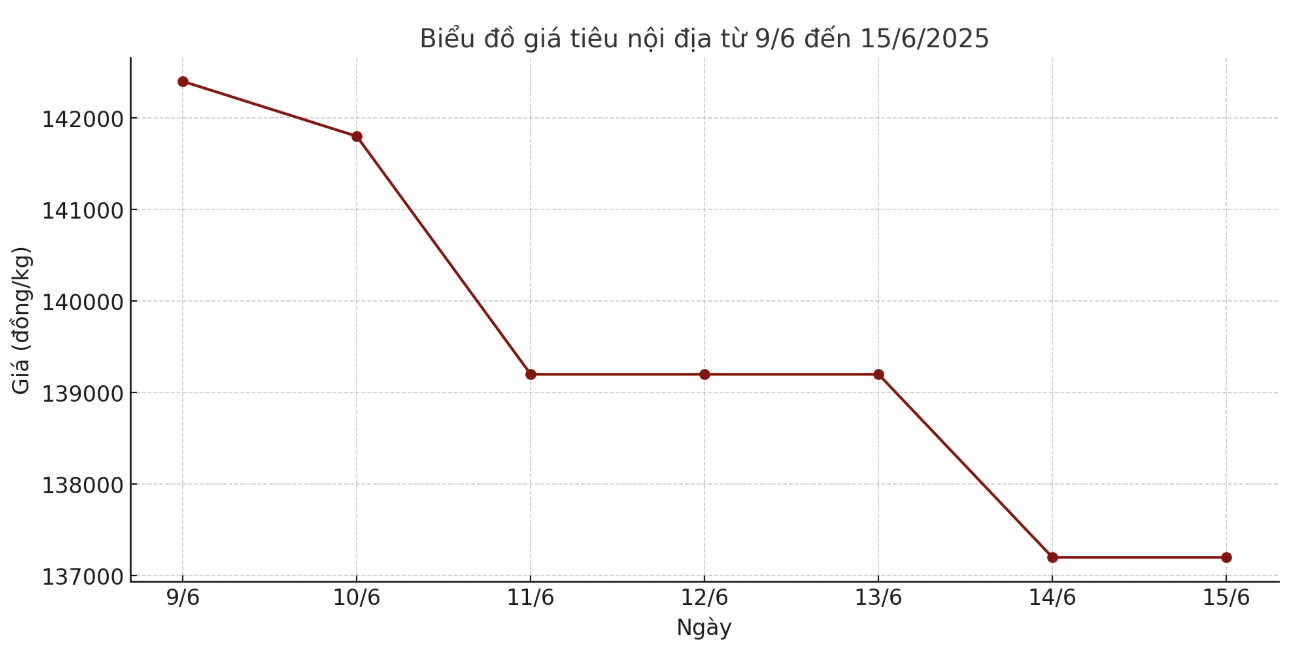
As of 11:15 today (February 15), domestic pepper prices are trading in the range of 137,000 - 138,000 VND/kg, down 5,000 VND/kg compared to last week.
Pepper prices in Dak Lak province are being purchased at the highest level of 140,000 VND/kg. Meanwhile, in two other localities in the Central Highlands region, Dak Nong and Gia Lai, pepper prices are still traded at 139,000 VND/kg.
Similarly, in the provinces in the Southeast region including Ba Ria - Vung Tau and Binh Phuoc, pepper prices are commonly at 139,000 VND/kg.
World pepper prices: Few fluctuations
In the recent trading session, the International Pepper Federation (IPC) quoted Indonesia black pepper at 7,500 USD/ton, down 63 USD/ton compared to the closing price of the previous week. The price of Indonesian white pepper stood at 10,132 USD/ton, down 10 USD/ton.
In other leading producing countries, export pepper prices have not recorded any new fluctuations. Currently, Malaysia's export black pepper prices are maintaining a stable level at the highest level of 9,100 USD/ton; while ASTA 570 Brazilian black pepper reached the lowest level at 6,175 USD/ton.
Vietnam's export black pepper prices continue to be stable in the range of 6,300 - 6,400 USD/ton for the 500 g/l and 550 g/l types.
However, the export prices of Malaysia ASTA white pepper and Vietnamese white pepper remain unchanged at 11,850 USD/ton and 9,300 USD/ton.
Assessment and forecast
In the short term, pepper prices are forecast to tend to stay flat or continue to decrease slightly. The reason is due to unstable export demand and cautious sentiment from importers. Although supply shows signs of tightening, it is not enough to create a breakthrough in the context of a weak market.
However, in the medium and long term, the global supply shortage is considered a strong support factor for the possibility of pepper price recovery. Vietnam's pepper output is showing a downward trend. At the same time, many farmers have proactively kept goods in warehouses waiting for prices, causing the supply-demand balance to gradually leaning towards sellers, creating a foundation for consumer prices to increase again in the coming time.