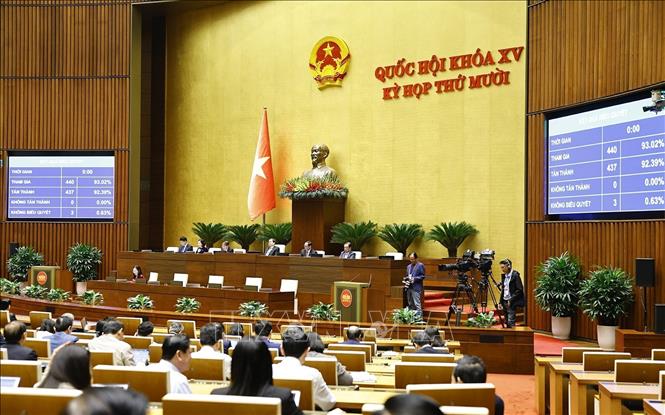
On the morning of December 10, with 437/440 delegates in favor, the National Assembly passed the revised Press Law. The new law was passed with 4 chapters and 51 articles and will take effect from July 1, 2026.
Before the National Assembly pressed the button to approve, Chairman of the Committee on Culture and Society Nguyen Dac Vinh presented a report on receiving and explaining the revised draft law.
Accordingly, compared to the current law, the bill has 6 new points. That is, clearly defining types of journalism in the new context; supplementing journalism development policies and ensuring implementation resources, from financial mechanisms to infrastructure investment and tax incentives in a more feasible direction.
Clarify the conditions for press operations, licensing mechanisms and organizational structure; identify key multimedia press agencies, representative offices, and permanent reporters.
Specific regulations on press cards, legal liability for information content; right to request correction and removal of violating information on platforms.
Complete regulations on the management of press activities in cyberspace and the application of new technologies, including adjusting the behavior of applying artificial intelligence (AI).
Notably, the new law has stipulated the press agency. In which, it stipulates that the main multi-medium press agency has many types of press, affiliated press agencies; has a specific financial mechanism; is established in accordance with the strategy for developing and managing the press system approved by the Prime Minister.
Newspaper, radio and television agencies under provincial and municipal Party Committees have many types of press and press products.
In addition, the Law stipulates that in cases of initial issuance of a journalist card, there must be a continuous working time at the press agency requesting the issuance of a card for 2 years or more up to the time of issuance of the card and have passed the training course for journalism and professional ethics.
For leaders of press agencies that have been appointed by the Ministry of Culture, Sports and Tourism with a document agreeing to not apply this condition.
Regarding subjects granted a journalist card, the law excludes the case of people working at scientific magazine agencies.
Regarding information provision to the press, the law stipulates that press agencies and journalists have the right and obligation not to disclose information suppliers, except in cases where there is a written request from the Chief Prosecutor of the People's Procuracy, Chief Justice of the Provincial People's Court and equivalent or higher, the Head of the Investigation Agency of the Ministry of Public Security, the Head of the Provincial Police Investigation Agency to serve the investigation, prosecution and trial of crimes.
The Chief Prosecutor of the People's Procuracy, Chief Justice of the Provincial People's Court and equivalent or higher, the Head of the Investigation Agency of the Ministry of Public Security, the Head of the Investigation Agency of the Provincial Police are responsible for organizing the protection of information providers.
Law enforcement agencies are responsible for coordinating with the Chief Prosecutor of the People's Procuracy, Chief Justice of the Provincial People's Court and equivalent or higher, the Head of the Investigation Agency of the Ministry of Public Security, the Head of the Provincial Police Investigation Agency to protect the person providing the information.