
Domestic pepper prices
As of 11:30 am today (August 15), domestic pepper prices continued to remain unchanged, listed at 137,000 VND/kg. Currently, key areas are trading in the range of 136,000 - 139,000 VND/kg.
Domestic pepper prices continue to remain unchanged for 4 consecutive days. Currently, provinces and cities list the domestic pepper prices as follows:
Dong Nai and Ho Chi Minh City simultaneously listed at the mark of 136,000 VND/kg.
Similarly, Dak Lak and Lam Dong respectively offered for sale at the highest purchase price in the whole region of 138,000 VND/kg and 139,000 VND/kg.
Compared to the same period in July, the domestic pepper price level is 1,500 VND/kg lower, showing that the technical adjustment is maintained after a week of unexpected sharp decline at the last minute.
World pepper price
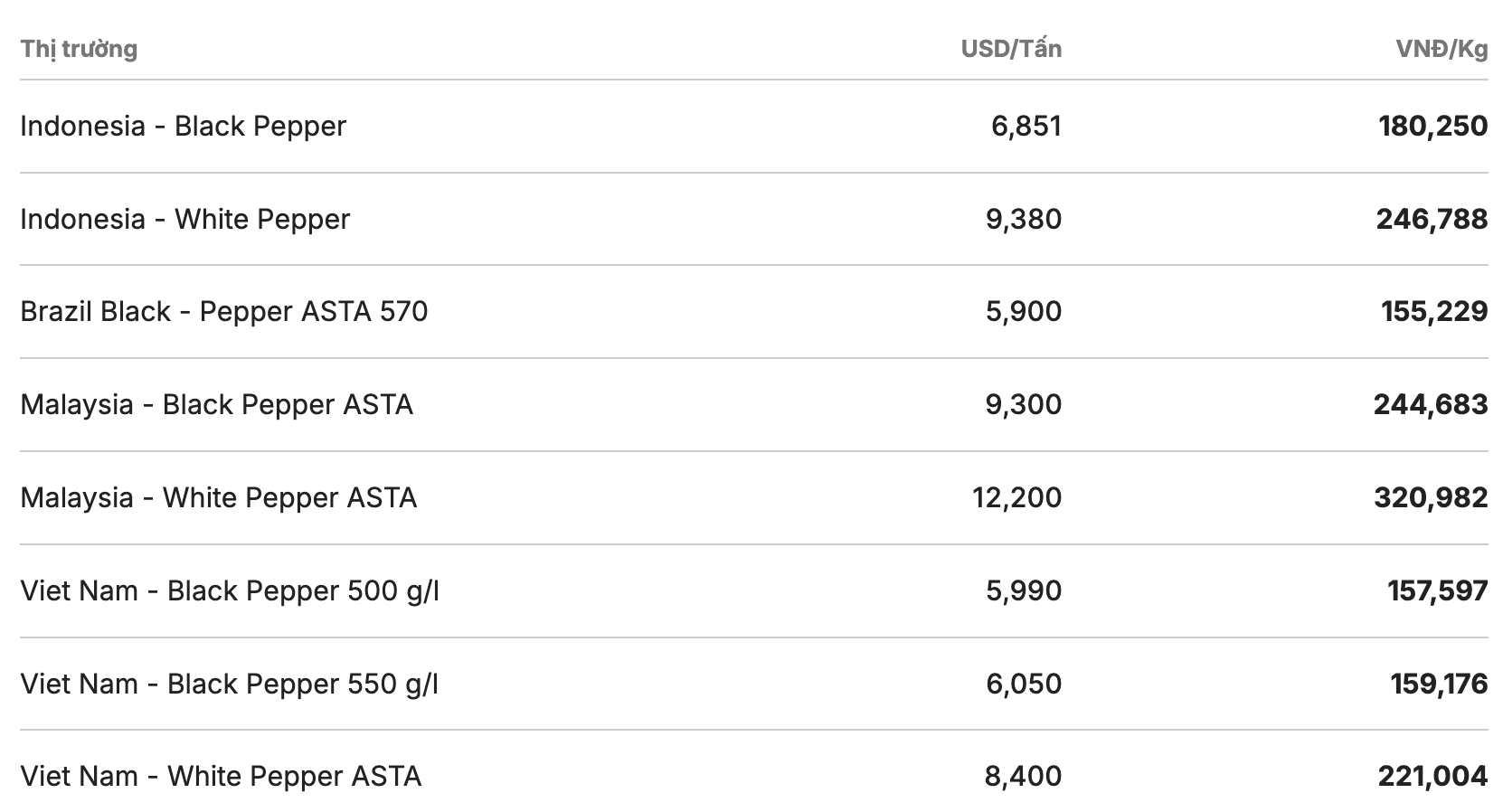
In the world market, pepper prices are maintained in high prices in most countries. Indonesia's black and white peppers are no exception, trading in the range of 6,851 - 9,380 USD/ton (equivalent to 180,250 VND/kg - 246,788 VND/kg), down 5 USD/ton and 7 USD/ton respectively.
Similarly, the price of Brazilian black pepper sold to the market is 5,900 USD/ton (about 155,229 VND/kg). However, black and white Malaysian pepper still maintain the same price range, trading at high prices, respectively 12,200 USD/ton and 9,300 USD/ton.
Notably, in Vietnam's pepper export market, black pepper prices of 500 g/l and 550 g/l increased slightly, trading at 5,990 - 6,050 USD/ton. ASTA white pepper price offered for sale at 8,400 USD/ton (equivalent to 221,004 VND/kg).
Assessments and forecasts
In the short term, pepper prices are forecast to continue to stabilize if the world geopolitical situation does not fluctuate much.
In the event that tensions in the Middle East are resolved, prices may rise again as inventories in import markets have fallen, while supply from major manufacturing countries is at its lowest level in many years.
However, the US market also poses new challenges when this country applies an import tax rate of 12.5% on Vietnamese goods.
The Vietnam Pepper and Spice Plant Association (VPSA) assesses that the impact on the pepper industry will not be too large when competing countries also bear similar tariffs. Moreover, the United States is still significantly dependent on the supply of imported pepper and Vietnam is a major supplier to this market. Therefore, pepper exports to the United States are expected to remain stable in the medium and long term.


