
Domestic pepper prices
As of 11:30 am today (September 16), domestic pepper prices recorded a slight decrease of 200 VND/kg, averaging 138,300 VND/kg. Currently, the listed price range is in the range of 137,000 - 141,000 VND/kg.
At the end of the recent transaction, Gia Lai and Dong Nai continued to hold together at the threshold of 137,000 VND/kg.
Similarly, Ho Chi Minh City put it on the market at a price of 137,500 VND/kg.
In the Dak Lak area alone, it unexpectedly decreased by 1,000 VND/kg, announcing a price of 139,000 VND/kg.
In Lam Dong, pepper prices are currently at the highest level in the whole region at 141,000 VND/kg.
World pepper price
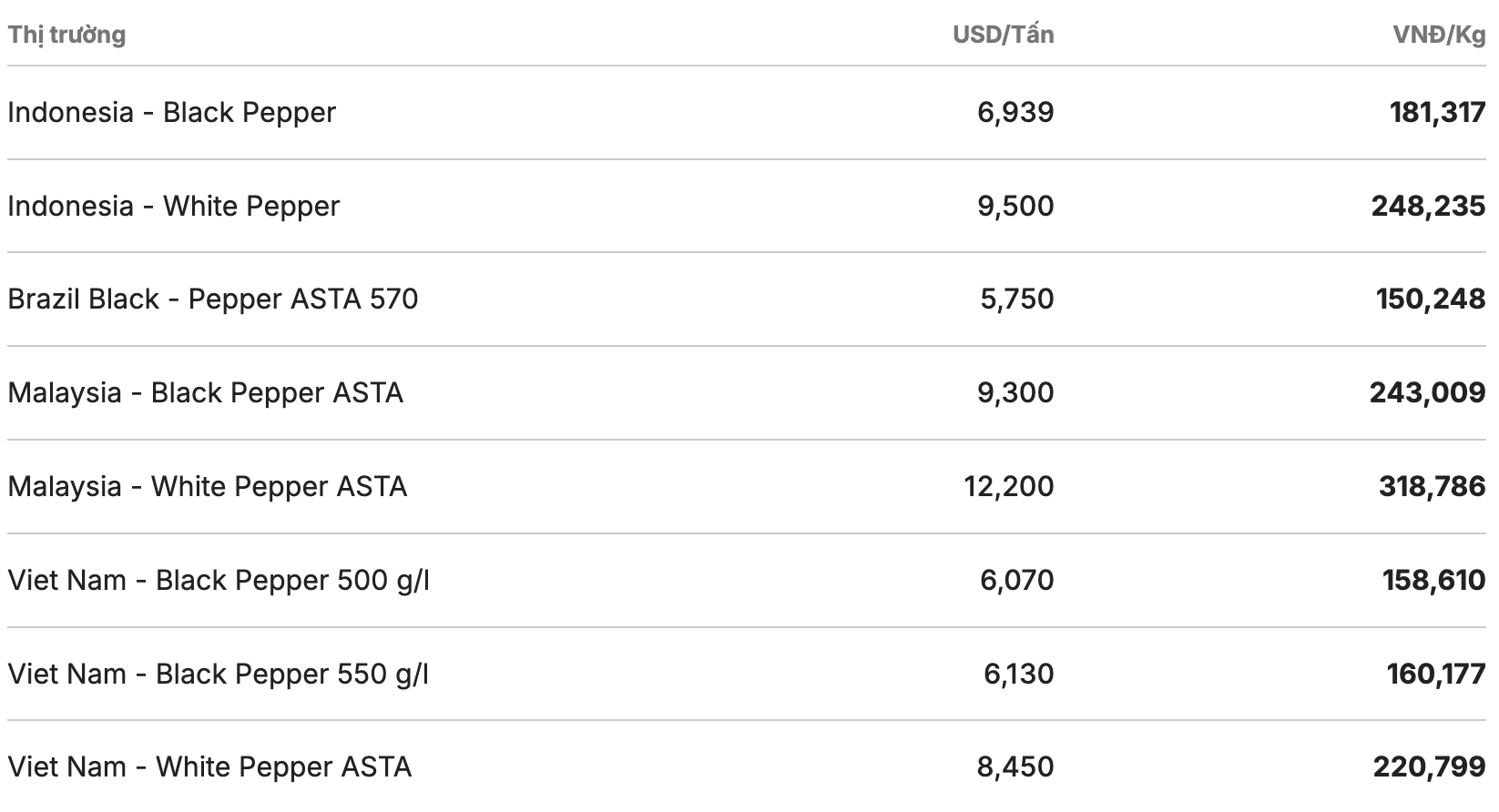
In the world market, pepper prices maintain a stable state in all countries. Indonesia's black and white peppers are no exception, trading in the range of 6,939 - 9,500 USD/ton (equivalent to 181,317 VND/kg - 248,235 VND/kg).
Meanwhile, the price of Brazilian black pepper sold to the market is 5,750 USD/ton (about 150,248 VND/kg). Black and white Malaysian peppers still maintain the same price range, trading at high prices, respectively 12,200 USD/ton and 9,300 USD/ton.
Notably, in Vietnam's pepper export market, after many days of sideways movement, black pepper prices of 500 g/l and 550 g/l traded at 6,070 - 6,130 USD/ton. ASTA white pepper price offered for sale at 8,450 USD/ton (equivalent to 220,799 VND/kg).
Assessments and forecasts
In the first days of September, world pepper prices adjusted in opposite directions according to each trading session. In which, pepper prices in Indonesia increased, prices in Brazil decreased, export prices of Vietnamese pepper increased slightly with one type, while the Malaysian pepper market continued its stable series of days.
Price fluctuations in September 2026 show that the world pepper market has not formed a clear trend but is in a correction phase and there are differences in each producing country.
For Vietnam, export prices basically remain stable and only increase slightly in some types. This development partly creates favorable conditions for businesses to be more proactive in implementing export contracts, in the context that prices in major producing countries are fluctuating in opposite directions.


