
Domestic pepper prices
As of 12:30 PM today (June 17), domestic pepper prices remained unchanged in all growing areas, averaging 139,200 VND/kg. Currently, key areas are trading in the range of 138,000 - 140,000 VND/kg.
Domestic pepper prices after a decrease of 500 VND/kg are currently listed at the following price:
Gia Lai and Dong Nai provinces trade at the mark of 138,000 VND/kg. This is the lowest price of domestic pepper offered to the market.
Ho Chi Minh City maintains the price threshold of 139,500 VND/kg.
Dak Lak and Lam Dong offer for sale at purchase prices of 140,500 VND/kg and 140,000 VND/kg respectively.
World pepper price
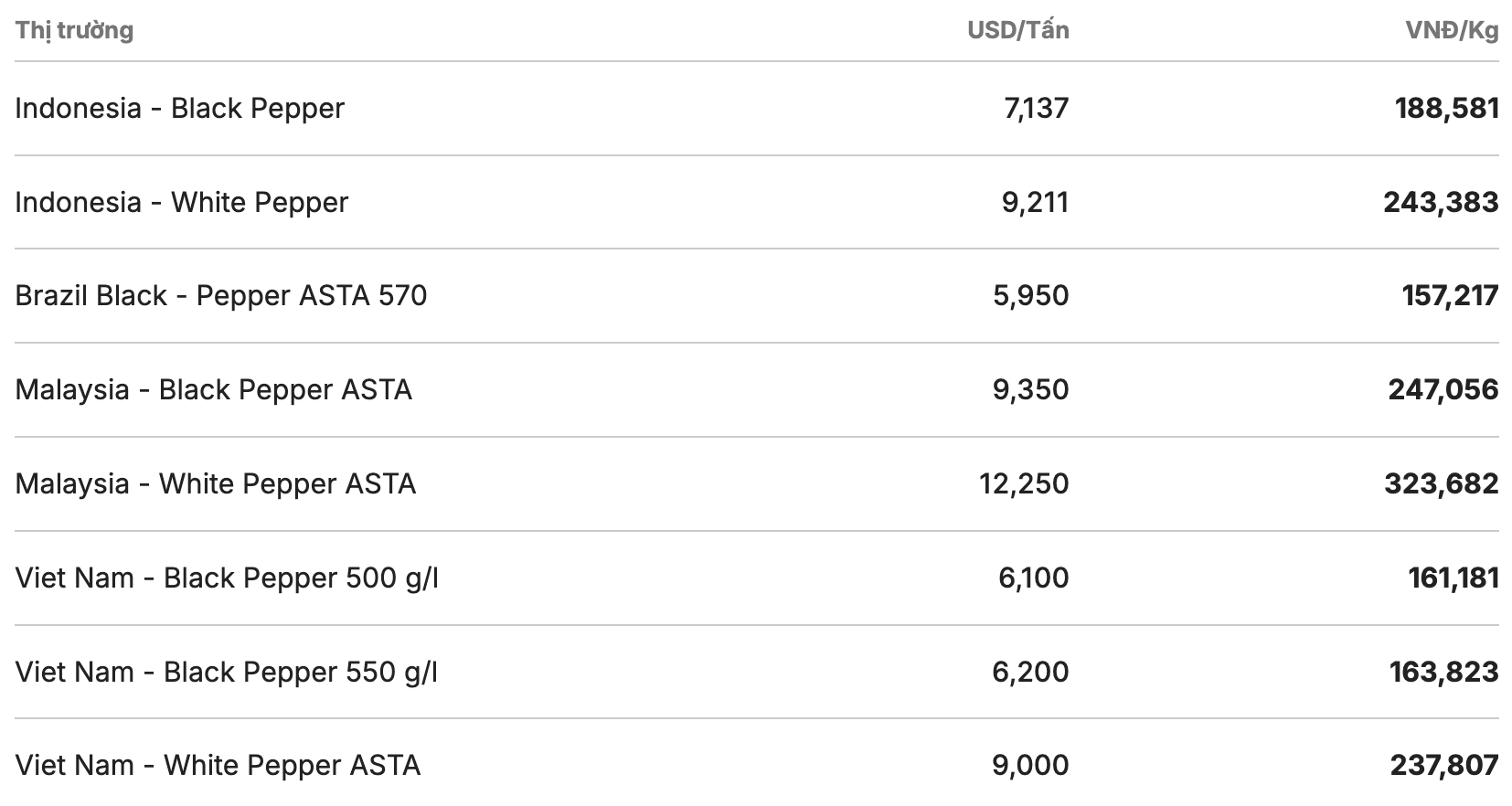
In the world market, pepper prices continue to extend the series of stagnant days in all countries. The two items of black and white pepper in Indonesia maintained the price range, trading in the range of 7, 137 - 9, 211 USD/ton (equivalent to 188,581 VND/kg - 243,383 VND/kg).
Meanwhile, the Brazilian market is holding at 5,950 USD/ton (about 157,217 VND/kg). Notably, black and white Malaysian peppers are still trading at high prices, respectively 12,250 USD/ton and 9,350 USD/ton.
In Vietnam's pepper export market, the price of black pepper of 500 g/l and 550 g/l remains at 6,100 - 6,200 USD/ton. In the same direction, ASTA white pepper is offered for sale at 9,000 USD/ton (equivalent to 237,807 VND/kg).
Assessments and forecasts
New agreements in the Middle East are expected to create a positive mentality for international trade activities. In Vietnam, the pepper industry is witnessing a strong breakthrough in export scale. In the first 5 months of 2026, Vietnam exported about 126,800 tons, earning 819.7 million USD, an increase of 27% in volume and 18.8% in value compared to the same period in 2025.
Forecast for the second half of 2026, although opportunities from Free Trade Agreements (FTAs) are still wide open, the pepper industry will face stricter standards from the US and EU on traceability, sustainable development and food safety. This requires businesses not only to focus on the number of orders but also to improve trade risk management.


