
Domestic pepper prices: Slight decrease
As of 1 pm today (April 18), domestic pepper prices are mostly stable, averaging 140,400 VND/kg. Currently, key areas are trading in the range of 139,500 - 141,000 VND/kg.
Domestic pepper prices maintain the price range, except for Gia Lai province. Currently, the listed price levels are as follows:
Gia Lai province is anchored at the threshold of 139. 500 VND/kg, down 500 VND/kg.
Ho Chi Minh City put it on the market at a price of 140,000 VND/kg.
Dak Lak and Lam Dong continue to be the 2 provinces offering the highest purchase price in the country with a price of 141,000 VND/kg.
World pepper prices: Indonesia fluctuates
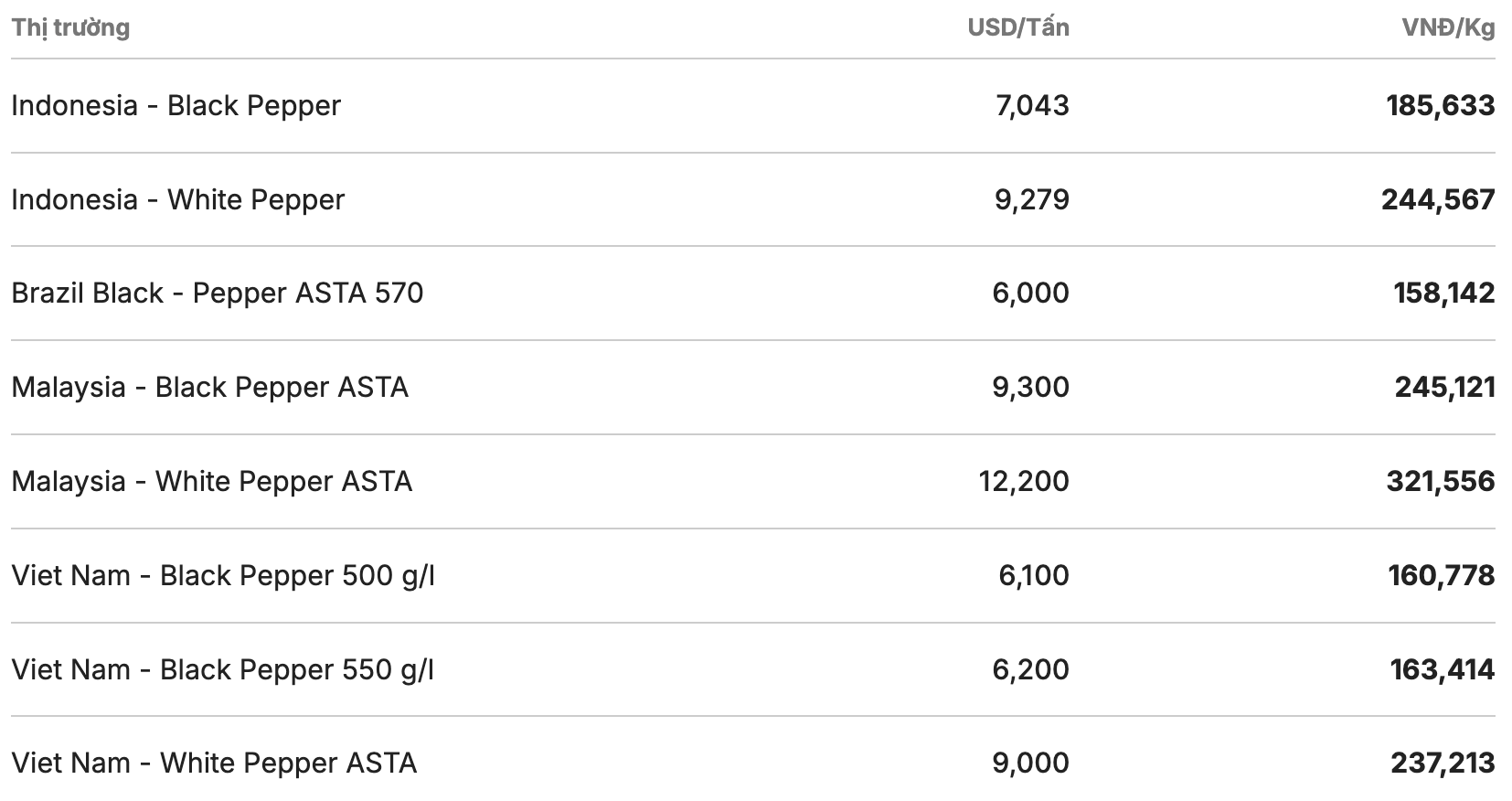
In the world market, pepper prices remained unchanged in most countries. Especially black and white peppers in Indonesia decreased sharply, trading in the range of 7,043 - 9,279 USD/ton (equivalent to 185,633 VND/kg - 244,567 VND/kg), down 19 USD/ton and 25 USD/ton respectively.
The Brazilian market is listed at the 6,000 USD/ton mark (about 158.142 VND/kg). Notably, black and white peppers maintain an increase of 100 - 200 USD/ton, trading at the 12,200 USD/ton and 9,300 USD/ton marks.
In Vietnam's pepper export market, the price of black pepper of 500 g/l and 550 g/l remains unchanged at 6,100 - 6,200 USD/ton. In the same direction, ASTA white pepper is offered for sale at 9,000 USD/ton (equivalent to 237.213 VND/kg).
Assessments and forecasts
Vietnamese domestic pepper prices fluctuate in a narrow range mainly due to strong supply increases during the main harvest season, while purchasing demand has not increased correspondingly.
Besides internal problems, the industry also faces great logistics pressure due to escalating conflicts in the Middle East, causing transportation costs to increase 3-4 times and forcing many ships to change direction.
Despite the decline in recent times, the Import-Export Department believes that domestic pepper prices will soon recover as supply gradually shrinks after strong sales during the season, along with that, international import demand is forecast to improve, especially from the US and other major markets.


