
Domestic pepper prices: Week of price increases
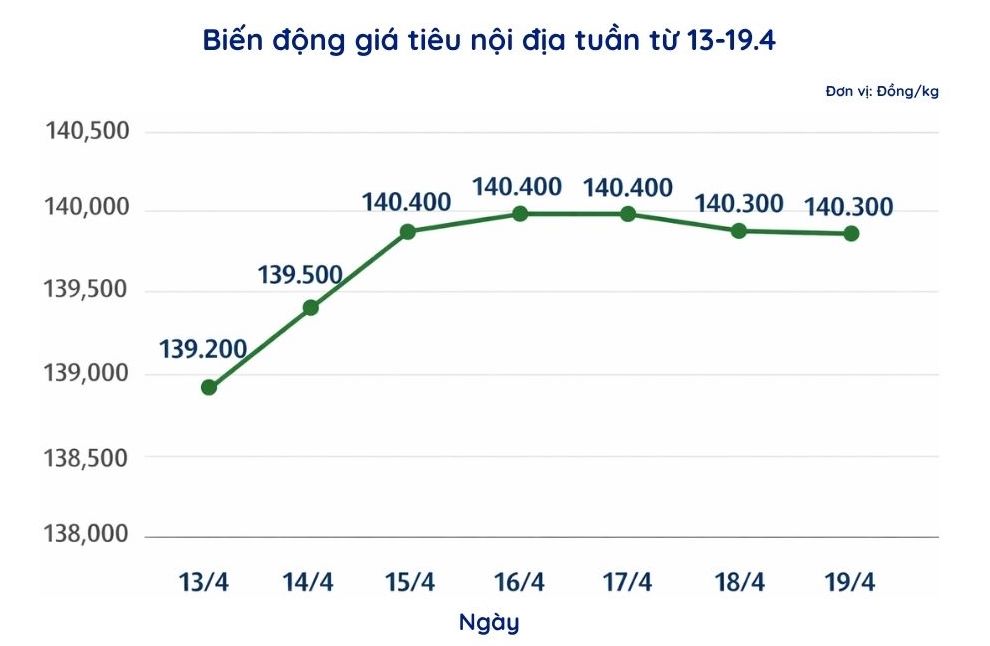
Today (April 19), domestic pepper prices traded in the range of 139,500 - 141,000 VND/kg, an increase of 1,000 - 1,200 VND/kg compared to last week.
At the end of last week, pepper prices in Dak Lak and Lam Dong increased by 1,500 VND/kg and 2,000 VND/kg respectively, both reaching the highest level of 141,000 VND/kg.
Dong Nai and Ho Chi Minh City diễn biến theo xu hướng nâng giá 1, 500 VND/kg, lên mốc 140,000 VND/kg.
Meanwhile, Gia Lai recorded a more modest increase, about 1,000 VND/kg, trading at 139,500 VND/kg.
World pepper prices: Price slippage
According to the International Pepper Corporation (IPC), pepper prices in leading producing countries decreased compared to the closing session of the previous week.
Indonesian black pepper closed last week at 7.043 USD/ton, down 0.44% (31 USD/ton) compared to the previous week. At the same decrease, Indonesian white pepper price reached 9,279 USD/ton.
Brazilian black pepper ASTA 570 last week fell sharply by 2.44% (equivalent to 150 USD/ton), to only 6,000 USD/ton. In the opposite direction, white pepper prices remained unchanged at 9,000 USD/ton and 12,200 USD/ton.
Similarly, in Vietnam, the export price of black pepper fluctuates in the range of 6,100 - 6,200 USD/ton for types 500 g/l and 550 g/l. The price of white pepper in Vietnam is flat, setting the milestone of 9,000 USD/ton.
Assessments and forecasts
Most major markets recorded a sharp decrease compared to the previous month, of which the US decreased by 45.2%, Vietnam decreased by 43.5% and India decreased by 6.9% except for China increasing by 15.3% compared to January 2026.
However, the domestic market recorded many signs of recovery when prices increased in the past week. Despite being at the peak of harvest, domestic pepper prices still maintained a high price range. This reflects that the actual supply is not as abundant as expected, and at the same time, selling pressure from farmers is still limited.
In the long term, price trends will depend heavily on global economic developments, consumption demand and geopolitical situation. If demand recovers and supply does not increase too quickly, pepper prices can completely remain at high levels.


