
Domestic pepper prices
As of 11:30 am today (August 19), domestic pepper prices continued to move sideways, listed at 137,000 VND/kg. Currently, key areas are trading in the range of 136,000 - 139,000 VND/kg.
Domestic pepper prices recorded the 4th consecutive day of maintaining a price range below the threshold of 140,000 VND/kg. Currently, provinces and cities list the domestic pepper prices as follows:
Dong Nai and Ho Chi Minh City simultaneously listed at the mark of 136,000 VND/kg.
Similarly, Dak Lak and Lam Dong respectively offered for sale at the highest purchase price in the whole region of 138,000 VND/kg and 139,000 VND/kg.
Compared to the same period in July, the current pepper price level is still 1,400 VND/kg lower.
World pepper price
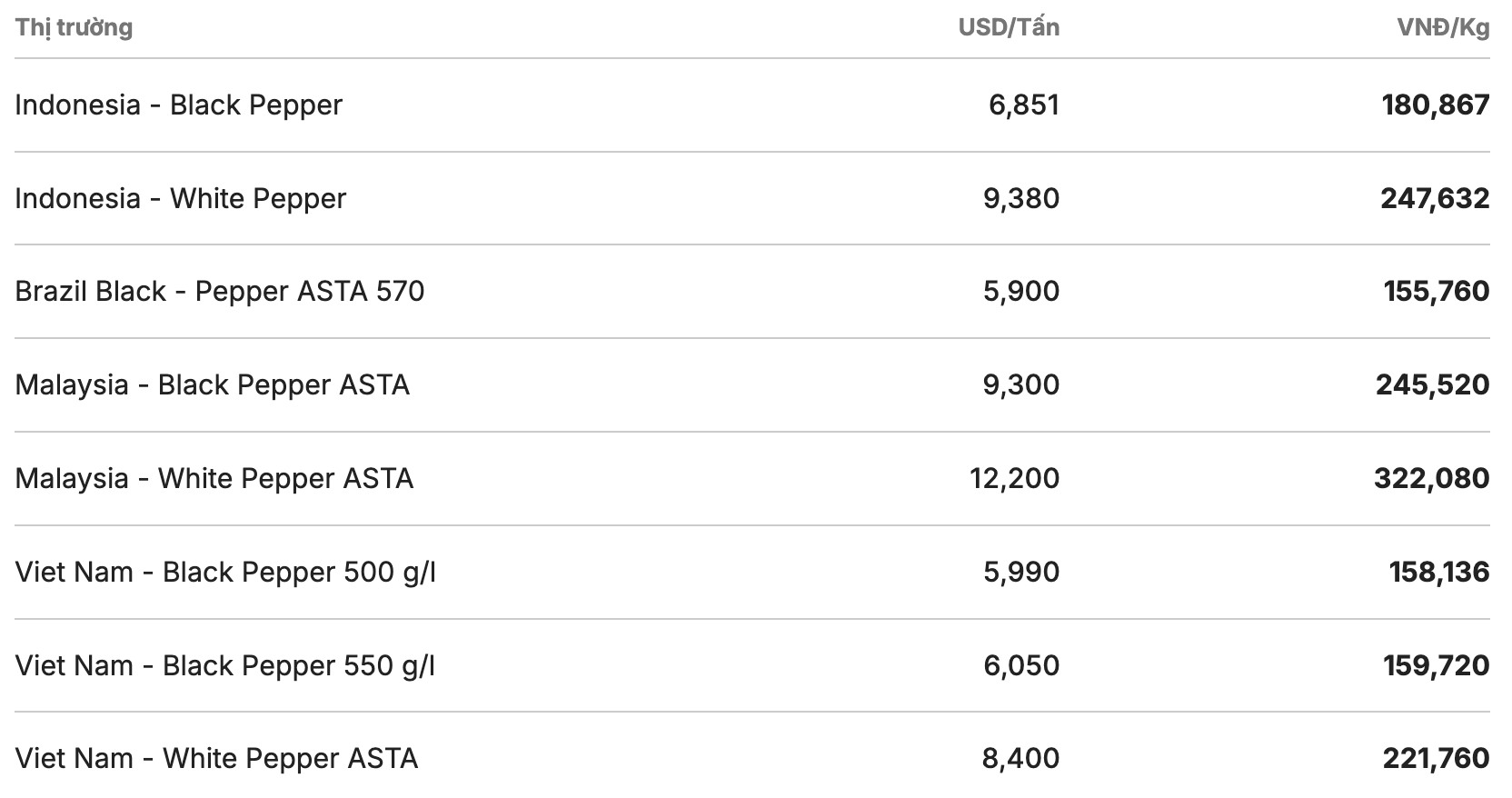
In the world market, pepper prices are maintained in high prices in most countries. Indonesia's black and white peppers are no exception, trading in the range of 6,851 - 9,380 USD/ton (equivalent to 180,867 VND/kg - 247,632 VND/kg).
Similarly, the price of Brazilian black pepper sold to the market is 5,900 USD/ton (about 155,760 VND/kg). However, black and white Malaysian pepper still maintain the same price range, trading at high prices, respectively 12,200 USD/ton and 9,300 USD/ton.
Notably, in Vietnam's pepper export market, black pepper prices of 500 g/l and 550 g/l are traded at 5,990 - 6,050 USD/ton. ASTA white pepper is offered for sale at 8,400 USD/ton (equivalent to 221,760 VND/kg).
Assessments and forecasts
Domestic pepper prices continue the long series of sideways movements, while export prices remain stable, contributing to creating a market state that is generally balanced.
According to a report by the Vietnam Pepper and Spice Plant Association (VPSA), in July 2026 alone, pepper exports reached 22,743 tons, with a turnover of 147.3 million USD.
Although down 1.6% in volume and 2.6% in value compared to the previous month, exports still increased by 8.8% compared to the same period in 2025. Whole pepper continued to account for the main proportion, with 19,623 tons, equivalent to 86.3% of total exports.
The world pepper market is entering a new cycle after a long period of oversupply. Experts believe that this industry is in a rebalancing phase as global supply tends to tighten.
Not only Vietnam, other major manufacturing countries such as Brazil and Indonesia also recorded significant production declines due to the negative impacts of climate change. While supply is limited, demand from major markets such as the US, Europe and the Middle East is showing signs of strong recovery.


