
Domestic pepper prices
As of 11:30 am today (August 20), domestic pepper prices continued to move sideways, listed at 137,000 VND/kg. Currently, key areas are trading in the range of 136,000 - 139,000 VND/kg.
Domestic pepper prices recorded the 4th consecutive day of maintaining a price range below the threshold of 140,000 VND/kg. Currently, provinces and cities list the domestic pepper prices as follows:
Dong Nai and Ho Chi Minh City simultaneously listed at the mark of 136,000 VND/kg.
Similarly, Dak Lak and Lam Dong respectively offered for sale at the highest purchase price in the whole region of 138,000 VND/kg and 139,000 VND/kg.
World pepper price
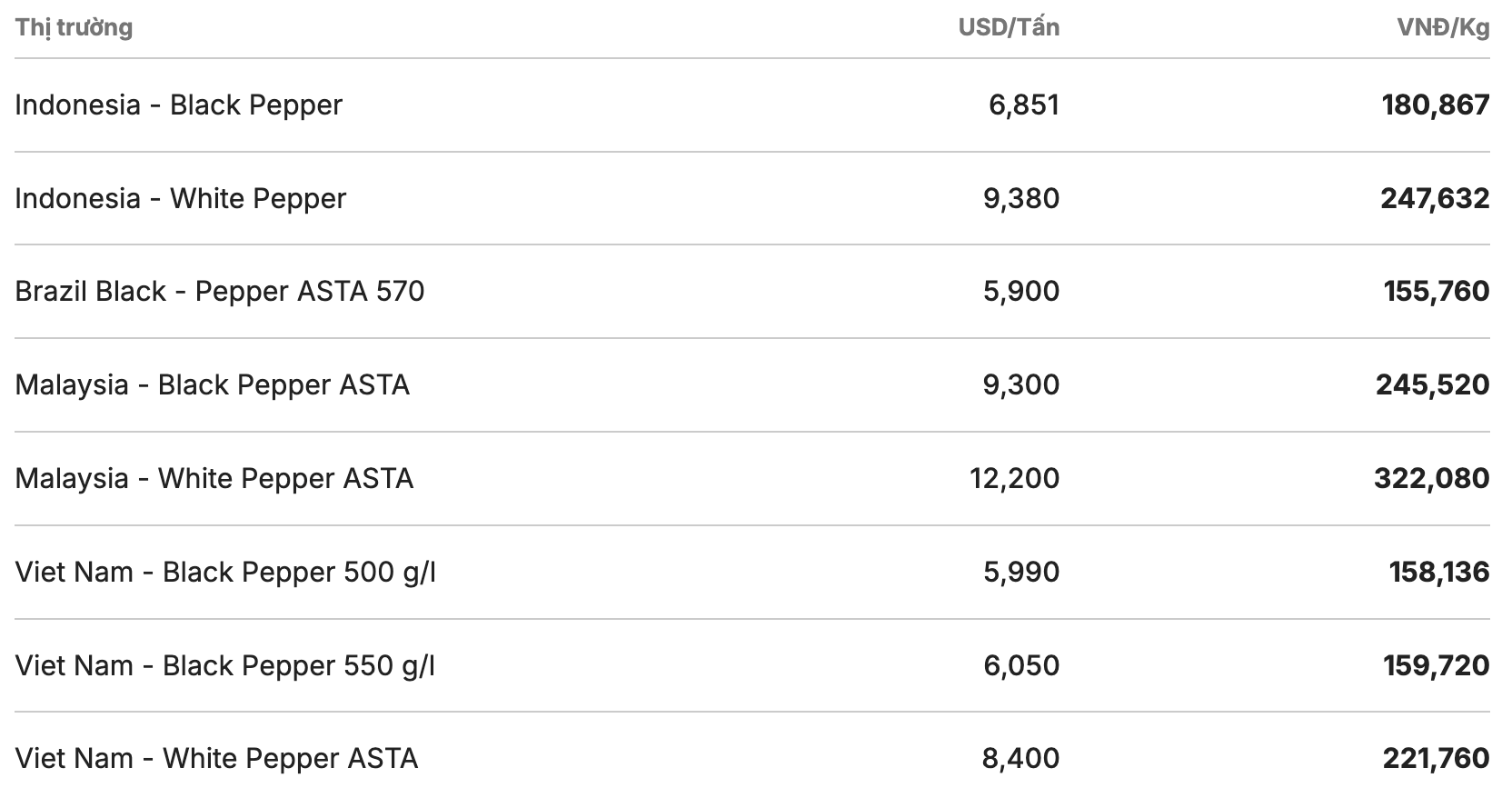
In the world market, pepper prices are unchanged in all countries. Indonesia's black and white peppers are no exception, trading in the range of 6,851 - 9,380 USD/ton (equivalent to 180,867 VND/kg - 247,632 VND/kg).
Similarly, the price of Brazilian black pepper sold to the market is 5,900 USD/ton (about 155,760 VND/kg). However, black and white Malaysian pepper still maintain the same price range, trading at high prices, respectively 12,200 USD/ton and 9,300 USD/ton.
Notably, in Vietnam's pepper export market, black pepper prices of 500 g/l and 550 g/l are traded at 5,990 - 6,050 USD/ton. ASTA white pepper is offered for sale at 8,400 USD/ton (equivalent to 221,760 VND/kg).
Assessments and forecasts
Pepper prices have entered the 5th consecutive day in a week without adjustments in both domestic and world markets. According to the Vietnam Pepper and Spice Plant Association (VPSA), in the first 15 days of August, Vietnam exported 10,514 tons of pepper, an increase of 7.4% compared to the same period in July.
In which, exports to China alone reached 1,585 tons, an increase of 200.8%. China increased pepper purchases mainly due to the large difference between domestic demand and output.
According to VPSA, China consumes about 90,000-100,000 tons of pepper per year, while domestic production only meets about 30,000 tons. This shortage makes China increasingly dependent on import supply.
In the context that global pepper supply is still relatively tight, increasing demand from China is expected to continue to be one of the factors supporting Vietnam's pepper exports in the last months of the year.


