
Domestic pepper prices: Continue to stand still
As of 11:30 am today (January 21), domestic pepper prices remained unchanged in all regions, averaging at 148,100 VND/kg. Currently, key areas are trading in the range of 147,500 - 148,500 VND/kg.
Maintaining a price lower than 4,000 VND/kg compared to the previous week, the pepper price list for specific regions is currently as follows:
Ho Chi Minh City and Gia Lai listed at 148,000 VND/kg.
Dong Nai province is the purchasing area with the lowest price of 147,500 VND/kg.
Dak Lak and Lam Dong are still the two provinces with the highest prices. Currently, these 2 areas are put on the market at 148,500 VND/kg.
World pepper prices: Price reduction
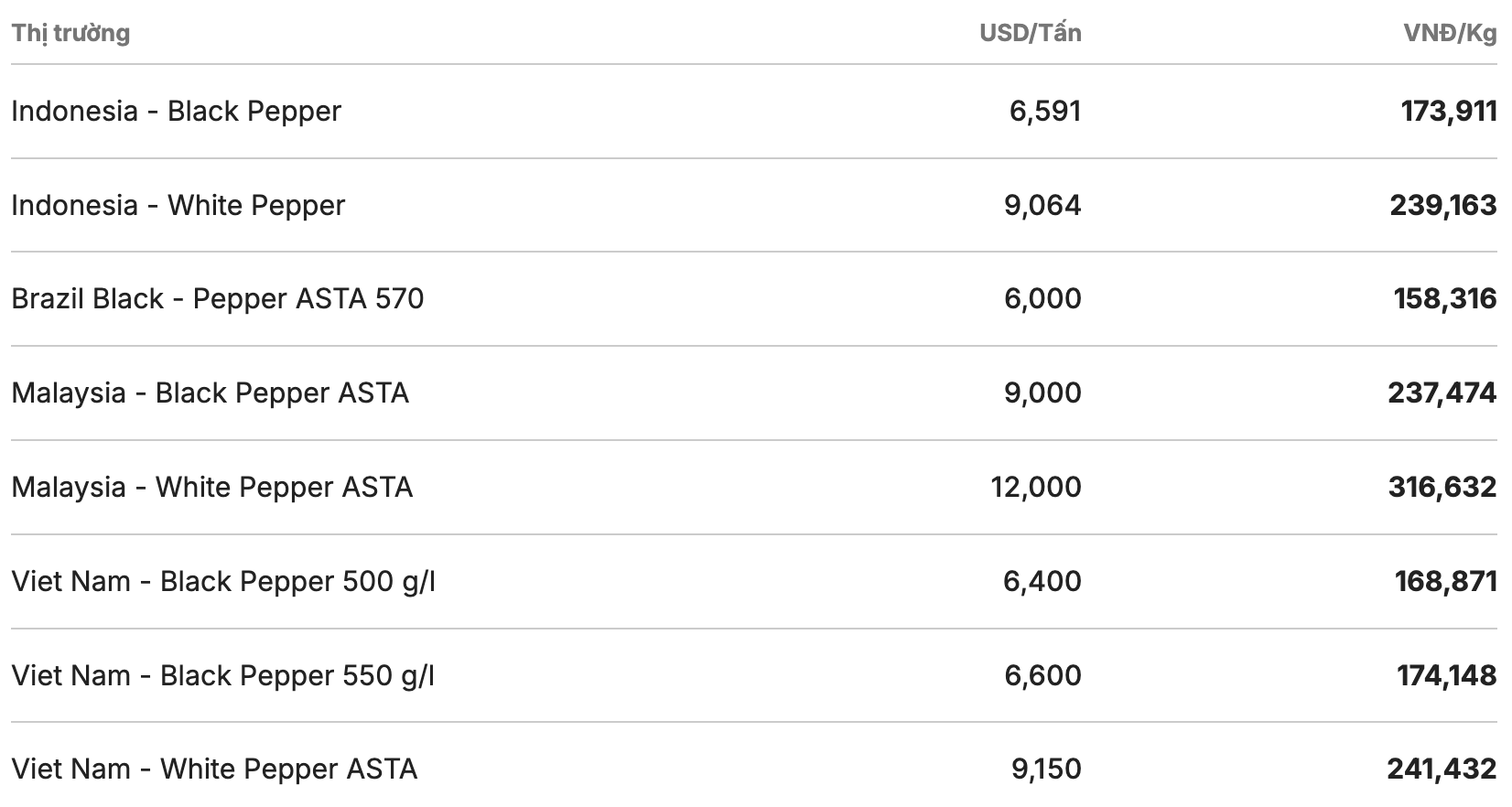
In the world market, pepper prices reversed in some countries. The Indonesian exchange - one of the most vibrant markets is no exception. These two items traded in the range of 6,591 - 9,064 USD/ton (equivalent to 174,386 VND/kg - 239,796 VND/kg), respectively down 18 USD/ton and 24 USD/ton.
In the same direction, the Brazilian market decreased by 100 USD/ton, trading at the milestone of 6,000 USD/ton (about 158,316 VND/kg). In the opposite direction, black and white pepper continued to remain unchanged, trading at 12,000 USD/ton and 9,000 USD/ton.
Notably, in Vietnam's pepper export market, black pepper prices of 500 g/l and 550 g/l remained at the threshold of 6,400 - 6,600 USD/ton. In the same direction, ASTA white pepper prices continued to maintain a decrease of 200 USD/ton, offering for sale at a price of 9,150 USD/ton (equivalent to 241,432 VND/kg).
Perspectives and forecasts
According to the Vietnam Pepper and Spice Plant Association (VPSA), the continuous decrease in global pepper production in recent years shows that maintaining pepper gardens in many countries is facing many difficulties due to many factors such as increasingly harsh weather conditions, competition from other plants, increasing input labor costs while pepper care is not easy at all.
Brazil will continue to be the only bright spot with increased area and stable output while most other major manufacturing countries have decreased.


