
Domestic pepper prices: Trading floor red
As of 11:30 am today (March 31), domestic pepper prices simultaneously decreased sharply, averaging 138,500 VND/kg. Currently, key areas are trading in the range of 138,000 - 139,000 VND/kg.
Domestic pepper prices simultaneously decreased by 2,000 VND/kg, provinces and cities in key areas listed prices as follows:
Gia Lai and Dong Nai provinces decreased by 2,000 VND/kg, both listed at the mark of 138,000 VND/kg.
At the same level of reduction, City. Ho Chi Minh anchored at 138,500 VND/kg.
Although lowering the price by 2,000 VND/kg, Dak Lak and Lam Dong are still the 2 provinces with the highest prices with prices of 139,000 VND/kg.
World pepper prices: Unexpectedly surge
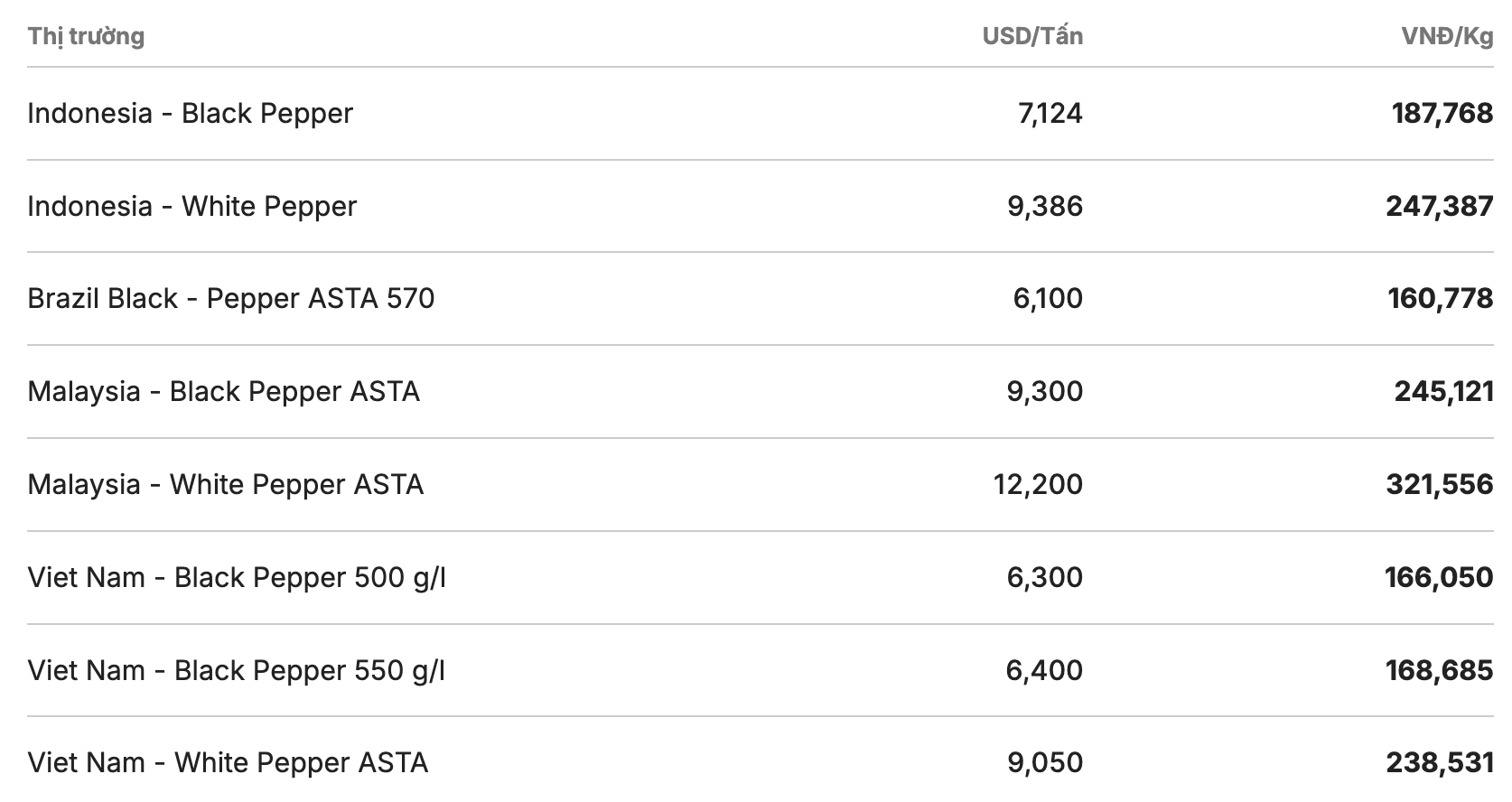
In the world market, pepper prices suddenly surged. The Indonesian exchange - one of the most vibrant markets is no exception. Black and white peppers traded in the range of 7, 124 - 9, 386 USD/ton (equivalent to 187, 768 VND/kg - 247, 387 VND/kg), increasing by 97 USD/ton and 82 USD/ton respectively.
The Brazilian market is listed at 6,100 USD/ton (about 160,778 VND/kg). Notably, black and white pepper kept increasing from 100 - 200 USD/ton, trading at 12,200 USD/ton and 9,300 USD/ton.
In Vietnam's pepper export market, black pepper prices of 500 g/l and 550 g/l are maintained at 6,300 - 6,400 USD/ton. Meanwhile, ASTA white pepper price remains unchanged, offered for sale at 9,050 USD/ton (equivalent to 238,531 VND/kg).
Assessments and forecasts
According to the International Pepper Community (IPC), the global pepper market in the last week of March generally remained stable, with price fluctuations mainly affected by supply conditions in each country and exchange rate developments, rather than systemic changes.
In Vietnam, the pepper market recorded a narrow range of adjustment in domestic prices, while export prices remained stable, showing that global demand continues to have good resistance.
In other producing countries, pepper prices fluctuated and increased again on the last day of March after a series of stagnant days. This continues to reflect a balanced supply-demand situation.


