
In recent years, the European Union (EU) has continuously tightened and lowered the maximum permissible residue level (MRLs) for many active ingredients, while expanding the scope of control for imported agricultural products. Besides the goal of protecting consumer health and the environment, MRLs regulations are increasingly becoming technical barriers with strict requirements, fast updates, many new regulations are issued in a short time, lacking a suitable transition roadmap, causing difficulties for exporting countries, including Vietnam.
This development shows that the EU not only strengthens inspections at border gates but also tightens the "acceptable threshold" for residues, especially for active ingredients no longer allowed to be used in the EU. The new approach is expected to directly impact the entire production chain, from cultivation, harvesting to processing and export.
According to the Ministry of Agriculture and Environment, Vietnamese dragon fruit is under enhanced control according to Appendix II of Regulation (EU) 2019/1793, with an inspection frequency of 30%, not 50% as some previous information.
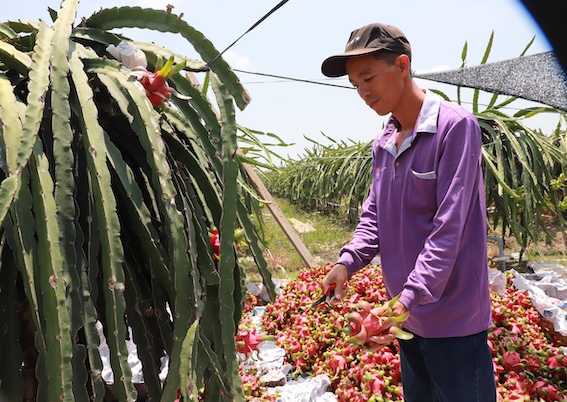
Some other items are also subject to increased control including: chili peppers (50%), okra (50%), durian (20%). Passion fruit is currently not subject to the EU's increased control measures.
Immediately after receiving notifications of non-compliance from the EU regarding violations of MRLs, the Ministry of Agriculture and Environment directed specialized agencies to organize the implementation of traceability, investigate the causes and complete remedial reports to send to competent EU agencies.
In addition, the Ministry of Agriculture and Environment also regularly issues documents and conferences to direct and urge localities, associations, industries and businesses to strengthen the implementation of food safety control (FS), especially for export goods. At the same time, it also directs the promulgation of many integrated pest control procedures, and the implementation of programs to raise biological pest control agents to minimize the use of pesticides in production. Thanks to this, the number of notifications of non-compliance with EU food safety regulations has decreased significantly in the past time. If in 2024, the number of notifications of non-compliance in Vietnam was 64 warnings, then by 2025 there will be only 17 warnings.
In the coming time, the Ministry of Agriculture and Environment determines that the EU continues to be a potential market but has very high requirements for plant quarantine and food safety. To maintain and develop this market, the Ministry of Agriculture and Environment will urgently complete the technical report on the implementation of the Action Plan to overcome shortcomings, in order to negotiate with the EU to reduce the frequency and rate of inspection at border gates for some items under Appendix II of Regulations (EU) 2019/1793.
Proactively monitor, summarize opinions and promptly exchange with EU functional agencies on draft new regulations, especially related to the approach to MRLs. Organize conferences and technical training for businesses, producers and local officials to warn and promptly disseminate new EU regulations.
At the same time, improve the capacity to comply with EU regulations for businesses, producers and local technical systems. Orient production towards sustainability, increase the use of biopesticides and biological pesticides, and reduce dependence on chemicals.


