
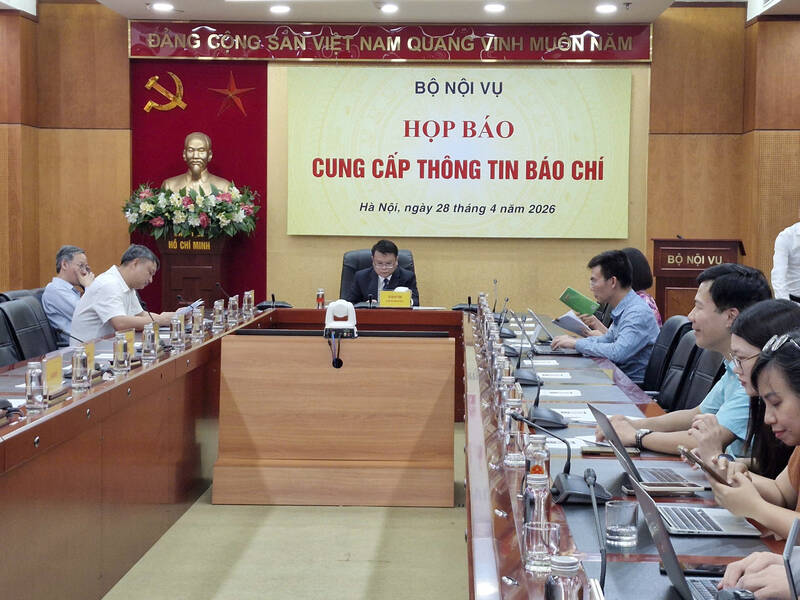
On the afternoon of April 28, at the press conference of the Ministry of Home Affairs, Ms. Nguyen Thi Tu Thanh - Deputy Director of the Local Government Department (Ministry of Home Affairs) - said that implementing the Party's policy on arranging villages and residential groups, this unit is drafting a Decree on the organization and operation of villages and residential groups and the regime for non-specialized personnel. The Decree will be the basis for the locality to implement in the coming time.
According to Ms. Thanh, the drafting of the Decree was carefully studied to report to competent authorities. The spirit is to arrange villages and residential groups nationwide in the direction of streamlining focal points, reducing the number, on the basis of being suitable to the practical scale and characteristics of each region.
Reducing the number of villages and residential groups nationwide will improve operational efficiency, facilitate the implementation of assigned tasks as well as reduce direct management pressure for commune-level authorities. The scale of villages and residential groups will be adjusted to suit the current commune-level scale.
The Ministry of Home Affairs is developing plans to reduce the number of villages and residential groups. However, the specific number has not been announced.
Regarding the operating model of the two-level local government, Ms. Thanh said that after one year of operation, many results have been achieved, but some problems have also emerged.
In which, the information technology system, databases and digital infrastructure for resolving administrative procedures initially achieved positive results. However, in some places, there is still a lack of synchronization, and some specific local utilities have not been operated smoothly, and need to be further overcome.
After arrangement, cadres and civil servants at the grassroots level must undertake a large volume of work, in which many are concentrated at the commune level. Meanwhile, professional human resources in some places are not uniform, and in some fields there is still a shortage of in-depth professional cadres. In some localities, cadres have to work scattered in many headquarters, causing difficulties in operating and handling work.
In the coming time, the Ministry of Home Affairs will continue to improve institutions, promote decentralization, delegation of power and improve the quality of the contingent of civil servants and public employees, especially at the grassroots level. The contingent of commune-level cadres and civil servants will continue to be rearranged in a direction that is more suitable to task requirements.
The policy of arranging villages and residential groups was set out by the Government from April 2025 in the project to reorganize administrative units at all levels and build a two-level local government model. Accordingly, the Ministry of Home Affairs is assigned to study the roadmap for arrangement in a streamlined direction, directly serving the community life.
On April 17, Prime Minister Le Minh Hung assigned the Ministry of Home Affairs to advise on arranging villages and residential groups in the second quarter of 2026, associated with the use of non-specialized cadres nationwide.
According to current regulations, villages are organized in communes, including names such as village, hamlet, village, hamlet, village, bon, phum, soc; residential groups are organized in wards with names such as residential groups, neighborhoods, blocks, hamlets, sub-areas. By the end of 2021, the whole country had more than 90,000 villages and residential groups, of which about 69,500 villages and 20,900 residential groups, with nearly 297,800 non-specialized workers.


