
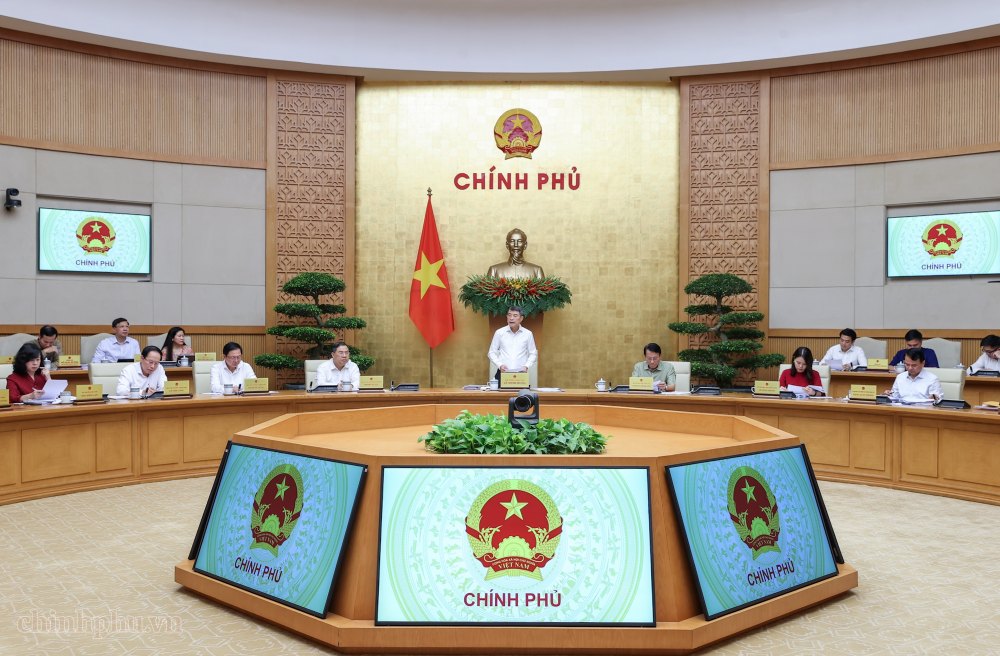
According to the Government Authority of Information and Communications, on the afternoon of August 26, Politburo Member, Prime Minister Le Minh Hung chaired a thematic Government meeting on law-making (session 2nd) in August 2026 on 11 draft laws.
The draft laws include: (1) Bidding Law (amended); (2) Law on legal normative documents; (3) Law on Data Security; (4) Law on Electronic Identification and Authentication; (5) Law on Food Safety (amended); (6) Law on Donation, Harvesting, Transplantation of Human Organs and Parts and Donation, Extraction of Corpses (amended); (7) Law on Marine and Island Resources and Environment (amended); (8) Law amending and supplementing a number of articles of the Law on Environmental Protection; (9) Law on Transaction of Derivative Goods; (10) Law on Cultural Industry Development; (11) Law amending and supplementing a number of articles of the Law on Intellectual Property.
Regarding the draft Law on Data Security, the Prime Minister noted that it is necessary to avoid causing confusion when one data simultaneously falls under multiple classification criteria, ensuring technical comparison requirements between different management criteria systems.
Review and fully explain the mechanism for controlling cross-border data transfer according to risk levels, ensuring compatibility with international commitments; unify the conditions, authority, and time limit for applying emergency measures that restrict the right to manage and own data of organizations and individuals and the right to protect the privacy of personal data must be fully stipulated in the law.
Regarding the draft Law on Electronic Identification and Authentication, the Prime Minister requested to only stipulate mandatory electronic identification and authentication for necessary subjects; study and strictly regulate contents on personal data protection, network security; the duration of storage of identity history and appropriate authentication logbooks to avoid unnecessary costs for businesses;
Thoroughly review administrative procedures and regulations that may create a burden of compliance for people and businesses; strongly transform management methods from pre-inspection to post-inspection; transfer tasks that the State does not necessarily have to perform to businesses and social organizations associated with ensuring absolute safety and network security.
Regarding the draft Law on Food Safety (amended), the Prime Minister requested to improve the management mechanism based on the level of risk, increase post-inspection, and traceability.
Review procedures for announcement, registration, and testing in a simple, transparent, and feasible direction; supplement appropriate regulations to manage food business in the digital environment and e-commerce; improve the effectiveness of warning, recalling and handling unsafe food.
Regarding the draft Law on Bidding (amended), the Prime Minister requested to review and ensure strong reform of bidding work, simplify procedures, reduce costs, ensure quality, consistency, feasibility, avoid duplication and overlap with relevant laws, especially regulations on selecting investors in the energy sector, contractors in the construction of transport projects, infrastructure, pharmaceuticals, medical equipment...
Ensure synchronization, have a post-inspection mechanism, not create obstacles in the implementation process; review and improve regulations on the scope of regulation, subjects of application, forms, contractor selection plans, prohibited acts in bidding activities, responsibilities of contractors, investors, cases of bid cancellation, contracts with a strict inspection and supervision mechanism to avoid loss of state assets.
Have a strict inspection and supervision mechanism to avoid violations and negativity; research and supplement regulations on resolving disputes in international bidding, overall bidding plans, direct appointment of contractors, direct appointment of investors, transitional regulations, supervision and inspection mechanisms, ensuring competition, fairness, transparency, efficiency, proper authority and not abusing policies...


