
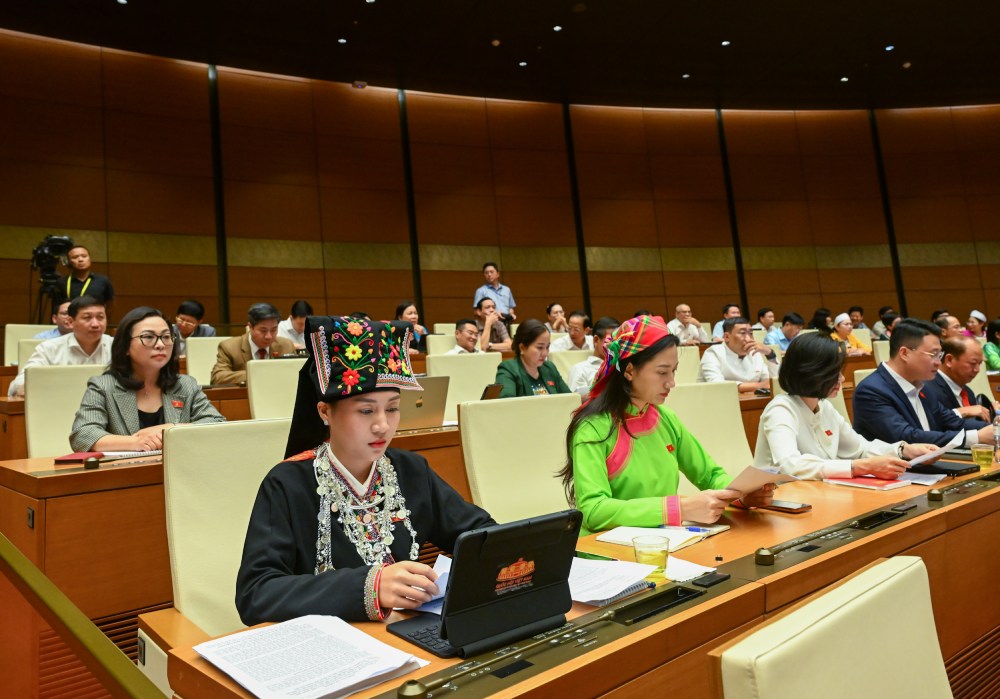
Continuing the First Session, on the afternoon of April 20, the National Assembly discussed in the hall about the socio-economic development plan.
Delegate Hoang Minh Hieu (Nghe An Delegation) said that there are still many cumbersome administrative procedures that cause difficulties for people and businesses.
Prolonged procedures and high compliance costs are also one of the reasons affecting the overall increase in labor productivity of the economy, which is one of the two targets that we have not achieved in the past term.
Therefore, it is necessary to determine that simplifying administrative procedures is not only an administrative task, but also a key solution to unlock resources, improve competitiveness and consolidate market confidence. The delegate proposed to strongly shift from simplification to substantive reduction: procedures that are still necessary should be simplified; procedures that are outdated should be abolished; procedures that can replace pre-inspection with post-inspection must be converted. This, according to the delegate, is to avoid the situation of reducing paperwork but maintaining the "ask - give" mindset.
In the immediate future, priority should be given to focusing on reviewing procedures that directly affect businesses and people, with a large spillover effect on the entire economy, such as land, investment, construction, environment...
It is necessary to build a specific set of indicators to evaluate administrative procedures, based on taking practical results as a measure, avoiding formality. Instead of just reporting the number of procedures that have been reduced, it is proposed to evaluate based on the actual time of completion of procedures; the number of times people have to travel; actual compliance costs; the rate of timely processing of dossiers; and the level of satisfaction of people and businesses.
For new administrative procedures, there must be a clear and substantive impact assessment. At the same time, there needs to be a continuous review and assessment process; for administrative procedures that do not achieve the goal after a certain period of 2 to 3 years, they must be promptly amended, supplemented or abolished.
Promoting digitization accompanied by redesigning processes and procedures. Digital administrative transformation is not about putting paper records online, but redesigning processes to suit the digital environment, to create practical convenience for people, for example, non-territorial administrative procedures, proactive administrative procedures.
Along with that, the delegate proposed to review and shorten the roadmap for completing important national and specialized databases.
Currently, many legal documents are regulating administrative procedures with the assumption that the databases have been completed and are shared and closely linked together, but the completion roadmap is stipulated with a very long deadline such as 2029, 2030 or only generally recorded when conditions permit.
Administrative procedure reform is a work with no stopping point and the important thing is to be in the right direction, in the right focus and measure the right results," the delegate emphasized.
Delegate Nguyen Ngoc Son (Hai Phong Delegation) proposed to carefully assess and have more specific handling solutions for real estate projects stuck in cases, projects that are slow to implement and are left fallow and wasted for many years.
According to the delegate, it is necessary to publicize information and soon have a mechanism to review the entire project, classify which projects are eligible to continue implementation with a clear deadline, and which projects are no longer capable of implementation or intentionally delayed, resolutely recall, auction, re-auction or change the purpose of use accordingly.


