
Proposal for officials who intentionally cause damage to return 30-50 months' salary
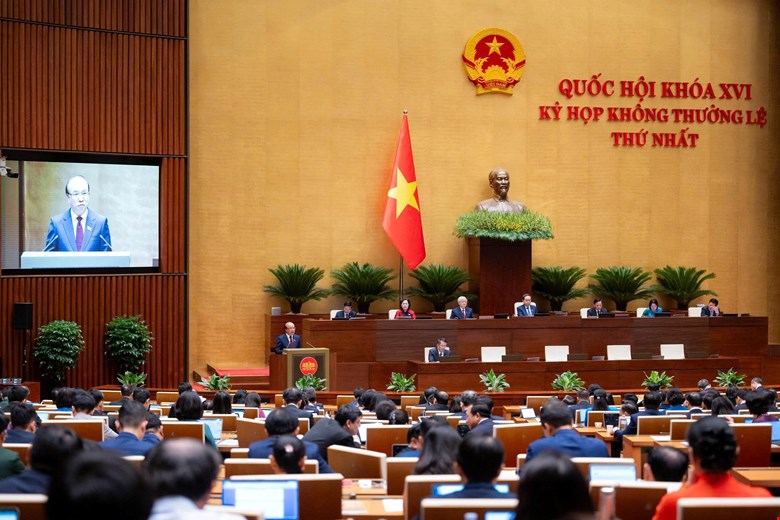
The above content is stipulated in the draft Law amending and supplementing a number of articles of the Law on State Compensation Liability. The draft was submitted to the National Assembly at the first non-scheduled session on August 3.
The draft law stipulates that if a person on duty intentionally causes damage but is not criminally prosecuted, the level of reimbursement is from 30 to 50 months' salary of that person at the time of the reimbursement decision, up to 50% of the amount that the State has compensated;
The head of the agency directly managing the person performing official duties causing damage decides to reduce the reimbursement amount but a maximum of 30% of the total amount to be reimbursed when the person performing official duties causing damage meets the following conditions: Proactively remedy the consequences; Fully fulfill obligations in the process of resolving compensation requests and has reimbursed at least 50% of the amount to be reimbursed; The person performing official duties has difficult economic circumstances.
In addition, the head of the agency directly managing the person performing official duties causing damage decides to exempt reimbursement when the person performing official duties causes damage due to unintentional fault and falls into one of the following cases: Belonging to a case of suffering from a serious illness certified by a medical examination and treatment facility according to the provisions of law; Falling into particularly difficult and prolonged economic circumstances due to natural disasters, fires, and accidents; Making great contributions certified by a person or competent authority.
Proposal for 14 cases where the State is responsible for compensation for damages
The draft law stipulates that the State is responsible for compensating for damages in the following cases:
1. Issuing decisions to sanction administrative violations against the law;
2. Apply measures to prevent and ensure the handling of illegal administrative violations;
3. Applying one of the following measures to remedy the consequences of administrative violations illegally: Forcing the demolition of works, parts of construction works without a permit or built not in accordance with the permit; Forcing the removal of violating elements on goods, goods packaging, business vehicles, and items; Forcing the recall of products and goods that do not meet quality standards;
4. Apply coercive measures to enforce decisions on administrative violations against the law;
5. Applying one of the illegal administrative handling measures;
6. Failure to apply or improperly apply measures to protect whistleblowers, people fighting against corruption, wastefulness, negativity and relatives in accordance with the Law on Denunciations and other relevant laws;
7. Intentionally providing false information without correction and without providing information again according to the provisions of the Law on Access to Information;
8. Issuing, revoking, canceling, not issuing Business Registration Certificates, Household Business Registration Certificates, Investment Registration Certificates, licenses and valuable papers such as licenses issued illegally by competent state agencies;
9. Committing illegal acts in tax management activities and other revenues under the Law on Tax Administration;
10. Applying illegal customs procedures;
11. Assigning land, leasing land, recovering land, allowing illegal land use purpose conversion; illegal compensation, support, site clearance, resettlement; issuing, not issuing or revoking Certificates of land use rights, ownership of assets attached to land illegally;
12. Issuing decisions to handle cases of illegal competition;
13. Grant protection certificates when there is a legal basis that the applicant has no right to apply or there is a legal basis that the object does not meet the protection conditions; refuse to grant protection certificates on the grounds that the object does not meet the protection conditions without legal basis; terminate the validity of the protection certificate without legal basis;
14. Issuing decisions on disciplinary action for illegal dismissal of civil servants holding positions below Deputy Ministers and below equivalent Deputy Ministers.


