
In the afternoon of July 14, at the Government Headquarters, Secretary of the Party Central Committee, Deputy Prime Minister Pham Thi Thanh Tra worked with the Ministry of Home Affairs on building a National Strategy Project on attracting and valuing talents.
Reporting at the working session, Deputy Minister of Home Affairs Truong Hai Long said that although there is a policy to attract talent, the effectiveness is still not as expected, especially for a team of senior experts such as chief engineers and chief engineers. The major bottleneck in attracting talent is the lack of financial resources and the lack of specific tasks associated with the implementation mechanism.
The Ministry of Home Affairs is studying a linkage mechanism between the public and private sectors, expanding policies to attract talents for businesses as well. At the same time, the Ministry proposes to mobilize resources from venture capital funds and the private sector, referring to the experience of China, South Korea and Singapore, instead of just relying on the state budget.
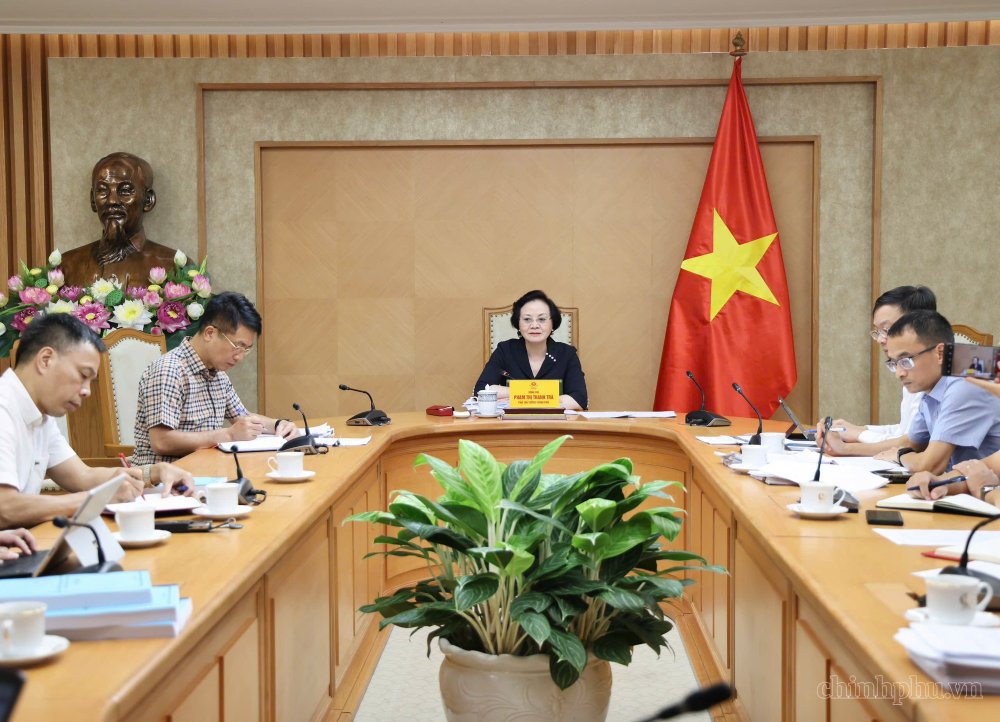
Speaking at the working session, Deputy Prime Minister Pham Thi Thanh Tra emphasized that this is a major issue, of strategic significance, so it is necessary to continue to improve it thoroughly to submit to the Central Government.
According to the Deputy Prime Minister, the goal of the strategy is to serve rapid and sustainable national development, initially meeting the requirements of double-digit growth and implementing development goals to 2030, vision 2045. Therefore, the scope and target audiences of attraction must be clearly defined, avoiding spreading out to ensure resources for implementation.
The Deputy Prime Minister noted that the strategic project focuses on about 3-4 key and focal talent groups such as: Groups of leading experts in the field of creating new growth momentum such as artificial intelligence (AI), big data, cloud computing, digital technology, digital infrastructure, network security, semiconductors, robots, automation, smart manufacturing, quantum technology and fundamental technologies of the Fourth Industrial Revolution.
Group of leading scientists, technology experts, innovators in the fields of biotechnology, new materials, environmental technology, biomedical technology, agricultural technology and marine technology.
Group of leading experts in fields serving national governance and sustainable development such as economy, finance, environment, culture and some other specific fields...
The Deputy Prime Minister requested the project to build a mechanism for connecting talents between the public and private sectors, between state agencies, research institutes, universities and businesses; and at the same time form a national list of key industries, fields and tasks that need to prioritize attracting talents.
Regarding policies, the Deputy Prime Minister emphasized the need to strongly innovate thinking in attracting and valuing talents; building a favorable working environment, empowering and protecting talents and having appropriate remuneration regimes.
The Deputy Prime Minister also suggested studying international experiences, including China, on preferential treatment mechanisms, research and innovation conditions, and the development of the talent ecosystem.
The Deputy Prime Minister requested the Ministry of Home Affairs to continue to improve the Project on a scientific and practical basis and refer to advanced models; and at the same time regularly update new Party policies, legal regulations, international experience and trends in developing high-quality human resources to submit to competent authorities for consideration and decision.


