
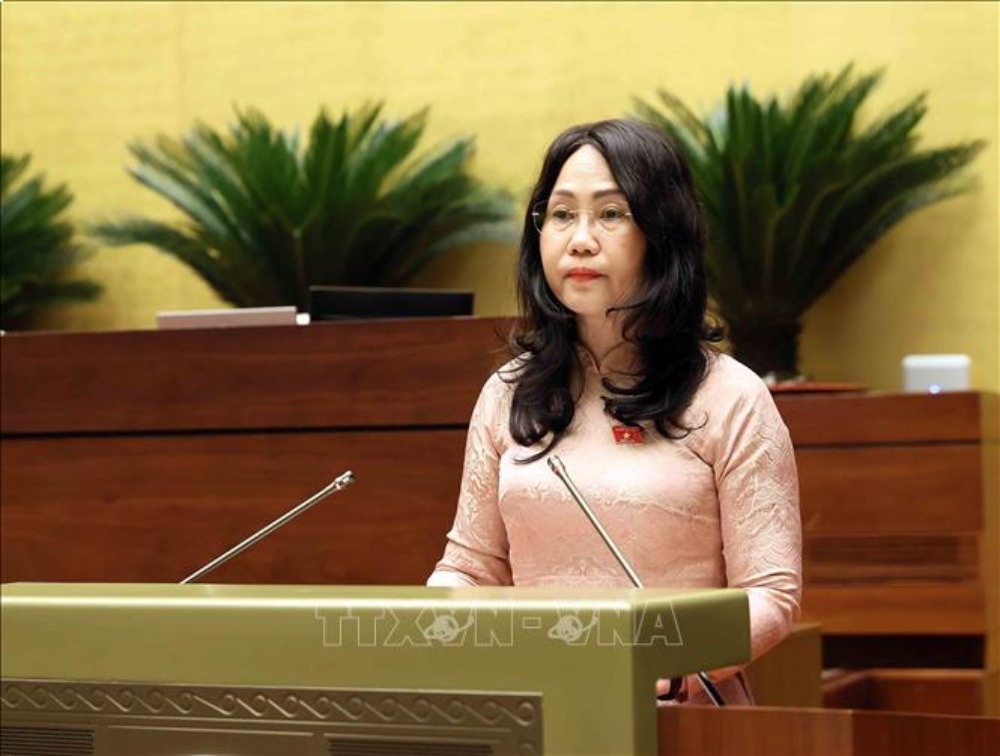
On the morning of April 20, continuing the First Session, the 16th National Assembly, Minister of Culture, Sports and Tourism (MCST) Lam Thi Phuong Thanh, authorized by the Prime Minister, presented a report on the draft Resolution of the National Assembly on a number of breakthrough mechanisms and policies for the development of Vietnamese culture.
Minister of Culture, Sports and Tourism Lam Thi Phuong Thanh informed about the 10 major policy groups of the Resolution.
First, regarding cultural development resources: The State ensures that cultural spending annually accounts for at least 2% of total state budget expenditure; and at the same time encourages the mobilization of social resources for cultural development.
Second, regarding mechanisms and policies to attract and unlock resources for investment in cultural development, including policies: supporting access to land and premises; supporting taxes, fees, and charges to invest in forming clusters and cultural creative industrial parks.
Third, regarding the investment incentive mechanism in the cultural field: propose applying a 5% value-added tax rate to film production, film distribution, film dissemination, exhibitions, physical education, sports, and performing arts.
Exempt 100% of import tax and customs fees to bring top artworks, national heritage treasures, and rare antiques from abroad purchased for auction and brought back to Vietnam for non-profit purposes for display; prioritize land funds for the construction of cultural, sports, and entertainment facilities at the grassroots level and use redundant public headquarters to attract investment projects in the field of culture and sports...
Fourth, on mechanisms and policies for preserving the culture of ethnic minorities, folk art, traditional art and national treasures, precious artifacts: focus on the task of preserving and promoting the value of national cultural heritage.
Fifth, regarding policies on remuneration and development of specialized human resource talents in the field of culture and sports, including: centralized and specialized training policies at home and abroad; non-exam recruitment mechanism; policies to support increasing professional preferential allowances, and training regimes for artisans and artists.
Sixth, regarding ordering and contracting expenditures for cultural creative activities using the State budget: The State has a mechanism to order creative and popularizing cultural works and works of high ideological, content and artistic value.
Seventh, on promotion, promotion, product development, Vietnamese cultural industry market, including policies: supporting the promotion of the image of the country and people of Vietnam abroad through organizing Vietnam Culture Week, replicating the Vietnamese neighborhood model; specialized exhibitions of Vietnamese cultural heritage at prestigious museums around the world.
Eighth, regarding digital transformation and digital cultural infrastructure development policies, priority is given to investing in building a national database on culture, digital cultural infrastructure and common platforms.
Ninth, on piloting the establishment of the Culture and Arts Fund at the central level and in some localities, operating under the public-private partnership model.
Tenth, regarding the institutionalization of the Politburo's policy that November 24th every year is "Vietnamese Culture Day", workers are allowed to take leave from work and receive full salary.
Appraising this content, Chairman of the National Assembly's Committee for Culture and Society Nguyen Dac Vinh said that the Committee agreed to determine November 24th every year as Vietnam Culture Day, employees are entitled to leave work and receive full salary.
Besides Vietnam Culture Day, it is proposed that the drafting agency continue to study and promote the effectiveness of major national holidays and anniversaries associated with traditional cultural values, in order to widely spread cultural values, and raise awareness of preserving and promoting national identity in social life.


