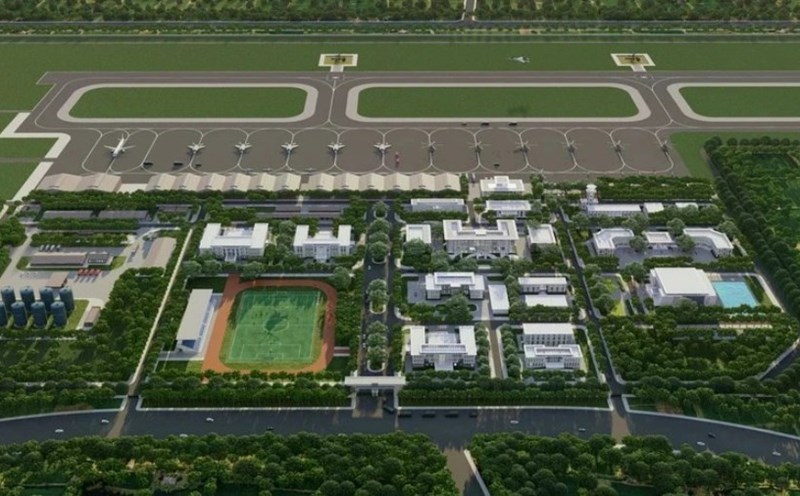
On the afternoon of December 8, the National Assembly discussed in the hall the investment policy for the Gia Binh International Airport construction project.
Many delegates gave their opinions on planning issues, specific policies and mechanisms for site clearance for the project, relocation of historical and cultural relics and policies to support people.
At the end of the discussion and explanation session to clarify the opinions of National Assembly deputies, Minister of Construction Tran Hong Minh said that Noi Bai International Airport is currently overloaded, and research on expanding this airport has been carried out but is facing many difficulties.
In particular, the construction of an independent runway requires a large amount of site clearance and relocation.
In that context, the planning and investment in the construction of Gia Binh airport is a strategic step, contributing to restructuring the airport network in the capital region according to the dual- port cluster model; expanding and improving aviation capacity when connecting with neighboring airports.
In addition, the project also contributes to creating jobs for about 10,000 local workers, leading to the development of other industries.
Some delegates proposed to clarify the feasibility and technical compatible of the "dual airport" and "aerospace center" exploitation model of the Capital region, especially in the allocation of passenger and cargo traffic and airspace management, to ensure safety, efficiency and synchronization in exploitation.
Minister Tran Hong Minh said that many countries in the world have effectively operated the model of simultaneously operating many airports in one sky.
For the Noi Bai - Gia Binh international airport cluster, flight operations are not operated independently but are organized and operated jointly, by the flight management agency to establish a unified airspace, access zoning and design separate flight routes, specifically for each port through satellite guidance and ground radar.
This ensures a safe distance between flight routes and flight operations, limits intersections, avoids conflicts and optimizes exploitation capacity. The specialized agencies have calculated the plan to ensure feasibility, safety and efficiency, the Minister emphasized.
Regarding site clearance, relocation of historical and cultural relics and support for people, the Minister said that the implementation of large-scale infrastructure projects, such as the former Long Thanh airport, must be relocated, compensated and resettlement supported according to the State's humanitarian policies.
Not only supporting housing, local authorities also pay attention to job creation for people subject to relocation; on the basis of legal regulations.
For the Gia Binh project, about 900 hectares of rice fields will be reclaimed and about 100 hectares have been cleared so far.
Regarding historical and cultural relics, the Minister said that Bac Ninh province has planned two relocation areas in accordance with the provisions of the Law on Cultural Heritage.
"The spirit is to ensure maximum preservation of the architectural form, while restoring and restoring when moving to the new location, meeting the aspirations of the people and the requirements of conservation", Minister Tran Hong Minh added.