
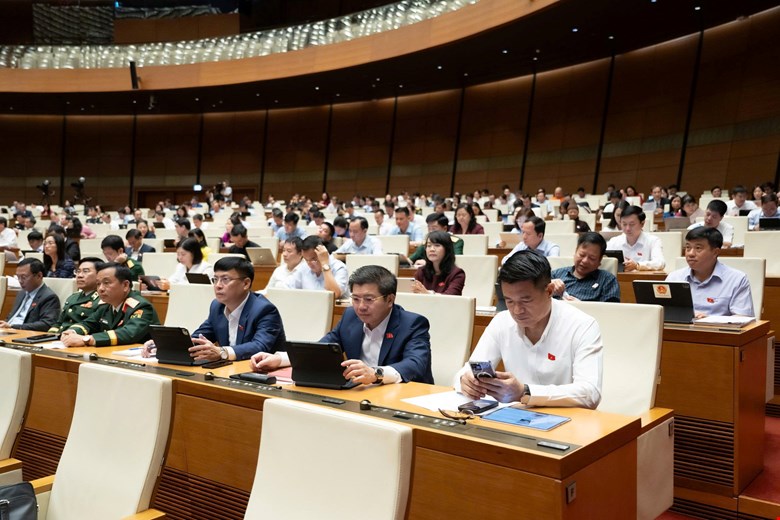
On the morning of April 21, the National Assembly discussed socio-economic development plans.
Delegate Nguyen Dang An (Lang Son Delegation) said that the operation of 2-level local government is a correct policy. In fact, the commune level has become stable and effective, and serving people and businesses is more convenient.
According to the delegate, currently at the commune level, there are 2 professional departments, the economic department and the cultural and social department. One department is subject to the management and professional guidance of 5-6 departments, leading to overload.
While commune-level cadres and civil servants in some places are still lacking in quantity and very lacking in people with in-depth expertise such as construction, transportation, and information technology.
Staffing in public non-business units such as health and education is also lacking and under pressure from staff reduction targets.
From the above reality, the delegate believes that it is necessary to comprehensively review the staffing of localities based on criteria of area, population, taking into account specific factors such as mountainous areas, borders, sandbanks, and islands to assign appropriate staffing.
Regarding non-specialized personnel at commune, village, and residential group levels, according to Official Dispatch 12 of the Government Steering Committee guiding a number of contents for non-specialized personnel at commune level when implementing the 2-level local government model, provinces have approved the list of non-specialized personnel resigning according to Decree 154 as of July 1, 2025.
Lang Son province alone currently has about over 330 cases being arranged by communes and wards to support work at commune-level departments, agencies, and units. The delegate said that this also needs specific guidance before the end of operation on May 31, 2026.
For villages and residential groups, after rearrangement, many villages are converted into residential groups after the merger between communes and wards to establish wards when implementing the two-level local government model.
The population size of these residential groups is low, if applying standards from 200 households or higher, it will not be suitable for mountainous provinces because the area of blocks belonging to wards is very large.
In fact, in Lang Son, there are blocks of 6.44km2 but only 75 households. If they continue to merge, the area of a block of streets can reach more than 10km2. While traffic infrastructure and information technology infrastructure have not been well met, it is very difficult for Party Secretaries and Heads of Blocks to cover their work.
Therefore, the delegate proposed to consider supplementing the standards of residential groups formed by the merger between communes and wards, which must be converted from villages to residential groups to suit the reality of local governments at 2 levels.
At the same time, the Government should soon issue a decree regulating the activities of villages and residential groups, and policies for non-specialized workers in villages and residential groups so that localities can promptly advise on contents related to the arrangement of villages and residential groups, and issue regulations on policies for non-specialized workers in villages and residential groups.
The delegate said that continuing to streamline villages and residential groups according to the Prime Minister's direction is very necessary for localities to implement immediately and accompanying policies need to be issued synchronously and promptly.


