
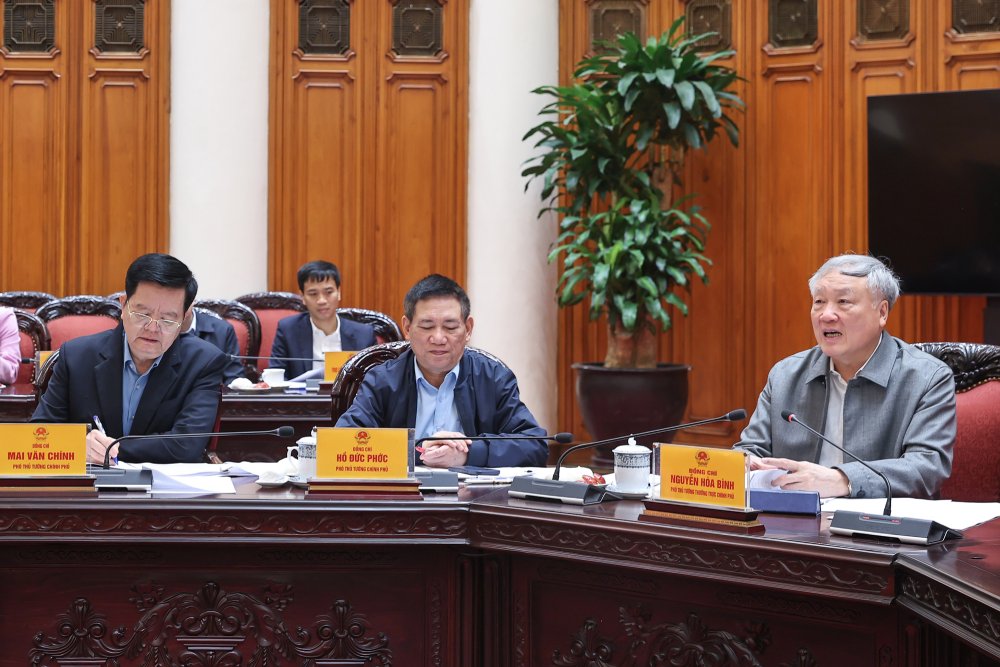
On January 17, Politburo Member, Prime Minister Pham Minh Chinh chaired a meeting of the Standing Committee of the Government on a number of important contents. Attending the meeting were Deputy Prime Ministers, leaders of ministries, branches, and government agencies.
At the meeting, the Standing Committee of the Government discussed and gave opinions on the following contents: Building a National Strategy on rare earths; drafting a Government resolution on mechanisms to remove difficulties and obstacles for transitional BT projects and drafting a decree detailing the handling of obstacles for BT transport projects; and some other contents.
Regarding building a national strategy on rare earths, Prime Minister Pham Minh Chinh emphasized the requirement to strengthen state management in this field, develop the rare earth industry, and contribute to strategic autonomy.
These include tasks and solutions on: Building and perfecting institutions, mechanisms, and policies, in which priority is given to deep processing; investing in finance, mobilizing state resources, public-private partnership resources and investor resources; building and developing infrastructure; transferring and mastering advanced and appropriate technologies; promoting public-private partnerships; smart governance based on digital transformation.
The Prime Minister requested the Ministry of Agriculture and Environment and relevant agencies to coordinate and absorb opinions at the meeting, and complete drafts, reports, and projects to submit to competent authorities for consideration and comments.
Regarding the mechanism to remove difficulties and obstacles for transitional BT projects, the Prime Minister directed the Ministry of Finance and relevant agencies to absorb opinions, complete and submit for promulgation the Government's resolution in simplified order and procedures.
The Prime Minister emphasized the requirement to comply with and apply regulations correctly, in accordance with the law, in accordance with authority, harmonizing benefits and risks shared between the State, businesses and people.
On that basis, consider and handle projects that have had inspection conclusions, and for projects that have not had inspection conclusions, assign provincial-level People's Committees to conduct inspections and handle them according to their authority in the spirit of local decision-making, local action, and local responsibility.
Ministries and sectors shall deploy tasks according to their authority, and if they exceed their authority, they shall report to the Government and the Prime Minister.


