On the morning of December 1, the National Assembly discussed the draft Law amending and supplementing a number of articles of the Law on Geology and Minerals.
Delegate Trinh Thi Tu Anh (Lam Dong Delegation) said that rare earth is the foundation of semiconductors, electric vehicles, national defense, medical equipment and many key industries.
Determining rare earths as a particularly important resource that needs to be unifiedly managed at the national level is an orientation that is completely consistent with the long-term development requirements of the country.
The delegate said that the law needs to affirm the principle of managing rare earth resources on a scientific basis and strictly controlling risks, in which environmental requirements must be set at the highest level.
Rare earth is not only a strategic mineral but also a resource group with a very large "environmental risk index". The entire collection and separation chain generates waste containing natural radiation, thorium, uranium at low concentrations; in addition, there are heavy metal mixtures and acidic solutions that are difficult to handle without advanced technology.
The female delegate cited her experience showing that countries that have developed rare earths massively but lacked control have had to face "residue radioactive polluted areas", the cost of environmental treatment and recovery is many times greater than the economic value gained and emphasized "this is an expensive lesson that Vietnam cannot repeat".
Therefore, it is necessary to set mandatory technical safety thresholds: closed collection - separation technology, radiation propagation modeling, continuous monitoring system,IAEA-standard sludge treatment plan, and environmental recovery requirements after exploitation right from the licensing stage.
Only enterprises with technological capacity, financial capacity and environmental governance systems that meet international standards are allowed to participate.
"It is necessary to emphasize the role of independent supervision of national radiation safety and nuclear safety agencies in the entire series of activities of selecting - separating - processing rare earths, from technology appraisal, risk assessment, site inspection, to waste treatment supervision and environmental restoration", the delegate expressed his opinion.
The delegate also proposed that the law allow for more flexible regulations for rare earths, to encourage investors with sufficient technological capacity and avoid rough and broken exploitation.
According to the delegate, with a special strategic resource such as rare earth, the requirement to ensure national defense and security must be placed at a higher level than that of conventional minerals.
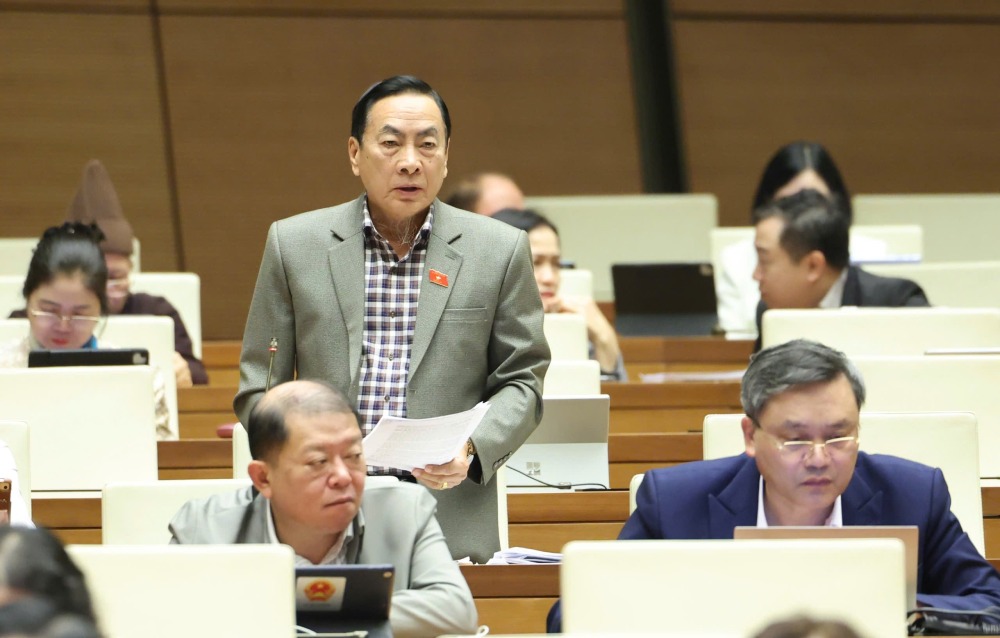
Delegate Pham Van Hoa (Dong Thap Delegation) said that exploitation of rare earths is very necessary to serve the living needs and lives of the people.
The delegate raised questions about how we will exploit this resource effectively, how we will manage it, and especially how we must protect rare earths. Other minerals may still be abundant, but rare earth is very limited, with few reserves.
If exploitation is not strictly managed and there are no strict protective measures, it will easily lead to littered exploitation, and even people can exploit it on their own.
Therefore, it is recommended that drafting agencies and environmental management agencies pay attention to and manage rare earths well, and have policies in rare earth protection.