
The above issue was raised by General Secretary and President To Lam when concluding the working session with the Standing Committee of the Ho Chi Minh City Party Committee on the afternoon of April 27.
Assessing Ho Chi Minh City's pioneering policies, General Secretary and President To Lam said that practice shows that many models and policies from the city have been replicated throughout the country, typically the tuition fee exemption policy. Recently, Ho Chi Minh City has also had a policy of free buses.
According to General Secretary and President To Lam, for Ho Chi Minh City, a spending level of about 7,000 billion VND per year will bring many benefits. However, for this policy to be effective, the city needs to continue to invest and expand more bus routes.
General Secretary and President To Lam emphasized that when buses are free and the network is widespread, people will use them more. Conversely, if it is free but the system is not wide enough, inconvenient, people will still not take the bus but continue to use motorbikes.
Therefore, Ho Chi Minh City needs to increase resources to develop bus routes, forming a convenient network for people. At that time, people will be willing to leave their motorbikes at home and switch to fast, timely, punctual, continuous and reasonable buses.
General Secretary and President To Lam also noted that the implementation must be done thoroughly, not halfway done; and at the same time said that Hanoi and some other localities need to study and follow suit.
According to the latest plan, the Ho Chi Minh City People's Committee will submit to the Ho Chi Minh City People's Council on the bus ticket exemption policy in May 2026.
Ho Chi Minh City, after expanding its administrative boundaries, has about 180 bus routes, including inter-provincial and inter-provincial, with more than 2,400 buses, of which electric buses account for nearly half.
According to the plan, toll exemption will be applied to 135 bus routes operating in the area, including 109 subsidized routes and 26 non-subsidized routes. Interprovincial bus routes are not applied.
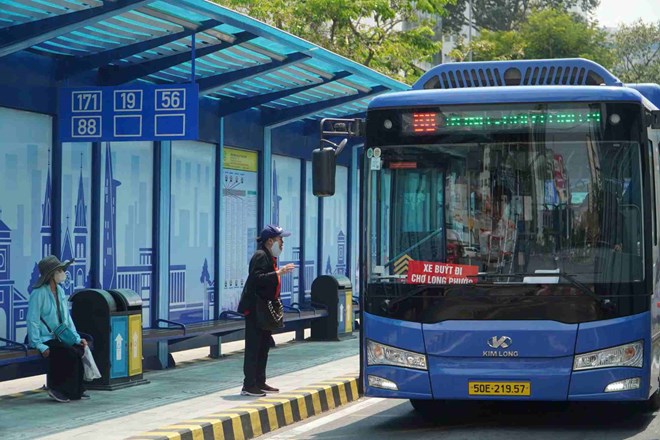
In a proposal sent to the Ho Chi Minh City People's Committee recently, the Ho Chi Minh City Department of Construction said that it will review and adjust the entire bus network in a more synchronous direction, while prioritizing infrastructure investment and improving operation quality.
The city will rearrange the existing route system, adjust unreasonable routes and open new types such as electric buses and small buses to increase access to residential areas.
The bus network is also oriented to expand inter-regional connections with the former Ba Ria - Vung Tau, Binh Duong areas and Long Thanh airport (Dong Nai).
Regarding infrastructure, Ho Chi Minh City is studying to arrange priority lanes at some traffic axes and intersections that meet the conditions such as Nguyen Huu Canh, Nguyen Tat Thanh (after expansion). Major bus stations such as Saigon, Cho Lon, District 8, Cu Chi and transfer stations will be upgraded, while improving pedestrian access for people to easily access.
The city plans to complete the common electronic ticket system for the entire network, promote the application of technology in management and operation. The cashless payment system has been deployed on many bus routes and metro line No. 1.
The Department of Construction said it will flexibly adjust routes, stops and operating hours according to actual needs; increase the frequency of vehicles in crowded areas during peak hours. Bus schedules will also be synchronized with the metro and other vehicles to reduce waiting times and increase inter-route connectivity.


