
Attending the working session were Prime Minister Pham Minh Chinh and leaders of many central and local departments, ministries, and branches.
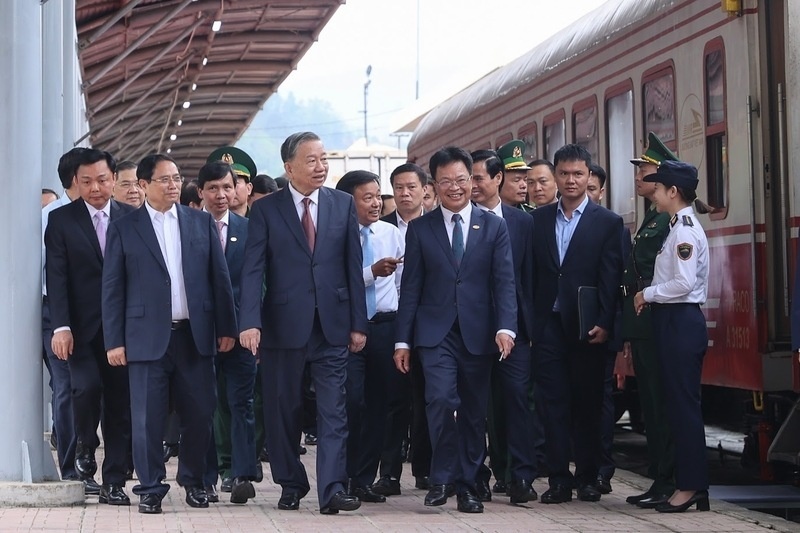
Before working, the General Secretary inspected the field at Dong Dang station.
Here, the Ministry of Construction briefly reported on the investment cooperation situation of three railway lines including Hanoi - Dong Dang, Lao Cai - Hanoi - Hai Phong, Hai Phong - Ha Long - Mong Cai; and at the same time stated the progress of connecting agreements, passenger transport with China and some related contents.
Concluding the working session, General Secretary To Lam assessed that railway cooperation between the two countries is not only a practical need but also an opportunity to open up a new development space for the bilateral economy.
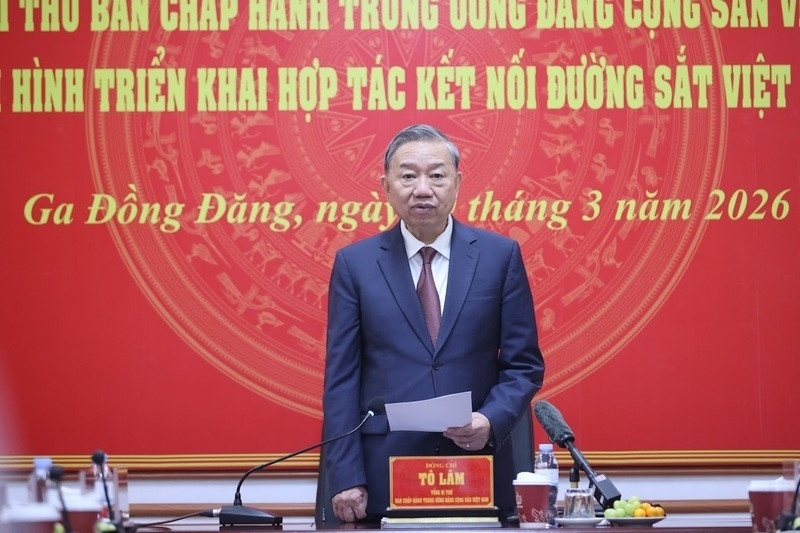
According to him, this is a field of cooperation with long-term significance, which can create momentum for Vietnam in modernizing infrastructure, reducing logistics costs and expanding international connections.
The General Secretary said that railway connectivity with China needs to be identified as a strategic breakthrough in economic cooperation between the two countries.
This not only helps shorten transportation time and reduce pressure on road border gates but also contributes to improving the competitiveness of the economy.
He also emphasized the broader meaning of these connecting routes, from promoting trade, developing the border economy, improving customs clearance capacity to forming logistics centers, border gate economic zones and industrial clusters along the transport corridor.
In the long term, this system also creates conditions for Vietnam to connect more deeply with the regional and Asia-Europe railway network, diversify international transport routes, and reduce dependence on sea routes.
Raising requirements for resources, the General Secretary noted that it is necessary to build a diverse and sustainable capital mobilization mechanism but still ensure national financial security.
Along with that is a unified coordination mechanism at the national level for strategic infrastructure projects, avoiding the situation of decentralized and lack of linkage.
According to the General Secretary, railway development cannot be separated from regional economic planning, logistics systems and industrial parks along economic corridors. Cooperation projects must also ensure compliance with national development strategies, economic efficiency, technology transparency and technical standards.
Believing that the workload is large, time is tight, and requirements are high, the General Secretary suggested that the entire political system must have determination and high unity in organizing implementation.
He assigned the Government Party Committee and directly the Ministry of Construction to develop a Vietnam - China railway development strategy in the overall Vietnam railway development strategy for the period 2026-2030, with a vision to 2045, 2100 and 2130.


