
Occupying high points, the command strategy of the economy
National conference to study, study, thoroughly grasp and implement Resolution No. 79-NQ/TW on state economic development and Resolution No. 80-NQ/TW of the Politburo on cultural development of Vietnam organized by the Secretariat on the morning of February 25.
The conference was organized in a direct and online connection form from the main bridge point at Dien Hong meeting room, National Assembly House (Hanoi) to 27,200 bridge points in provincial and city Party committees, Party committees directly under the Central Government, bridge points of departments, ministries, branches, central agencies, agencies and units with more than 2 million delegates participating.
Speaking to direct at the Conference, General Secretary To Lam said that, in addition to the Resolutions issued earlier, Resolutions 79 and Resolution 80 of the Politburo were formed on the basis of deeply summarizing practice and theoretical thinking in the context of the country entering a new stage of development, in order to simultaneously solve 2 fundamental requirements.
That is to strengthen material internal strength and consolidate spiritual internal strength, affirming the determination to build an independent, self-reliant, proactive, and efficient economy, associated with deep international integration associated with building an advanced Vietnamese culture imbued with national identity.
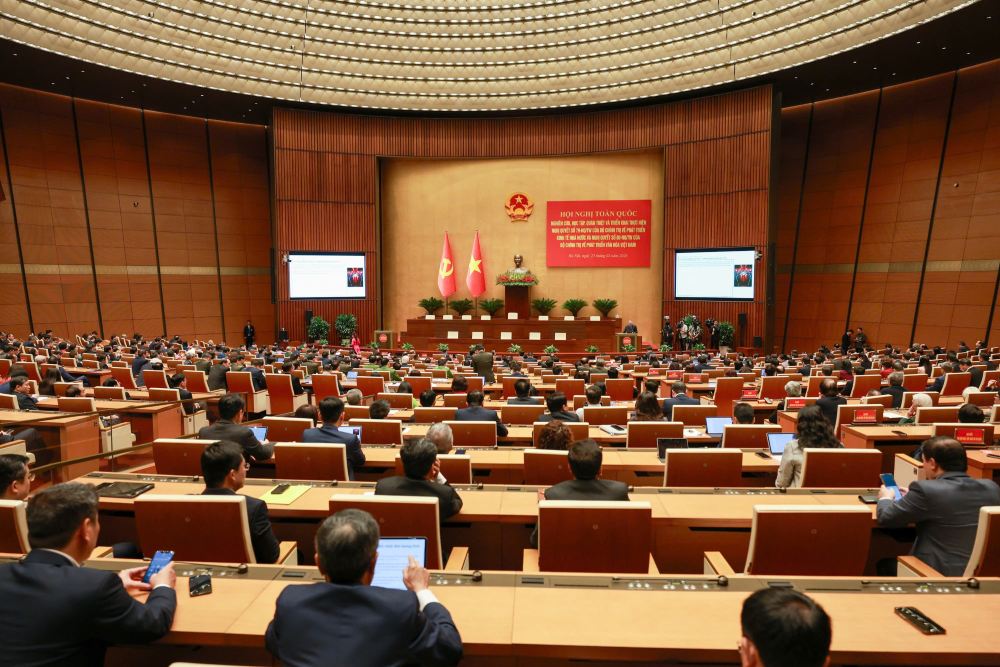
In his directing speech, General Secretary To Lam exchanged more contents, including those related to Resolution 79-NQ/TW on the state economy.
The General Secretary emphasized that the state economy must truly dominate, peak, and strategic command of the economy, play a leading role, and become a national fulcrum in the new era.
According to the General Secretary, in recent years, the state economy along with the private economy have become 2 important pillars of the socialist-oriented market economy. The private economic sector is increasingly developing dynamically, making great contributions to growth, and many private enterprises have gradually participated more deeply in regional and global value chains.
Meanwhile, the state economy plays a leading role, ensuring major balances, macroeconomic regulation stability and implementing long-term strategic tasks directly related to energy security, finance, currency, telecommunications security, essential infrastructure and key sectors of the economy.
In other words, the state economy must occupy strategic peak points, commanding the economy. The state economic sector must be strongly restructured, focusing on key industries and sectors, key and strategic areas, and high spillover" - the General Secretary said.
Breakthrough contribution to national autonomy capacity
According to the General Secretary, the leading role must be demonstrated by leadership capacity, efficiency, and substantive contributions to macroeconomic stability, economic security, and medium and long-term development. That is a very important task of the state economy.
In which fields the state holds itself to ensure sovereignty and stability, it must hold them firmly, make them sharp and strong. In which fields the state should only play a leading role, creating a foundation and opening the way, it must design a mechanism for the private sector to participate together, compete together, and develop together. In which fields the state does not need to do or does not effectively, it must resolutely rearrange them according to market principles, transparency, anti-group interests, anti-backyard, anti-manipulation, anti-policy profiteering" - the General Secretary said.
The General Secretary believes that the state economy must make breakthrough contributions to national autonomy capacity, ensuring stability and timely intervention when systemic risks arise. Therefore, in the new period, the state economy must truly be concretized into a major fulcrum.
That is the fulcrum for security and economic sovereignty. The state economy must hold onto the blood vessels, to the national backbone, from energy, strategic infrastructure, finance, credit, key logistics, data and essential digital platforms.
According to the General Secretary, holding is not for monopoly but to ensure sovereignty, avoid dependence and protect national interests in all situations, and has a spillover effect on the entire economy.
The next fulcrum mentioned by the General Secretary is the fulcrum for stable regulation and resilience, especially during times of many intertwined shocks such as supply chain breakdowns, interest rate fluctuations, exchange rates, trade wars, and epidemics. The state economy must maintain a stable role in essential markets, ensure the provision of essential public services, and maintain the foundation and reserve capacity to respond to risks of the entire system.
If the state economy does not do this, no one can do it. These are very important support points that we must emphasize in the requirements of the state economy" - the General Secretary said.
The General Secretary said that to do this, if the state economy wants to maintain this role, efficiency and leadership are very important, and this content cannot be relaxed.


