
On the afternoon of March 17, at the Party Central Committee Headquarters, General Secretary To Lam worked with the Ministry of Industry and Trade and a number of related ministries and sectors on international trade relations and trade connections with important partners in the current world geo-political and geo-economic context.
Attending the working session were members of the Politburo, Secretary of the Party Central Committee: Head of the Central Organization Committee Le Minh Hung; Head of the Central Policy and Strategy Committee Nguyen Thanh Nghi; Chief of the Party Central Committee Office Pham Gia Tuc. Also attending were members of the Politburo, Minister of Foreign Affairs Le Hoai Trung.
On the side of the Ministry of Industry and Trade, there were Member of the Party Central Committee, Acting Minister of Industry and Trade Le Manh Hung; Deputy Ministers, along with leaders of departments and agencies of the Ministry of Industry and Trade; representatives of leaders of a number of ministries, departments, and central agencies.
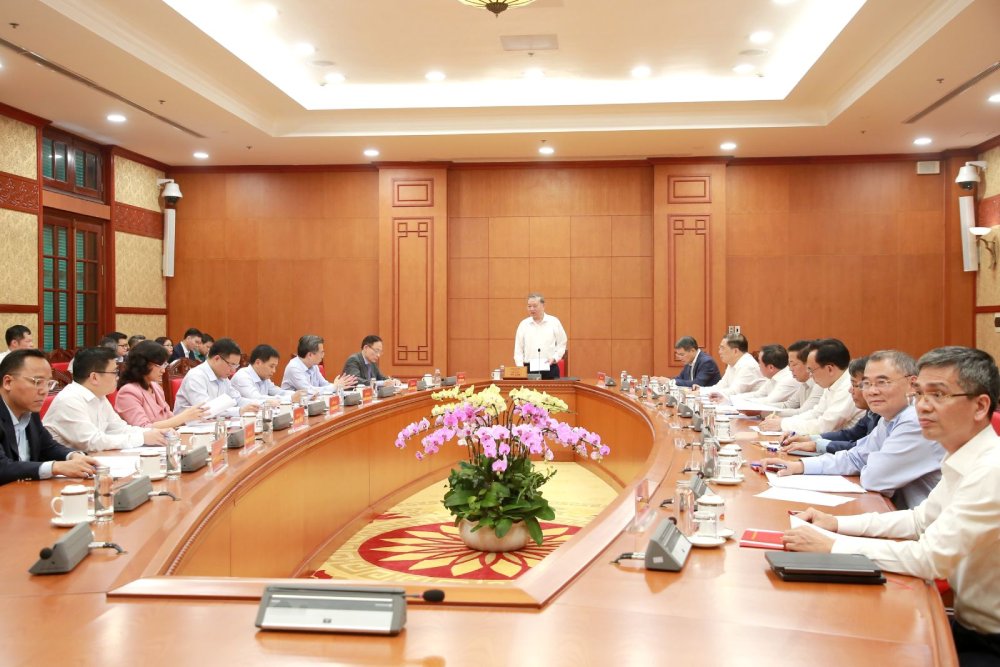
According to the Electronic Information Portal of the Communist Party of Vietnam, after listening to the report of the Ministry of Industry and Trade and the opinions and contributions of delegates at the working session, General Secretary To Lam acknowledged, praised, and highly appreciated the results that the industry and trade sector has achieved in 2025, and requested the Ministry of Industry and Trade to continue to strive to complete the key tasks of 2026, worthy of the core and pillar role of the national economy.
The General Secretary requested the Ministry of Industry and Trade to continue to study and fully absorb the opinions at the meeting, urgently review and report to the Politburo and the Party Central Committee on the remaining issues in the economic and trade relations between Vietnam and important partners and propose solutions to overcome them.
Regarding the development orientation of economic and trade relations between Vietnam and partners in the coming time, the General Secretary emphasized the policy of the Party and State of Vietnam to steadfastly pursue an independent and self-reliant foreign policy for peace, friendship, cooperation and development, diversification and multilateralization in international relations, ensuring the principle of putting national and ethnic interests at the highest position.
Based on the Resolution of the 14th National Party Congress, Resolution No. 66-NQ/TW, dated April 30, 2025 of the Politburo on innovating the work of building and implementing laws to meet the requirements of national development in the new era with strategic autonomy, the General Secretary requested relevant agencies to have specific strategies to restructure the economy, gradually balance the trade balance while still ensuring economic growth goals; "untie" the old way of thinking, create a balanced awareness between promoting cooperation and risk management; link trade with upgrading technology, equipment, high-quality investment accompanied by high requirements for localization rates, technology transfer, and enhancing the position of Vietnamese enterprises in the production chain.
The General Secretary directed the Standing Committee of the Government Party Committee to focus resources on researching and implementing a number of orientations in the coming time such as: rapidly increasing sustainable exports, improving domestic production capacity and diversifying import and export markets; reviewing and perfecting the process of inspection and supervision of production activities, quality-test-quarantine management, planting area management and traceability; reviewing the flow of commodity groups; researching and developing industrial cooperation plans in a practical, balanced direction, improving production capacity, localization rate and added value for Vietnamese industrial products.
The General Secretary assigned the Standing Committee of the Government Party Committee, the Party Committee of the Ministry of Industry and Trade and relevant ministries and sectors to urgently research and propose solutions to implement the above orientations, ensuring the principle of one agency doing many tasks, one task only assigned to one agency to take the lead in implementation and be primarily responsible; implement drastically, methodically, creatively and create substantial results.


