
Speaking at the seminar, Politburo Member, National Assembly Chairman Tran Thanh Man said that in recent years, Vietnam has gradually affirmed its position as a stable, friendly, and safe country; an attractive investment destination; a dynamic production center and an economy with a high level of integration.
Vietnam's economic scale in 2025 is estimated at about 514 billion USD, ranking 32nd in the world and 4th in the ASEAN region. Vietnam belongs to the group of 15 developing countries attracting the largest FDI in the world, with total accumulated FDI capital attracted reaching about 530 billion USD, of which Vietnam in 2025 continues to be a stable and sustainable destination for international investment capital with total registered capital reaching over 38.4 billion USD.
According to the National Assembly Chairwoman, the above results were achieved primarily thanks to Vietnam always maintaining a stable socio-political environment, creating confidence for the business community and investors. Along with that, Vietnam's investment environment is becoming more attractive and competitive.
Regarding the legal framework, in 2025 alone, the Vietnamese National Assembly passed many important laws, contributing to strongly improving the investment and business environment, focusing on simplifying administrative procedures, enhancing transparency, and protecting investors' rights.
The National Assembly Chairwoman stated clearly that in the new development stage, Vietnam will not only participate, but will actively participate in a higher position in the value chain; Vietnam not only produces, but also innovates, designs and masters technology.
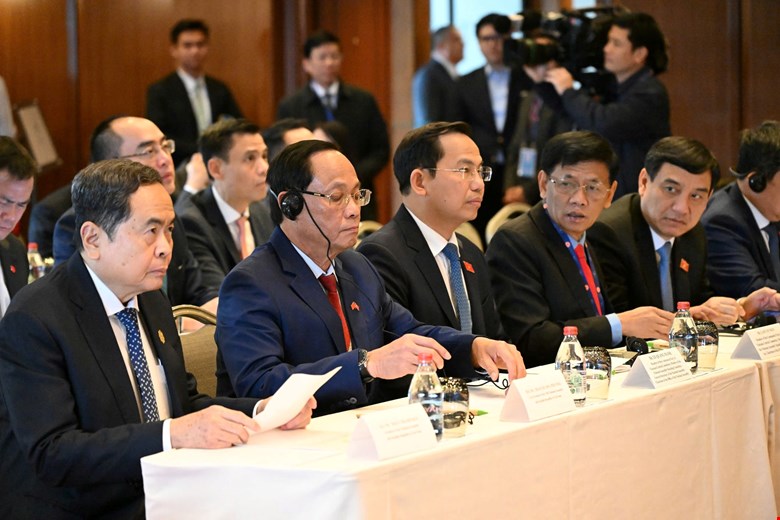
The National Assembly Chairwoman affirmed that Turkey is one of Vietnam's important partners in the region, playing a strategic bridge between Asia and Europe.
Conversely, Vietnam is a dynamic economy with high growth rates, an important gateway for Turkey to access the Southeast Asian market and the Asia-Pacific region. These complementary advantages are a solid foundation for the two countries to promote deeper and wider cooperation in the coming time.
However, it is necessary to frankly recognize that the scale and results of current cooperation are still not commensurate with the potential and strengths of the two countries. Bilateral trade turnover has only reached about 2.3 billion USD.
The National Assembly Chairwoman proposed a number of major orientations in the coming time: First, continue to consolidate political trust through strengthening the exchange of high-level delegations, including parliamentary cooperation channels.
Second, strongly promote economic - trade and investment cooperation, considering this an important pillar of bilateral relations.
Third, expand cooperation in fields with potential and strengths that complement each other such as processing and manufacturing industry, textiles, garments, footwear, high-tech agriculture, tourism, energy, transportation infrastructure and logistics; new strategic fields such as: digital transformation, innovation, green economy, circular economy and renewable energy.
Fourth, promote the role of the parliament in perfecting the legal framework, monitoring the implementation of cooperation commitments, and creating a stable, transparent and favorable investment and business environment for businesses of the two countries.


