
On June 23, at the Government Headquarters, Member of the Party Central Committee, Deputy Prime Minister Ho Quoc Dung chaired a meeting on the Project on Developing a key research, testing and laboratory center serving strategic technology.
At the meeting, Member of the Party Central Committee, Minister of Science and Technology (S&T) Vu Hai Quan said that from 2000 to now, the State has invested in 16 key national laboratories.
However, this system has not yet truly become a national strategic research infrastructure because the selection of investment fields is not closely linked to strategic technology; investment is still scattered and small in scale; lacking investment mechanisms according to life cycles, operating costs, professional human resources, common mechanisms and evaluation based on results.
The draft project proposes a 3-level research infrastructure development model. In which, Level A provides national capacity for core technology, platform technology and shared infrastructure; Level B implements applied research, technology development, system integration and prototyping associated with specific tasks; Level C implements testing, measurement, inspection, certification, trial production, product completion and commercialization support.
Regarding objectives, by 2035, a modern, interconnected and shared research infrastructure network will be formed nationwide; including 10-15 Grade A infrastructure serving core technology, platform technology; Grade B infrastructure directly linked to strategic technology tasks; Grade C infrastructure serving testing, measurement, testing, certification and product launching to the market.
With a vision to 2045, Vietnam will have a number of centers and laboratories that reach the leading level in the region.
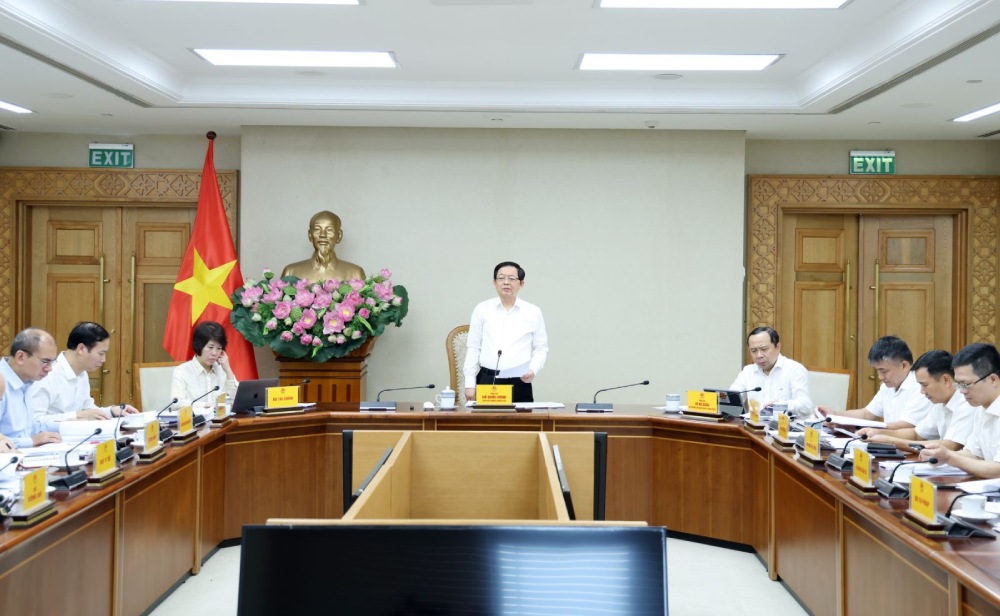
To complete the project, Deputy Prime Minister Ho Quoc Dung reminded the Ministry of Science and Technology to continue to carefully review the goals, targets and tasks set out, ensuring the construction of a modern, synchronous, interconnected and effective national research and laboratory infrastructure system.
In which, it is necessary to prioritize strategic technology and spearhead technology that are meaningful in leading the country's development in the coming time.
The Ministry of Science and Technology needs to clarify the specific goals and output results, determine a suitable implementation roadmap for each stage, associated with implementation resources to ensure the feasibility of the Project.
The Deputy Prime Minister emphasized that in the immediate future, it is necessary to focus on reviewing, exploiting and improving the efficiency of the existing laboratory system at ministries, branches, research institutes, and universities.
These are facilities that have been invested and operated for many years, with a certain foundation of experience and capacity, and need to be further upgraded and improved in the direction of supplementing, connecting and promoting the unique strengths of each unit.
According to the Deputy Prime Minister, each research institution needs to focus on areas with advantages and specific strengths.
The Deputy Prime Minister assigned the Ministry of Science and Technology to comprehensively review the existing laboratory system at ministries, branches, localities, research institutes and training institutions to determine the priority order for investment and upgrading in the coming time.
The Ministry of Science and Technology closely coordinates with the Ministry of Finance to review the entire financial mechanism, investment plan and resource allocation, ensuring that the implementation roadmap is not interrupted, and there is no shortage of resources for the operation of laboratories.


