
High growth expectations and the problem of capital becoming central
Many securities companies agree when looking at bank stocks in 2026 - there will be good developments when profits can still maintain double-digit growth.
In 2026, banking industry profits, as forecast by Shinhan, DNSE, Mirae Asset, will increase by around 17-19%, based on the assumption that credit growth will remain at about 16-17%, while the driving force comes from sustainable credit, slight recovery of net interest margins, and improved bad debt recovery progress.
From a valuation perspective, DNSE believes that the attractive level is still there when the forecast P/B for 2026 is about 1.28 times, lower than the 5-year average by 1.65 times, and the industry-wide ROE is expected to be maintained around 18%, reflecting a relatively stable profit prospect.

In banking operations, lending space is bound by capital source structure (especially medium- and long-term capital requirements) and safety indicators, of which the most important is the capital adequacy ratio (CAR). When capital adequacy regulations are tightened towards approaching international standards, the need to increase capital will become a necessary condition for many banks to maintain growth rates while still ensuring system safety.
This context also explains why the market is talking more about a new "capital increase cycle" in the entire industry. And Circular 14/2025 of the State Bank of Vietnam will activate a "capital increase race" throughout the system and may change the game of capital and credit growth of the banking industry.
SHB increases capital by 7,500 billion VND and aims to improve financial foundation
In the wave of capital increase of private banks, SHB's capital increase plan is noted thanks to its expected scale of about 7,500 billion VND, deployed in many components (private offering to professional securities investors, offering to existing shareholders and ESOP). After completion according to the announced plan, SHB's charter capital will exceed 53,400 billion VND, putting the bank in the Top 4 private banks in terms of charter capital.
A noteworthy point is that the story of capital increase is not only to "expand the scale", but also to create a safe buffer for growth. SHB currently announces CAR at over 12.4%, which is in the industry's highest group and is expected to continue to be raised after the capital increase.

In the context of capital safety requirements becoming criteria for credit growth, a solid CAR ratio helps this bank be more flexible in asset allocation, while ensuring growth and maintaining safe risk management.
Along with capital increase activities, sustainable profit growth of SHB is an attractive factor to attract investors. As of the first 9 months of 2025, SHB's pre-tax profit reached more than 12,200 billion VND, an increase of 36% compared to the same period, equivalent to 85% of the plan. Rong Viet Securities Company also assessed that SHB is likely to exceed the plan if credit growth and net profit and income are maintained positively in the fourth quarter.
On the stock market, SHB shares always lead in liquidity, averaging 70 million shares/session, many breakthrough sessions exceeding 100 million shares traded. On the other hand, despite strongly increasing in price by 110% this year, SHB's P/B valuation ratio is still in the group of low compared to industry average, currently around 1.1x. Accordingly, many investors are interested in SHB, with the expectation of finding opportunities from low-value stocks with a lot of growth potential.
Stocks are continuously bought by foreign funds
2025 marks a pivotal time for the history of Vietnam's stock market development with FTSE Russell upgrading from a frontier market to a secondary emerging market. Along with the official upgrade taking effect in September 2026, experts from Shinhan Vietnam Securities Company (SSV) believe that Vietnam can attract more capital flows from global investment funds, creating a positive spillover effect on liquidity, valuation and market size.
Bright stocks with potential to attract capital flow from FTSE Russell are also gradually emerging, including SHB, one of the 4 banking stocks forecast to enter the FTSE Global All Cap basket. This is a positive signal for SHB as this stock approaches the criteria of scale, liquidity and level of information transparency according to FTSE standards.
At the same time, SHB is likely to continue to be actively traded with other foreign funds including Xtrackers Vietnam Swap UCITS ETF (STOXX Vietnam Total Market Liquid Index simulation fund with total managed assets of about 352 million USD, equivalent to 9,300 billion VND) and VanEck Vectors Vietnam ETF (referencing Market Vector Vietnam Local Index basket with total managed assets of about 577 million USD, equivalent to 15,200 billion VND).
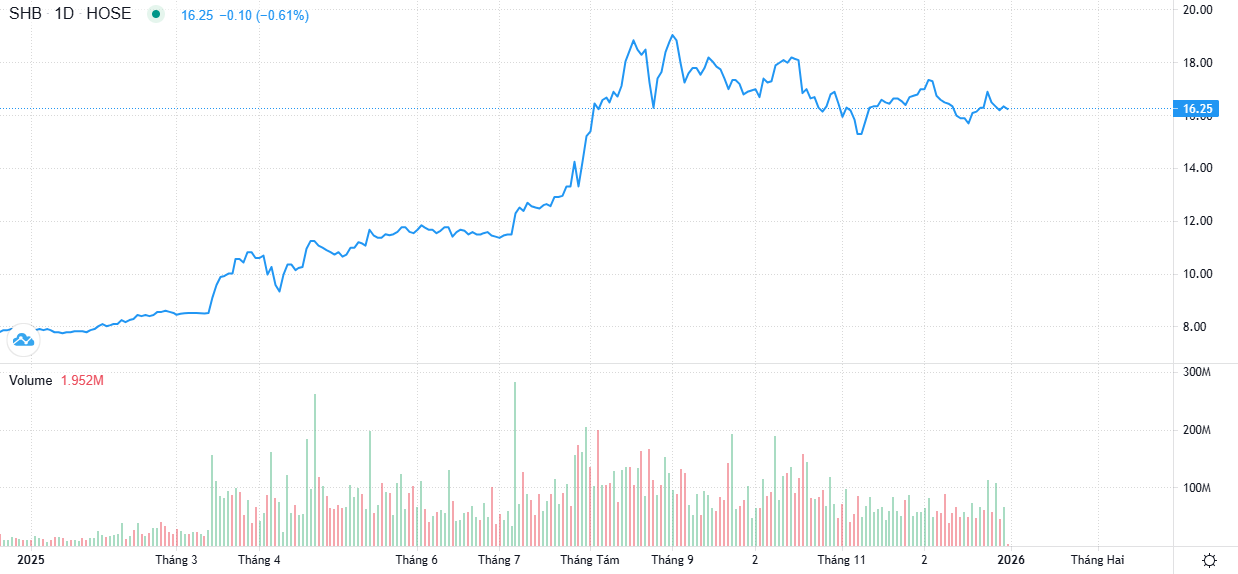
In December alone, foreign investors net bought nearly 1,000 billion VND in the market, international cash flow focused on the banking - finance group. With stocks with a lot of "foreign room" like SHB, expectations are not only stopped at passive capital flows in ETF funds like FTSE but also capital flows from large-scale active funds that are assessed as stable capital flows in the medium and long term.
At the M&A Forum in early December, Mr. Do Quang Vinh, Vice Chairman of SHB's Board of Directors, emphasized that the core factor that international investors are interested in is transparency, through meeting financial reporting standards, financial governance and especially risk management. When the transparency platform is improved, the ability to access foreign capital flows may be wider, while raising market monitoring standards for operational efficiency after capital increase.
With the prospect of a bright picture for the banking industry, SHB has placed itself in a strategic position, expanding the scale of operations with a plan to strongly increase capital to ensure transparency and towards international standards. This is also a potential stock that can attract foreign capital when Vietnam is upgraded, with positive signals from trading from foreign investors and foreign ETF funds.


