
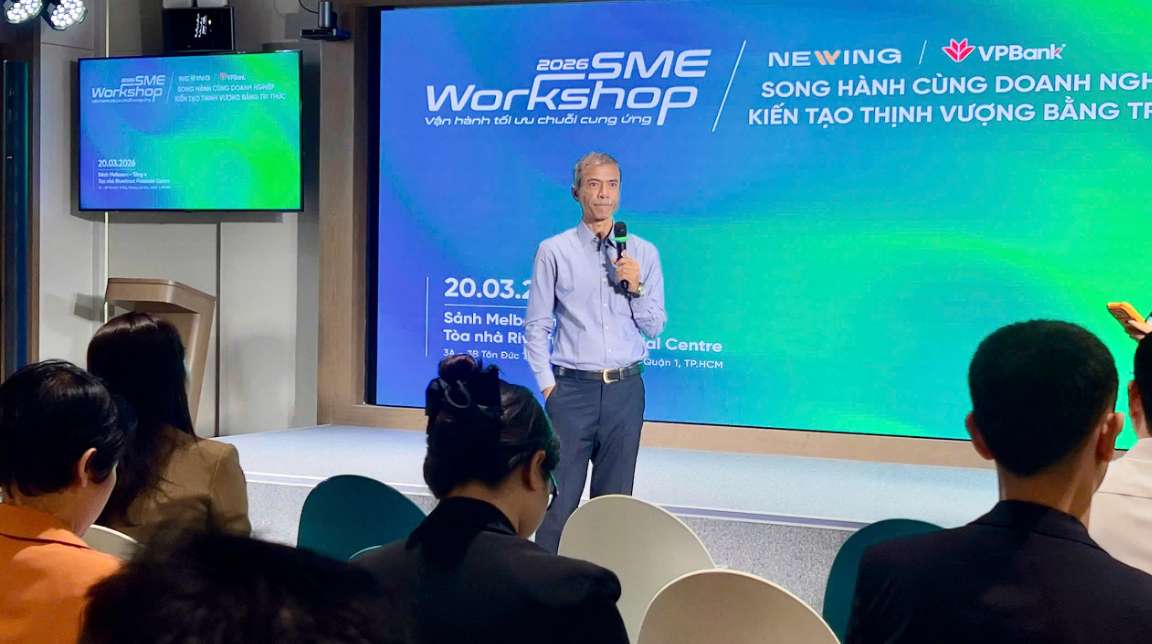
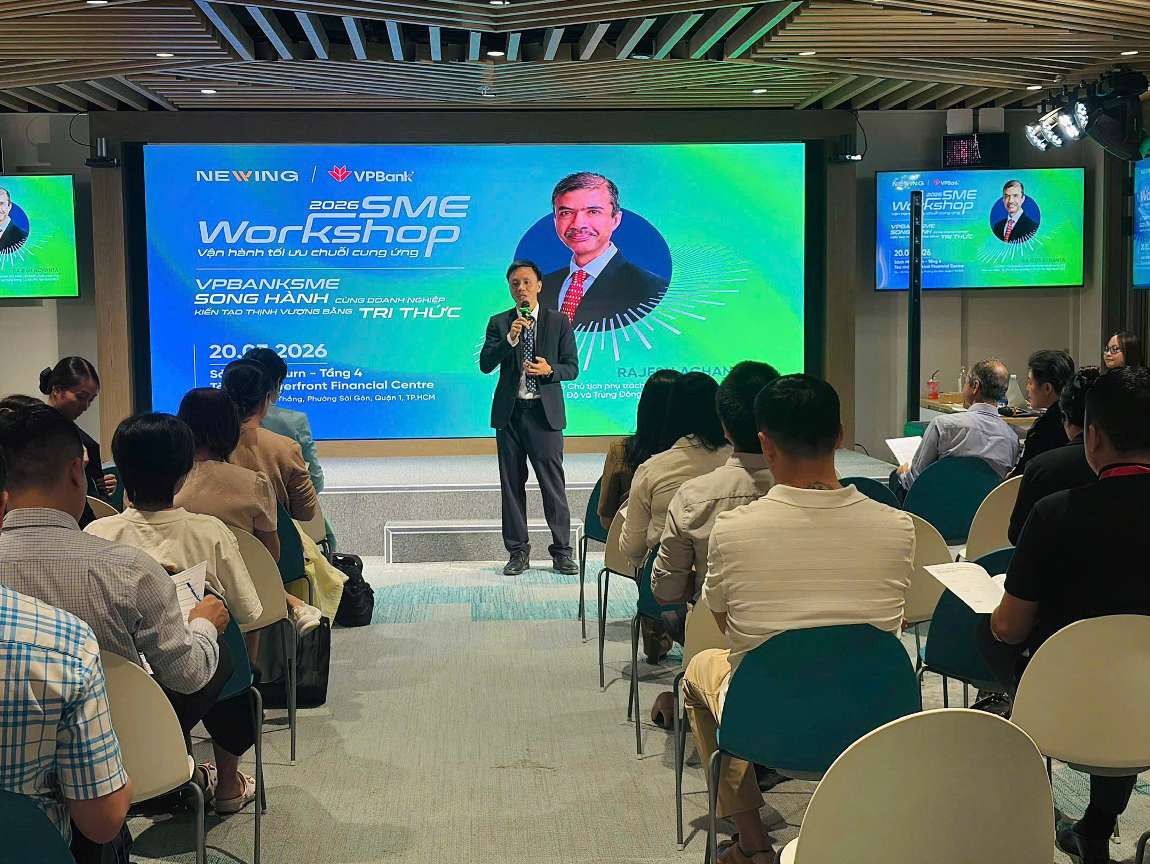
This is the consistent message shared by Mr. Rajesh Achanta, Former Vice President of APAC Regional Supply Operations, P&G Group with the Vietnamese Small and Medium Enterprise (SME) community at the Workshop "Optimal Supply Chain Operations". The event was co-organized by Vietnam Prosperity Joint Stock Commercial Bank (VPBank) and Newing on the afternoon of March 20, at VPBank Ho Chi Minh City headquarters, immediately after the SME Forum 2026 session.
When businesses "guess" the market
The workshop was "specially ordered" by VPBank for more than 60 of its SME customers, with very specific topics, sharing practical knowledge so that business owners can apply it immediately as soon as they step out the door.
Designed with a 1:1 sharing model, entrepreneurs have truly "gutted" and expressed the deepest stories of their businesses, to share and find solutions with experts and companions.
A rather familiar story has been "put on the table" by a representative of a animal feed production enterprise: the enterprise does not lack orders, but lacks... data.
The business's sales team knows the total consumption output, but when going into the details of each product code, they encounter difficulties. Which products will sell well, which products need to be promoted - all are still more predictive than data.
Therefore, the production plan is also not really "solid". The production department is forced to make estimates and decisions on resource allocation themselves. This makes the business always in a state of "doing while looking for a way", posing potential risks of supply-demand matching.
This story is not isolated. This is a common situation of many small and medium-sized enterprises (SMEs) in Vietnam. When data is not complete, the system is not synchronized and the process is not standardized, forecasting capacity is often limited.
Precisely because the forecasting platform is still limited, these businesses are also more vulnerable to major shocks. The reality over the past time shows that "black swan" events such as the COVID-19 pandemic, trade tensions or the hottest conflict in the Middle East have created strong fluctuations, causing many SMEs to fall into a passive position and face difficulties in reversing the situation.
Need a script to adapt to fluctuations
Mr. Rajesh Achanta, former Vice President of APAC Regional Supply Operations, gave a rather frank perspective: the issue is not how the market fluctuates, but how far businesses have prepared.
He believes that many businesses often feel "surprised" by events such as geopolitical conflicts or rising oil prices. But in reality, signs often appear beforehand. The important thing is whether businesses are monitoring and recognizing them or not.
According to him, these tensions accumulate over time and can be fully identified if businesses monitor them closely enough. More importantly, oil prices as well as many other variables in the economy are inherently unstable. They always fluctuate according to supply-demand, political and global economic factors. Therefore, the issue is not to accurately predict the cause, but to prepare response scenarios.
He compares risk management to weather forecasting: it is impossible to know exactly when it will "rain", but it is entirely possible to track trends and prepare plans. The important thing is that businesses must identify major impact factors, track related data and develop clear action plans.
Resilience, accordingly, is not a quick response, but a systematic preparation: early identification of signals, building plan A, B and being ready to activate when needed. Notably, in many cases, the impact of fluctuations does not occur immediately but has a delay – which is the "golden time" for businesses to prepare.
What is the solution to the long-term problem of Vietnamese businesses?
With more than 940,000 businesses, most of which are SMEs, this sector is playing an important role in the Vietnamese economy, but also facing many challenges in operating capacity.
In the context of a constantly changing market, businesses not only need to grow but also adapt faster. As the scale grows, the limitations in organization, operation and decision-making are also becoming clearer. This requires a shift: from following experience to following data, from response to proactiveness and from short-term to long-term.
According to Mr. Rajesh Achanta, businesses do not need to change too quickly or follow all trends. The important thing is to understand where you are, go in the right direction, and improve step by step. "Making decisions based on data, investing in people and connecting departments instead of operating loosely - that's the foundation," the expert emphasized.
SME Forum 2026 and workshop "Optimal Supply Chain Operation" are the opening events for a series of knowledge-parallel actions that VPBank SME brings to Vietnamese businesses starting this year, realizing the message of accompanying businesses to develop prosperity of the bank.


