
According to Barclays (a large bank in the UK), the 26% drop in gold prices during the Iran conflict stemmed from the strong rise of the USD, bond yields and stock markets, overwhelming the safe haven role of precious metals.
However, persistent inflation, policy uncertainty and demand from central banks remain, thereby potentially bringing gold prices to nearly 4,800 USD/ounce in 2026 and 4,900 USD/ounce in 2027.
In a research report released on Monday, Barclays bank's multi-layered asset analysis group led by Lefteris Farmakis and Themistoklis Fiotakis said that the 3-month sell-off of gold was driven by a stronger USD, the stock market rose sharply attracting most of the risk-taking capital flow, along with the removal of gold positions using leverage. The selling of gold by central banks in Russia and Turkey also contributed to putting pressure on prices.
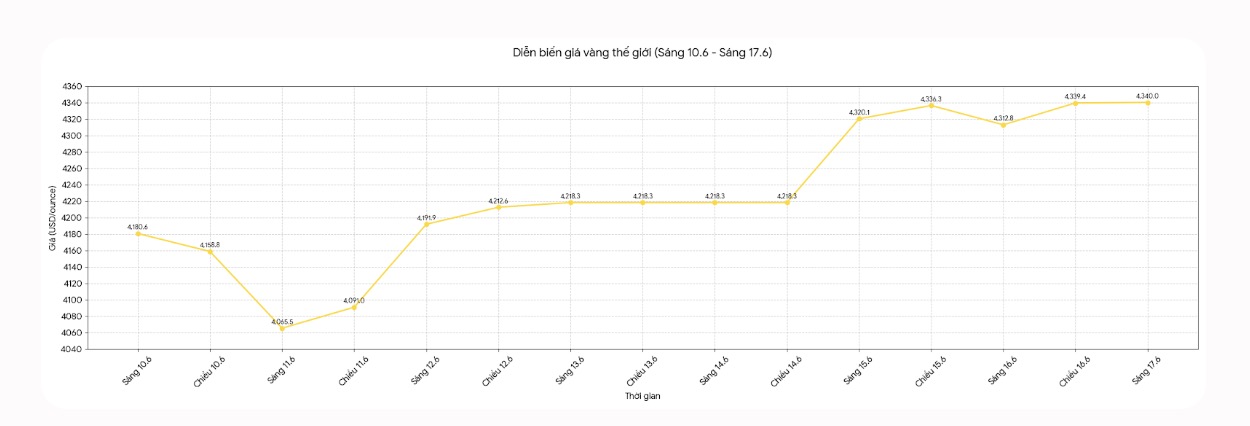
Analysts believe that the decline in gold from the January peak to the June bottom reflects the normalization process of real interest rates. The market's reduced expectations, the US Federal Reserve (Fed)'s interest rate cut this year, as well as the short-term attractiveness of the stock market's gains, weaken the investment role of gold.
Barclays' expert group calculated that the increase in the USD index and the 10% increase in the S&P 500 index explained about 10% of the decrease in gold prices. The rest came from the settlement of positions in the metal market.
However, analysts believe that these factors are only temporary. The structural drivers of gold, including persistent inflation, policy uncertainty and the trend of stock diversification, remain and will reaffirm their role when geopolitical tensions related to the Hormuz Strait crisis subside.
Barclays describes these factors as "slow-moving variables, with accumulative effects over time". This is also why they are not strong enough to support gold prices in the short-term shock from the Iranian crisis.
According to Barclays calculations, every time inflation increases by 1 percentage point, gold prices may be supported to increase by about 5%. The bank believes that the energy shock related to Iran will create more inflationary momentum, thereby supporting gold.
Barclays estimates the current fair value of gold at 4,150 USD/ounce and expects the precious metal to recover as the Iran conflict shows signs of cooling down.
Barclays' analysis team said they currently forecast that the downward trend of the USD will return, regular gold buying activities by central banks will continue, while high energy prices continue to put upward inflationary pressure.
Barclays maintained its gold price forecast for 2026 and 2027 at 4,791 USD/ounce and 4,900 USD/ounce respectively. However, the bank warned that gold could still face downward pressure in the short term due to market-based price adjustments.
Analysts also recommend that investors allocate to gold mining stocks, including Endeavour, Hochschild, Fresnillo, Newmont and Agnico Eagle.
Despite recent price fluctuations, if there is a period when gold should be traded with a higher valuation, then that is the present," the analysis group said.


