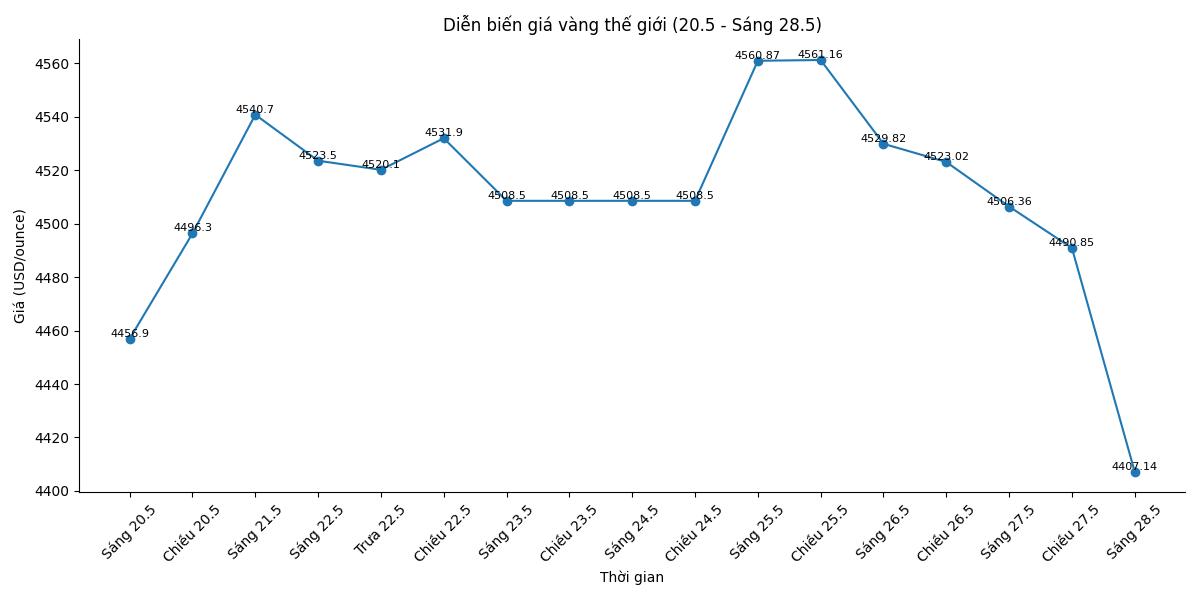
Gold prices fell for the second consecutive session as concerns that prolonged conflict in the Middle East will continue to maintain inflationary pressure and cause high interest rates to overwhelm expectations of a peace agreement between the US and Iran.
This precious metal traded close to the 4,400 USD/ounce mark after falling 1.4% in Tuesday's session.
US President Donald Trump said he was "not satisfied" with the negotiation process with Iran, thereby weakening expectations of a breakthrough in negotiations soon.
For the gold market, expectations of a ceasefire are currently not enough to ease concerns that high oil prices will continue to maintain inflationary pressure, forcing central banks to keep interest rates at higher levels for longer instead of early cuts as expected before the Iranian conflict breaks out.
In a high interest rate environment, gold is often disadvantaged because this precious metal does not bring yields.
Mr. Ryan McKay – Senior Commodity Strategist at TD Securities said that inflationary pressure will not be able to cool down soon even if an agreement is signed on the same day.
I think the current macroeconomic environment is still not really positive for gold," he said.
Since the Iranian conflict broke out at the end of February, gold prices have fallen by about 16%.
The near-blockade of the Strait of Hormuz has created an inflation shock to the global economy, making central banks more cautious about the possibility of loosening monetary policy.
As of 9:25 am Vietnam time, spot gold price decreased by 2.11% to 4,407.14 USD/ounce. Silver price decreased by 1.86% to 73.28 USD/ounce. Platinum and palladium also simultaneously went down.
Meanwhile, the Bloomberg Dollar Spot Index - a measure of the strength of the USD - almost went sideways.