
New developments in the Middle East, following US military moves against Iran, have made global financial markets more cautious. Investors are increasing the proportion of gold in their portfolios as a risk hedge against the risk of widespread conflict and chain reactions to energy supplies as well as global inflation.
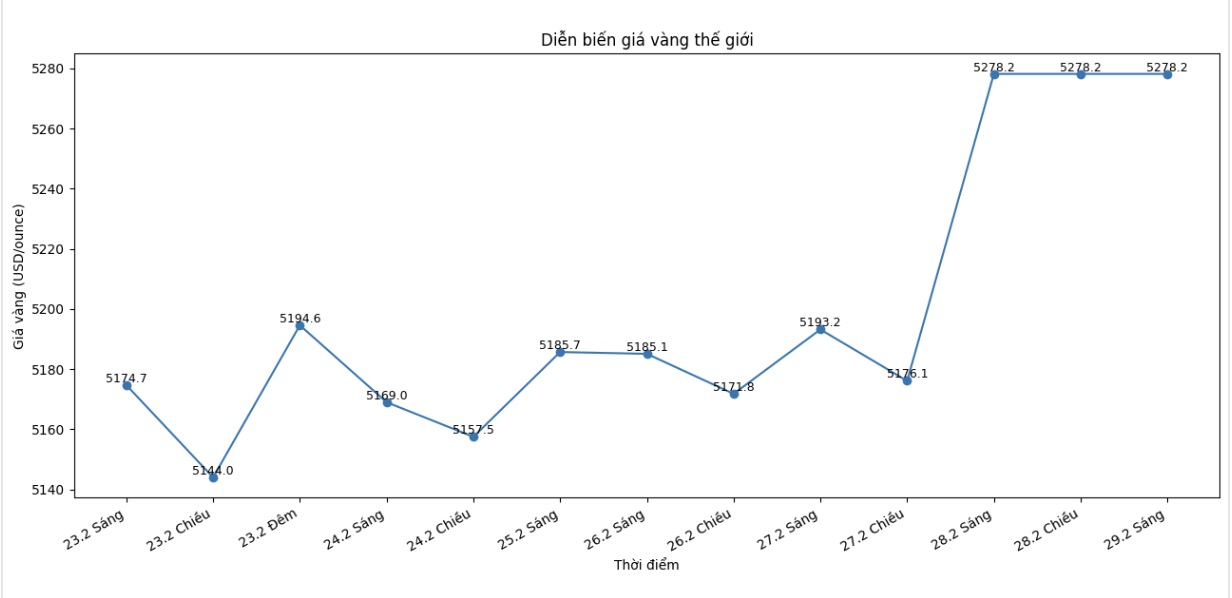
Analysts believe that the fact that gold prices hold firmly above 5,200 USD/ounce shows that defensive demand is still very strong. However, the current upward momentum does not show signs of a strong breakthrough to new peaks in the short term.
Mr. Aaron Hill - Market Analysis Director at FP Markets, said that the long-term upward trend of gold is still strengthened by geopolitical instability and expectations that monetary policy will gradually ease. However, the market is currently in a state of accumulation rather than acceleration.
According to him, the important resistance zone is still around recent peaks, while the support area is formed from short-term correction phases. Decisively overcoming the resistance can open up room for further increase, and if the support zone is lost, the market may enter a deeper correction phase.
Besides geopolitical factors, gold is still particularly sensitive to US monetary policy. Recent wholesale inflation data shows that price pressure has not completely cooled down, raising concerns that the US Federal Reserve (Fed) may maintain interest rates at a higher level longer than expected.

Conversely, any signs of weakening in the US economy or cooling inflation data could create more momentum for the precious metal.
Ms. Michele Schneider - Market Strategy Director at MarketGauge - said that although gold is still supported by geopolitical factors, the risk/profit ratio in the current price range is no longer as attractive as before. According to her, the 5,400 USD/ounce mark may be a strong resistance zone in the short term.
She also noted that when gold prices remain high, a part of investors may turn to other defensive assets, especially US government bonds. Recent bond yield developments show that defensive cash flow is not only focused on gold but also distributed to the debt market.
However, in the context of increasing geopolitical instability and many risks to the global economic outlook, most experts still maintain a positive view on gold.
Mr. Naeem Aslam - Investment Director at Zaye Capital Markets - said that the market may fluctuate strongly next week when a series of US economic data is released, including jobs, manufacturing and retail sales figures. This information will play a role in orienting monetary policy expectations and directly affecting gold price movements.
According to him, if economic data sends weakening signals, demand for gold is likely to continue to be strengthened. Meanwhile, if the US economy shows better resistance than expected, the gold market may witness technical corrections.
In general, with closing the week at 5,278.2 USD/ounce, gold is maintaining its position as the leading shelter between geopolitical fluctuations and global economic uncertainties. Short-term prospects will largely depend on the developments of US-Iran tensions and policy signals from the Fed in the near future.


