In the latest updated report, Heraeus's precious metal analysts believe that silver has shown clear downward signals on the monthly chart.
Accordingly, the price movement in March shows that the market is entering a more sensitive phase, when the previous upward trend showed signs of weakening and investor sentiment became more cautious.
Heraeus said that on the silver monthly price chart, a "subsidence" candlestick pattern has formed - a technical signal often seen as a warning that the upward momentum is gradually losing momentum.
Silver prices in March opened higher than the closing price at the end of February, but then turned down and ended the month at a lower level than the price range at the beginning of February. According to the analysis group, the appearance of this pattern on the monthly chart shows that the market may have to go through a period of accumulation, sideways or slight decrease in a few months before the upward trend returns.
This assessment shows that silver is facing the possibility of short-term correction after a significant increase before. Compared to gold, silver usually has stronger fluctuations because it is both a precious metal and closely associated with industrial demand.
Therefore, whenever global economic prospects become uncertain or US monetary policy sends unpredictable signals, silver prices usually react more sensitively.
Although the technical signal is not very positive, the demand for physical silver investment is still a noteworthy bright spot. Heraeus said Perth Mint silver bars and silver coin sales in March reached 976.450 ounces.
This level decreased sharply compared to nearly 2 million ounces in February - the month that recorded the highest sales in more than 2 years - but still reflects significant buying power from investors.
According to Heraeus, the strong sell-off that ended in early February created an opportunity for investors to increase silver holdings. As a result, Perth Mint's total sales of silver bars and coins in Q1 exceeded 4.6 million ounces. This shows that 2026 is starting significantly more positively than the previous year, despite short-term price corrections.
The physical silver market in the US also recorded a similar trend. US Mint's American Eagle silver sales fell from 1.7 million ounces in February to 1.6 million ounces in March. Despite a slight decrease, this is still considered a fairly positive selling level in the context of a volatile market.
In the first 3 months of the year, American Eagle silver sales exceeded 8.1 million ounces, significantly higher than the 5.3 million ounces of the same period last year.
According to Heraeus, this development shows that investors still maintain great interest in silver, especially after price adjustments. This may be a factor that helps partially limit deep downward pressure if the market enters a longer correction phase.
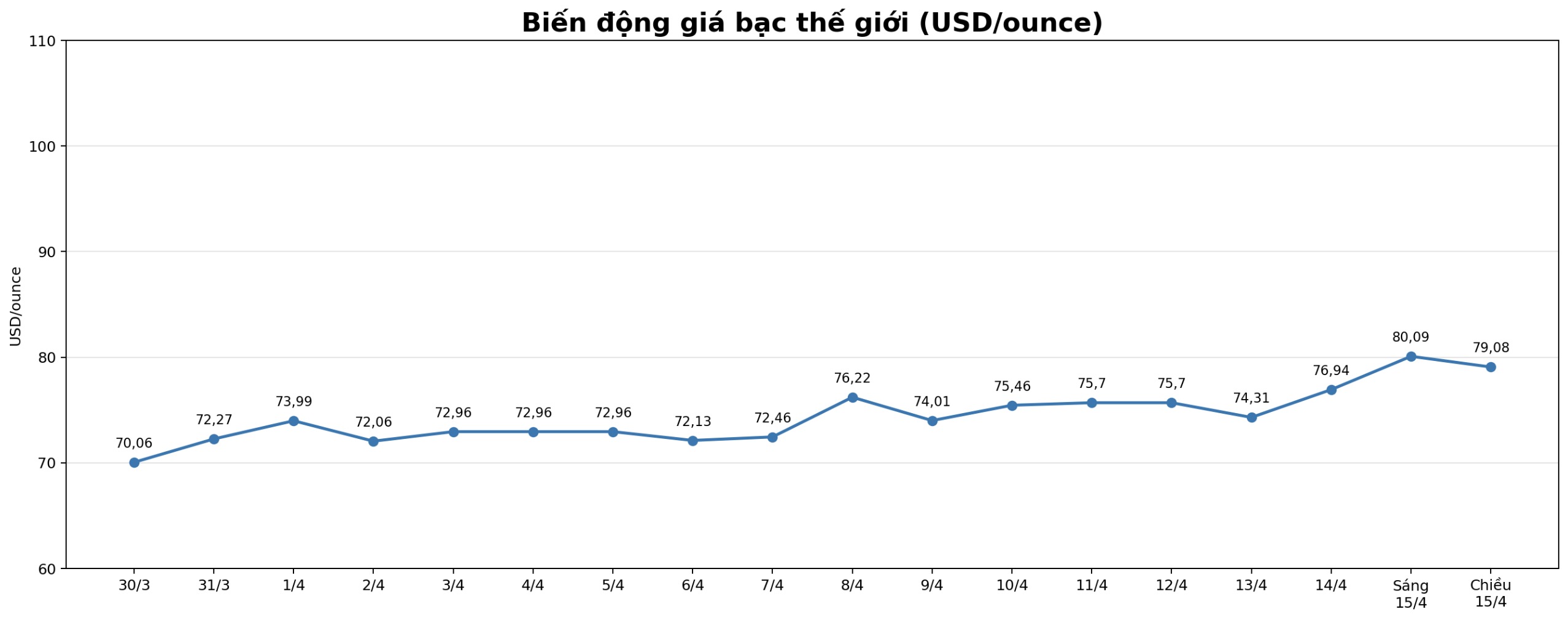
Analysts believe that the outlook for silver in the near future will depend heavily on the developments of US monetary policy, the strength of the USD and global economic growth expectations.
If interest rates remain at a higher level longer than expected, pressure on precious metals in general and silver in particular may continue to extend. Conversely, if the Fed sends clearer easing signals, silver may soon regain its upward momentum.
However, warnings from Heraeus show that the market is not yet ready for an immediate strong increase. The technical model appearing on the monthly chart is a signal that investors need to be more cautious in the short term, especially when cash is an asset with much higher volatility than many other commodities.
Overall, silver still retains some important supporting factors from physical investment demand, but the technical signal of price decrease in March shows that the market may still have to go through a period of adjustment or accumulation.
In that context, the dominant trend of silver in the coming months is likely to be sideways or slightly downward, before there is an opportunity to establish a new upward cycle.