
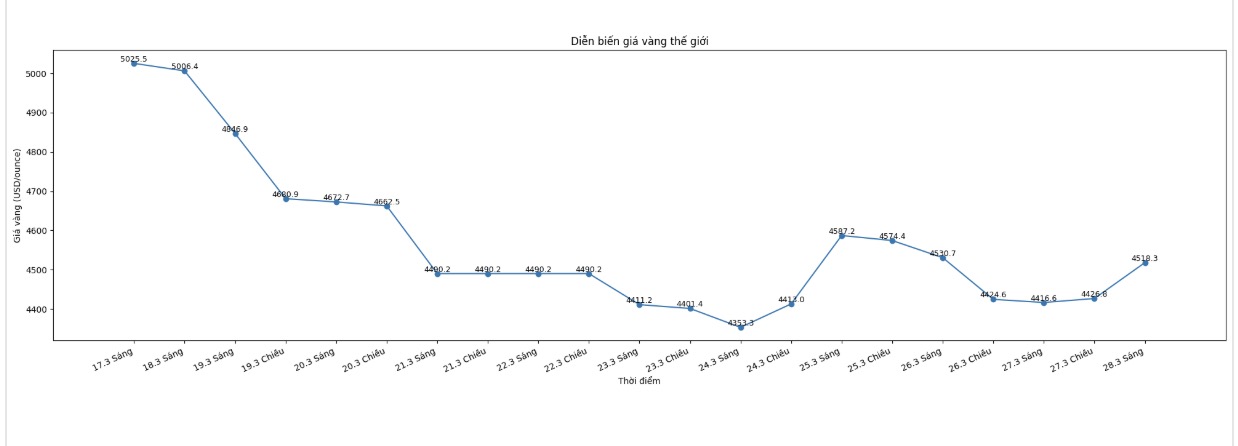
The gold market is heading towards the end of the week with prices slightly above the initial resistance level of 4,500 USD/ounce. Analysts said gold has made a significant recovery after falling to 4,009 USD at the beginning of the week. Notably, the increase on Friday occurred even when oil prices and the USD went up together.
The nearest spot gold price was traded at 4, 525.7 USD/ounce, up more than 3% in the day and up 0.65% compared to the end of last week. Meanwhile, the WTI crude oil contract for May delivery exceeded the 98 USD/barrel mark, up nearly 4% in the day.
Although it is too early to confirm that the market trend has clearly reversed, Mr. Michael Brown - senior market analyst at Pepperstone, said that this is a positive starting signal.
He commented: "This shows that the market may have formed a solid bottom and the safe haven role of gold is gradually being restored.
However, Mr. Brown also warned that risks remain, especially if the prolonged conflict with Iran forces many central banks to sell gold reserves to get money.
Updated data from the Central Bank of Turkey shows that the country has sold nearly 60 tons of gold in the past two weeks.
If many countries follow suit, it will put significant downward pressure on gold prices, reversing the upward trend that has lasted for the past 2-3 years," Mr. Brown said. However, he believes that the 4,100 USD/ounce level is still an important milestone and difficult to break in the short term because buying power will protect strongly.
Commodity experts from TD Securities also predict that gold prices may continue to weaken as central banks use gold reserves to cope with rising inflation due to rising energy costs.
According to them, gold is currently trading like a risky asset, because buying demand from the official sector is closely linked to USD diversification. Conflicts in the Middle East have weakened the surplus of many economies, causing gold demand from this region to temporarily decline.
Mr. Neil Welsh - Director of Metals at Britannia Global Markets, said that despite bottom-fishing buying in the week, the gold market is still in a waiting state, monitoring whether the Middle East situation will cool down or escalate to trigger safe-haven demand.
He said: "The reversal has not really taken place, but conditions are gradually forming. Gold prices may have increased too much before. There are still many factors affecting it, but when the market stabilizes, gold may return to its inherent shelter role.
Analysts say prolonged conflict causing energy prices to rise is raising concerns aboutstagflation - a situation of both high inflation and slow growth. This is seen as a favorable environment for gold, as central banks may have to reduce interest rates in the context of inflation, causing real yields to fall sharply.
Mr. Aaron Hill - market analyst at FP Markets, said that it is too early to worry about stagnant inflation, but this risk may increase as economic data is about to be released.
He said: "Carefulness of stagflation only really dominates the market when growth weakens significantly, such as PMI decreasing or unemployment rising - like the 1970s scenario, which often put pressure on gold in the short term before the metal rebounds.
Mr. Hill also emphasized that gold needs to improve technical signals before attracting sustainable upward cash flow.
He commented: "The rebound from below 4,100 USD may just be a liquidity response, not a confirmed bottom. To form a solid price base, gold needs to retest the 4,200 - 4,300 USD/ounce range with stronger momentum before heading towards the 4,800 USD/ounce mark.
Meanwhile, Mr. Naeem Aslam - Investment Director at Zaye Capital Markets, said that although gold prices may continue to fall in the short term, this is still a buying opportunity, due to increasing inflation risks.
He said: "Retailers have begun to face cost pressure, and if the war lasts, prices will continue to rise. Inflation is right in front of our eyes and becoming increasingly apparent.
The next trading week will be shortened due to the Easter holiday, but the market will still focus on US economic data such as jobs and manufacturing.
Although the market was closed on Friday, the US non-farm payroll report for March was still released. Investors will have to wait until the Asian opening session on Sunday to react to this data.
In addition, Fed Chairman Jerome Powell's speech at Harvard University will also be closely watched.


